Unit 8 · Topic 8.1 · about 30 minutes · 7 parts · 10 scored checks, 2 of them multiple choice, plus 2 from earlier lessons
AP Environmental Science 8.1: Sources of Pollution
Unit 8: 7 to 10% of the multiple-choice section
What you'll be able to do
- Identify differences between point and nonpoint sources of pollution.
Key vocabulary
| Term | What it means | The exam trap |
|---|---|---|
| Point source | A single, identifiable source of a pollutant, such as a smokestack or a waste discharge pipe. | A source is a point source because it is one place you can name, not because it releases a large amount. |
| Waste discharge pipe | A pipe that releases wastewater from a factory or treatment plant into a river, lake or sea. | What the pipe carries can be anything from warm water to sewage; it is the pipe that is the source. |
| Urban runoff | Rain or melting snow that flows off a city's streets, roofs, lawns and parking lots, carrying what it picks up. | Runoff is more than rainwater; it carries oil, litter and fertilizer picked up on the way. |
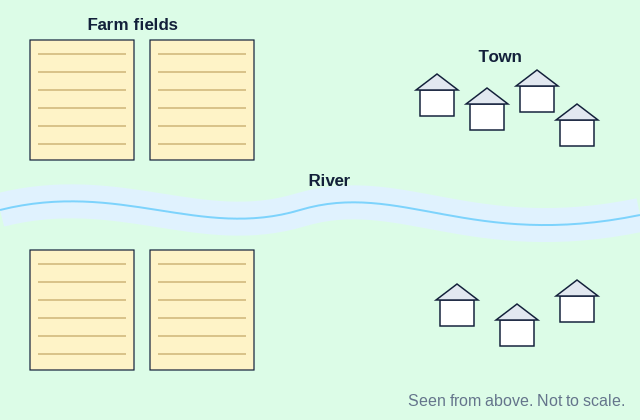 Tap to open the picture full size
Part 1 Think first Two polluted rivers
Commit to a guess first. Being wrong now makes the right idea stick better.
Predict first
Two made-up rivers carry the same pollutant. In river P it pours out of one pipe at a paper mill. In river Q it washes in from thousands of lawns and streets across a city whenever it rains. Which pollution do you predict officials will find harder to track to where it enters?
In short. A source of pollution is the place a pollutant enters the environment, and every source is either a point source or a nonpoint source.
- A point source is a single, identifiable source, such as a smokestack or a waste discharge pipe.
- Pesticide spraying is a nonpoint source of pollution, and so is urban runoff.
- A smokestack sends its pollutants into the air, and a discharge pipe sends them into water.
Part 2 Learn it Where pollution comes from
2a. One source you can point to
A point source is a single, identifiable source of a pollutant, such as a smokestack or a waste discharge pipe.
- Single: the pollutant comes out of one place.
- Identifiable: you can name that place and go to it.
A smokestack releases its pollutants into the air. A waste discharge pipe releases wastewater from a factory or treatment plant into a river, lake or sea.
For example, a made-up fish cannery sends its washing water into a harbor through one concrete pipe. Anyone who wants to know what the cannery adds to the harbor can sample the water at the end of that pipe.
Quick check · Multiple choice
Which made-up source of pollution is a point source?
2b. Sources spread over a wide area
Nonpoint sources of pollution are diffused and can therefore be difficult to identify, such as pesticide spraying or urban runoff.
- Diffused: spread out over a wide area, entering from many places at once rather than from one.
- Pesticide spraying: spreading chemicals that kill insects, weeds or other pests over crops, lawns or forests. Spray drifts on the wind, and rain washes what lands on the ground into streams.
- Urban runoff: rain or melting snow that flows off a city's streets, roofs, lawns and parking lots, carrying what it picks up on the way, such as oil, litter and fertilizer.
Because the pollutant enters from so many places, there is no single spot where testing shows where it came from.
For example, oil and road salt wash into a made-up reservoir from the whole length of a highway that runs beside it.
Quick check · Decide and justify
Streams in a made-up farm region carry a weed killer that is sprayed on corn. A student says that testing the region's river at one spot will show which single field the weed killer came from. Is the student right?
Which reason supports your answer?
2c. Telling the two apart
To sort a source, ask one question: does the pollutant enter from a single place you can name, or is it diffused over many?
The same pollutant can come from either kind. Fertilizer pouring out of one factory's pipe comes from a point source. Fertilizer washing off thousands of lawns comes from a nonpoint source.
The kind of source changes how you find it. A point source can be tested directly: sample the water just above the place where a pipe empties and just below it, and compare. If the pollutant jumps between the two samples, the pipe adds it. A nonpoint source has no such place to sample around, which is what makes it difficult to identify.
For example, a made-up city sends treated sewage into its river through one pipe, while rain carries oil off its streets all along the bank.
Quick check · Select all
An official suspects that a made-up dairy's one drain pipe adds bacteria to a creek. Which two water samples should the official compare to find out? Pick two.
Select 2 answers, then check.
Part 3 Watch it done How much comes from nonpoint sources?
Open each step in turn, answer the why, then finish the calculation yourself.
A made-up river carries 900 kilograms of nitrate a day past a town. The only pipe on that stretch, from a fertilizer plant, adds 210 kilograms a day. The rest washes in from farm fields and streets. What percent of the river's nitrate comes from nonpoint sources?
Step 1 · Find the nonpoint amount
The pipe is the only point source, so the rest is nonpoint: kilograms a day.
Why this step?
Why can the pipe's share be measured directly, while the fields' share has to be found by subtracting?
The pipe is a single, identifiable source, so its water can be sampled where it empties. The fields and streets are diffused, with no one place to sample, so their share is what is left over.
Step 2 · Set up the percent
Divide the nonpoint amount by the whole amount and multiply by 100.
Your step · Calculate
Finish it. Of the river's 900 kilograms of nitrate a day, 690 kilograms come from nonpoint sources. What percent is that? Give the percent to the nearest tenth.
%
More than three quarters of the nitrate enters from sources with no single place to sample, which is why it is the harder share to control.
Part 4 Try it Name two sources, then check an account
First complete a description of two made-up sources. Then find where a student's account goes wrong.
Try it · Fill the statement
Complete the description of two made-up sources of pollution in one county.
A chicken processing plant releases its wastewater into a river through one pipe, so it is a source. Rain washing manure off hundreds of the county's farm fields into the same river is a source.
Try it · Spot the error
A student describes the sources of pollution around a made-up harbor. Tap the first line that goes wrong.
Part 5 Explain it Is the pipe adding phosphate?
Write your answer first. Nothing you type here leaves this page. Then compare it with the model and each scoring point.
Free response is 40% of the exam score. This one is shaped like Question 1, Design an investigation.
Free-response practice · Question 1 style
A made-up creek flows past farm fields and then past one outflow pipe from a food-processing plant. A student wants to find out whether the pipe adds phosphate to the creek. The student can sample the water at four sites:
- 100 meters upstream of the pipe
- 20 meters upstream of the pipe
- 20 meters downstream of the pipe
- 100 meters downstream of the pipe
(a) Identify a testable hypothesis for the investigation.
(b) Identify the independent variable and the dependent variable.
(c) Describe one way the student should take the samples so the four sites can be compared fairly.
(d) Describe the results that would support your hypothesis.
(e) Explain why phosphate already in the creek above the pipe is harder to trace to where it entered than phosphate from the pipe.
Model answer
(a) If the pipe adds phosphate to the creek, then the phosphate concentration will be higher at the sites below the pipe than at the sites above it.
(b) Independent variable: where the sample is taken, above or below the pipe. Dependent variable: the phosphate concentration of the water, in milligrams per liter.
(c) Take all four samples on the same day, within the same hour, during dry weather, so rain washing phosphate off the fields does not change the creek between samples.
(d) Both sites below the pipe have higher phosphate than both sites above it.
(e) Phosphate above the pipe washes in from many farm fields. That is a nonpoint source: it is diffused, entering from many places, so there is no single place to sample around. The pipe is a point source, a single, identifiable place where the water can be tested.
Score your own answer. This is a self-check, not a grade. Tick each point your answer makes.
Part 6 Check yourself Nitrate before and after a storm
The first two questions use the table.
A made-up agency samples nitrate at four sites along a river that flows through farm country and then past one outflow pipe from a fertilizer plant. The pipe empties between sites X and Y. The agency samples once in dry weather and again the day after a heavy rain. The numbers are made up for practice.
| Site | Where | Dry | After rain |
|---|---|---|---|
| W | 3 km above pipe | 1.2 | 3.9 |
| X | 1 km above pipe | 1.4 | 4.1 |
| Y | 1 km below pipe | 4.2 | 6.8 |
| Z | 3 km below pipe | 4.1 | 6.6 |
Case question 1 · Multiple choice
An official claims that the plant's pipe is the river's only source of nitrate. Which statement from the data shows the claim is wrong?
Case question 2 · Calculate
Using the table: by what percent did nitrate at site W rise from dry weather to the day after the rain? Give the percent to the nearest whole number.
The rest stand on their own and do not use the case.
Check yourself · Put it in order
Put the events in a made-up valley in order, first to last.
Check yourself · Match
Match each made-up case of pollution to the source it comes from.
Part 7 Keep it Bring back earlier ideas
Two questions from earlier topics: noise from a fireworks show, and a student's account of a drive in a made-up car.
First complete an account of a made-up event. Then find where a student's account goes wrong.
From 7.8 Noise Pollution · Fill the statement
Complete the account of a made-up fireworks show on a beach.
A shell that bursts a few meters from a spectator can leave the spectator with , and the show's booms can cause of the calls that nesting terns on the beach use to find their chicks.
First fill in the devices at work in a made-up town. Then find where a student's account of a drive goes wrong.
From 7.6 Reduction of Air Pollutants · Spot the error
A student describes a drive in a made-up car. Tap the first line that goes wrong.
In three lines
- A point source is a single, identifiable source of a pollutant, such as a smokestack or a waste discharge pipe.
- Nonpoint sources are diffused, such as pesticide spraying or urban runoff, and so can be difficult to identify.
- To sort a source, ask whether the pollutant enters from one place you can name or from many.
Exam strategy for this topic
- Section I, Multiple Choice: 80 questions in 90 minutes.
- Section II, Free Response: 3 questions in 70 minutes.
- This lesson's Explain it is shaped like free-response question 1, Design an investigation.
- A four-function, scientific, or graphing calculator is allowed on both sections of the exam.
When a question asks you to classify a source, name it as point or nonpoint and give the reason: a single, identifiable place such as a pipe or smokestack, or a diffused source such as pesticide spraying or urban runoff.
Questions students ask
What is a point source of pollution?
A single, identifiable source of a pollutant, such as a smokestack or a waste discharge pipe.
What is a nonpoint source of pollution?
A source that is diffused, such as pesticide spraying or urban runoff, and so can be difficult to identify.
Why are nonpoint sources hard to identify?
They are diffused: the pollutant enters from many places at once, so there is no single place to test.
Can the same pollutant come from both kinds of source?
Yes. Fertilizer from one factory's pipe comes from a point source; fertilizer washing off many lawns comes from a nonpoint source.
Course alignment, for teachers
AP Environmental Science topic 8.1, Unit 8: Aquatic and Terrestrial Pollution.
- Skill 1.A: Describe environmental concepts and processes.
This lesson maps all 2 essential knowledge statements of the topic to the part that teaches each one: 2 are checked by a scored question. The map is in the lesson file.