Unit 5 · Topic 5.5 · about 30 minutes · 7 parts · 10 scored checks, 2 of them multiple choice, plus 2 from earlier lessons
AP Environmental Science 5.5: Irrigation Methods
Unit 5: 10 to 15% of the multiple-choice section
What you'll be able to do
- Describe different methods of irrigation.
- Describe the benefits and drawbacks of different methods of irrigation.
Key vocabulary
| Term | What it means | The exam trap |
|---|---|---|
| Irrigation | Supplying crops with water beyond what rain brings. | Irrigation is how water reaches a field, not a kind of crop. |
| Aquifer | An underground layer of rock or sediment that holds water. | An aquifer is not an underground lake; the water fills spaces in the rock or sediment. |
| Water table | The top of the groundwater, below which the ground is soaked with water. | Its height can change from season to season. |
| Waterlogging | A state in which so much water is left in the soil that it sits there instead of draining. | It happens in the soil of a field, not only in a flooded river. |
| Salinization | A buildup of salts in soil. | It can happen far from any sea. |
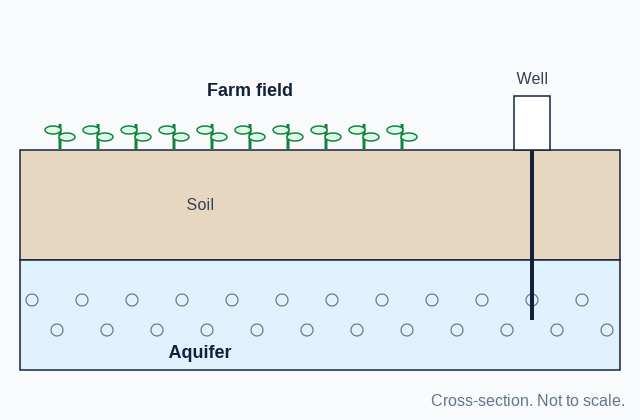 Tap to open the picture full size
Part 1 Think first Ditches or hoses?
Commit to a guess first. Being wrong now makes the right idea stick better.
Predict first
Two farmers in the same hot, dry valley grow the same crop with water pumped from the same well. One fills open ditches between the rows; the other runs hoses with tiny holes along the base of each plant. Which farmer's crop do you predict gets the larger share of the water pumped?
In short. Irrigation is supplying crops with water beyond what rain brings.
- Farms deliver water to their crops in four main ways, and the ways differ in cost and in how much water they lose.
- Irrigation can change the soil it waters and the groundwater it draws on.
- This lesson weighs what each way of watering saves against what it costs.
Part 2 Learn it Four ways to water a crop
2a. Where fresh water goes
Irrigation is supplying crops with water beyond what rain brings. On a global scale, approximately 70% of human freshwater consumption is used for agriculture, more than homes, businesses and industry together.
Farms deliver that water in four main ways:
- Drip irrigation: hoses with small holes (perforated hoses) release small amounts of water to the plants' roots.
- Flood irrigation: water is let onto the field until it covers it.
- Furrow irrigation: furrows, shallow channels, are cut between the crop rows and filled with water.
- Spray irrigation: groundwater is pumped to spray nozzles that send it across the field.
Because farming takes so large a share, a small change in how a farm waters its crops can save a great deal of water.
Quick check · Multiple choice
On a global scale, about what share of the fresh water people consume is used for agriculture?
2b. What each type loses and costs
Not all the water a farm sends out reaches the roots. Some evaporates and some runs off the field. Each type has its own loss and its own main drawback:
- Furrow: inexpensive, but about 1/3 of the water is lost to evaporation and runoff.
- Flood: about 20% of the water is lost to evaporation and runoff, and it can waterlog the soil (2c).
- Spray: more efficient than flood and furrow, with only 1/4 or less of the water lost. It is more expensive than flood and furrow, and it needs energy to run its pumps.
- Drip: the most efficient, with only about 5% of the water lost. It is expensive, so it is not often used.
So the cheapest system, furrow, loses the most water, and the most efficient one, drip, costs the most. A farmer choosing a system trades money and energy against water.
Quick check · Decide and justify
A farmer has flat fields, little money to spend, and no power line or fuel supply to run pumps. A neighbor says spray irrigation is a poor fit for this farm. Is the neighbor right?
Which reason supports your answer?
2c. When irrigation harms the land
Irrigation can damage the soil and the water supply in three ways.
Waterlogging occurs when too much water is left to sit in the soil. It raises the water table, the top of the groundwater, and it inhibits plants' ability to absorb oxygen through their roots. Flood irrigation can lead to it.
Salinization occurs when the salts in groundwater remain in the soil after the water evaporates. Water leaves as vapor; the salt it carried does not. Over time, salinization can make soil toxic to plants.
Aquifer depletion. An aquifer is an underground layer of rock or sediment that holds water. Aquifers can be severely depleted if overused for agricultural irrigation, as has happened to the Ogallala Aquifer in the central United States. Overused here means pumped faster than rain and seeping water refill it.
Quick check · Select all
A farmer floods a field with far more water than the crop needs, and the water sits in the soil for weeks. Which two are likely results? Pick two.
Select 2 answers, then check.
Part 3 Watch it done How much must a furrow farm pump?
Open each step in turn, answer the why, then finish the calculation yourself.
A made-up farm needs 2,400 cubic meters of water to reach its crop's roots each week. It uses furrow irrigation, which loses about 1/3 of the water pumped to evaporation and runoff. How many cubic meters must the farm pump each week?
Step 1 · Find the share that reaches the roots
About 1/3 of the water pumped is lost, so of it reaches the roots.
Why this step?
Why not just add a third of 2,400 to 2,400?
The third is lost from the water pumped, not from the water that arrives. The amount pumped is the larger number, so a third of it is more than a third of 2,400.
Step 2 · Set up the equation
cubic meters.
Step 3 · Solve for the water pumped
Divide 2,400 by the share that reaches the roots.
Your step · Calculate
Finish it. A made-up farm needs 2,400 cubic meters of water to reach its crop's roots each week, and its furrow irrigation loses about 1/3 of the water pumped. How many cubic meters must it pump each week?
cubic meters
The farm pumps 3,600 cubic meters to put 2,400 at the roots, so 1,200 cubic meters a week leave as vapor or runoff. A more efficient system pumps less for the same crop.
Part 4 Try it Rank the losses, then check an account
First rank three irrigation types by the water they lose. Then find where a student's account of salty farm soil goes wrong.
Try it · Rank it
Rank these three irrigation types by the share of their water lost to evaporation and runoff.
Largest share lost first
Give each one a place, 1 for first. Give two the same place if they are equal.
Your ranking: none yet
Try it · Spot the error
A student explains how irrigated soil can turn salty. Tap the first line that goes wrong.
Part 5 Explain it Switching a valley to drip
Write your answer first. Nothing you type here leaves this page. Then compare it with the model and each scoring point.
Free response is 40% of the exam score. This one is shaped like Question 3, Analyze an environmental problem doing calculations.
Free-response practice · Question 3 style
Farms in a made-up dry valley water 200 hectares of crops with furrow irrigation, pumping from an aquifer whose water table falls every year. Each hectare needs 3,800 cubic meters of water to reach the crop's roots each season. Furrow irrigation loses about 1/3 of the water pumped; drip irrigation loses about 5%.
(a) Calculate the water that must be pumped per hectare each season with furrow irrigation. Show your work.
(b) Calculate the water that must be pumped per hectare each season with drip irrigation. Show your work.
(c) Calculate how much less water the valley's 200 hectares would pump each season if every farm switched to drip. Show your work.
(d) Years of irrigation can also leave the valley's soil salty. Describe how this happens, and explain why the salt stays in the soil.
(e) Some farmers suggest pumping extra water onto the fields instead. Describe one harm to crops that too much water left sitting in the soil can cause, and explain how it causes that harm.
Model answer
(a) Two thirds of the water pumped reaches the roots: cubic meters per hectare.
(b) 95% of the water pumped reaches the roots: cubic meters per hectare.
(c) cubic meters per hectare, and cubic meters less each season.
(d) Salinization. The groundwater pumped onto the fields carries dissolved salts. When the water evaporates, it leaves as vapor and the salts stay behind, so they build up in the soil and over time can make it toxic to plants.
(e) Waterlogging. Water left to sit in the soil raises the water table and fills the soil, so the roots cannot absorb the oxygen they need.
Score your own answer. This is a self-check, not a grade. Tick each point your answer makes.
Part 6 Check yourself From furrow to drip
The first two questions use the table.
A made-up farm over a shrinking aquifer waters one test hectare with furrow irrigation for a season, then with drip irrigation the next. Both seasons it measures the water pumped and the water reaching the crop's roots, and it records what each system cost to set up. The numbers are made up for practice.
| System | Water pumped (cubic meters per season) | Water reaching roots (cubic meters per season) | Cost to set up (dollars) |
|---|---|---|---|
| Furrow | 14,250 | 9,500 | 400 |
| Drip | 10,000 | 9,500 | 2,600 |
Case question 1 · Multiple choice
Using the table: which statement describes an advantage and a disadvantage of the switch to drip?
Case question 2 · Calculate
Using the table: by what percent less water did the farm pump with drip than with furrow irrigation?
The rest stand on their own and do not use the case.
Check yourself · Sort it
Which irrigation type does each description fit? Tap a card, then its group.
Drip
Flood
Furrow
Spray
Check yourself · Fill the statement
Complete the account of one farm town's wells.
A farm town's wells must be drilled deeper every decade. The farms pump the aquifer than rain and seeping water refill it, and if that goes on, the aquifer will be .
Part 7 Keep it Bring back earlier ideas
Two questions from earlier topics: which farming practice each scene shows, and a student's account of what trees do for the air.
First sort six farm scenes by the practice each shows. Then find where a student's account of fertilizer goes wrong.
From 5.4 Impacts of Agricultural Practices · Sort it
Which practice does each farm scene show? Tap a card, then its group.
Tilling
Slash-and-burn farming
Use of fertilizers
First match each result of a clearcut with what causes it. Then find where a student's account of a forest's carbon goes wrong.
From 5.2 Clearcutting · Spot the error
A student explains what a forest does for the air. Tap the first line that goes wrong.
In three lines
- About 70% of the fresh water people consume worldwide is used for agriculture, delivered by drip, flood, furrow or spray irrigation.
- Furrow is inexpensive but loses about 1/3 of its water, flood about 20%, spray 1/4 or less at a higher cost and with energy, and drip about 5% at a high cost.
- Irrigation can waterlog soil, leave salts that make it toxic to plants, and severely deplete aquifers such as the Ogallala.
Exam strategy for this topic
- Section I, Multiple Choice: 80 questions in 90 minutes.
- Section II, Free Response: 3 questions in 70 minutes.
- This lesson's Explain it is shaped like free-response question 3, Analyze an environmental problem doing calculations.
- A four-function, scientific, or graphing calculator is allowed on both sections of the exam.
When a question compares irrigation types, give the trade-off: furrow is cheap but loses about a third of its water, flood loses about a fifth, spray loses less but costs more and needs energy, and drip loses the least but is expensive.
Questions students ask
What share of fresh water is used for agriculture?
On a global scale, about 70% of human freshwater consumption is used for agriculture.
Which irrigation method is the most efficient?
Drip irrigation, with only about 5% of its water lost to evaporation and runoff. It is expensive, so it is not often used.
What is salinization?
Salinization occurs when the salts in groundwater remain in the soil after the water evaporates. Over time it can make soil toxic to plants.
Course alignment, for teachers
AP Environmental Science topic 5.5, Unit 5: Land and Water Use.
- Skill 7.C: Describe disadvantages, advantages, or unintended consequences for potential solutions.
This lesson maps all 9 essential knowledge statements of the topic to the part that teaches each one: 9 are checked by a scored question. The map is in the lesson file.