Unit 2 · Topic 2.3 · about 30 minutes · 7 parts · 11 scored checks, 4 of them multiple choice, plus 2 from earlier lessons
AP Environmental Science 2.3: Island Biogeography
Unit 2: 6 to 8% of the multiple-choice section
What you'll be able to do
- Describe island biogeography: what it studies about the living things on islands, and how islands came to hold the species they have.
- Describe the role of island biogeography in evolution: why many island species have evolved to be specialists, and why introduced generalists put them at risk.
Key vocabulary
| Term | What it means | The exam trap |
|---|---|---|
| Island biogeography | The study of the ecological relationships and distribution of organisms on islands, and of these organisms' community structures. | An island in a question may sit in a lake as well as in the sea; the same ideas apply. |
| Specialist species | A species that uses a narrow range of resources, such as one kind of food. | A specialist is not the same as a rare species; look at what it uses, not how many there are. |
| Generalist species | A species that uses a wide range of resources, eating many foods and living in many kinds of places. | A generalist is not the same as a common species; look at what it uses, not how many there are. |
| Invasive species | A species brought to a place where it did not live before, usually by people, that spreads there. | A species is not invasive just because it is new to a place; ask whether it spreads there. |
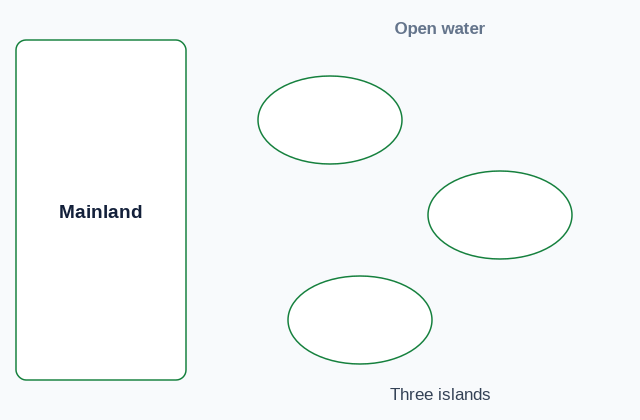 Tap to open the picture full size
Part 1 Think first The bird and the shipwreck
Commit to a guess first. Being wrong now makes the right idea stick better.
Predict first
Suppose a small island is home to a ground-nesting bird found nowhere else on Earth. It eats the seeds of one kind of shrub. Then a ship runs aground, and rats that eat seeds, insects and fruit get ashore and spread. The story is made up for practice. Over the next 50 years, what do you predict happens to the bird?
In short. Island biogeography is the study of the ecological relationships and distribution of organisms on islands, and of these organisms' community structures.
- Islands have been colonized in the past by new species arriving from elsewhere.
- Because food and territory are limited on most islands, many island species have evolved to be specialists rather than generalists.
- Islands show evolution at work: the descendants of species that arrived long ago have changed over many generations to fit what the island offers.
Part 2 Learn it Island biogeography
2a. Islands as a natural laboratory
Island biogeography is the study of the ecological relationships and distribution of organisms on islands, and of these organisms' community structures. In plainer words, it asks three kinds of question about the living things on islands:
- Ecological relationships: who eats whom, who competes with whom, and who depends on whom.
- Distribution: which species live on which islands, and where on each island.
- Community structure: which species live together in one place, and how many of each there are.
Islands suit this kind of study because each one is a separate patch of land with water all around it, so its living things can be counted and compared island by island.
Its subject is the organisms. A study that measures only the soil or the water, and nothing about what lives there, is not island biogeography.
Quick check · Multiple choice
Four students each plan a project. Which project is a study in island biogeography?
2b. Where island species came from
Many islands began with no life on them at all. A volcano that rises from the sea, for example, starts as bare rock. Every species living on an island like that today got there at some point in the past.
Islands have been colonized in the past by new species arriving from elsewhere. A bird or a bat can fly in. A seed can float in on the water or be carried on a bird's feathers. A small animal can drift in on a mat of floating plants after a storm. When an arrival survives and leaves offspring, its population becomes part of the island's community.
That is why the living things on an island are related to living things somewhere else, even when some island species are now found nowhere else on Earth. The ancestors came from elsewhere. What happened to their descendants on the island is the next chunk.
Quick check · Decide and justify
Suppose an island in a lake formed when the water level dropped and uncovered a bare gravel bar with nothing living on it. Fifty years later it has willows, beetles and nesting gulls. A student says each of those species got there from somewhere else. Is the student right?
Which reason supports your answer?
2c. Why so many island species are specialists
Most islands offer limited resources: a small area, few kinds of food and little territory to share.
A specialist species uses a narrow range of resources, such as one kind of food or one kind of nest site. A generalist species uses a wide range, eating many foods and living in many kinds of places.
Many island species have evolved to be specialists rather than generalists, because of the limited resources, such as food and territory, on most islands. This happened over many generations, not within any one animal's life.
Picture a few seed-eating birds that reach an island with only two kinds of seed plant. Over many generations, their descendants became suited to using those two plants very well, and their populations came to depend on them.
This is the part island biogeography plays in the study of evolution. On an island, the descendants of species that arrived long ago change over time to fit the limited resources they find, and some become species found nowhere else.
Quick check · Multiple choice
Many species on small, remote islands are specialists. Which best explains why?
2d. When a generalist arrives
Being well suited to an island's few resources leaves a specialist exposed. The long-term survival of specialists may be jeopardized if and when invasive species, typically generalists, are introduced and outcompete the specialists.
An invasive species here means one brought to a place where it did not live before, usually by people, that spreads there. A generalist can eat many foods and live in many places, so it does not depend on any one resource.
Suppose a lizard found only on one island hunts the ants that live on one kind of tree. A mainland lizard that eats almost any insect comes ashore in a shipment of timber. It eats the same ants, and many other insects too. When ants run short, the mainland lizard turns to other prey; the island lizard cannot. Over the years, the island lizard is outcompeted and its numbers fall.
The risk is a long-term one. A decline like this can take many years, and it can end with the specialist gone from the island.
Quick check · Multiple choice
Inspectors at an island's port find four kinds of stowaway animal in cargo from the mainland. Which one is most likely to become an invasive species that outcompetes the island's specialists?
Part 3 Watch it done A finch and a newcomer
Open each step in turn, answer the why, then finish the reasoning yourself.
Suppose a finch found only on one island eats the seeds of a single kind of cactus. A mainland sparrow that eats grass, weed and cactus seeds is brought to the island and spreads. The story is made up for practice. What is likely to happen to the finch over many years, and why?
Step 1 · Name each species' role
The finch uses one food, so it is a specialist. The sparrow eats many kinds of seed, so it is a generalist, and it was introduced from the mainland.
Step 2 · Find what they share
Both eat cactus seeds. Every cactus seed a sparrow eats is one a finch cannot.
Step 3 · Ask who has a way out
When cactus seeds run short, the sparrow can eat grass and weed seeds instead. The finch has evolved to use cactus seeds and has no other food on the island.
Why this step?
Why does it matter that the sparrow is a generalist?
A generalist does not depend on one food. It can keep its numbers up on other seeds while it goes on taking cactus seeds from the finch, so the competition does not ease when cactus seeds get scarce.
Your step · Multiple choice
Finish it. On a made-up island, a finch eats only the seeds of one kind of cactus, and an introduced sparrow eats grass, weed and cactus seeds. Which describes the finch's long-term outlook?
Over many years, the finch's numbers fall while the sparrow's hold up on other seeds. A species found nowhere else that falls far enough can be lost for good.
Part 4 Try it New islands, same ideas
Each question puts the ideas on a new island. Ask where the species came from, what resources the island offers, and whether a newcomer uses the same resources.
Try it · Select all
A remote island has many kinds of snail found nowhere else, and most of them feed on only one or two kinds of plant. Which two statements help explain this? Pick two.
Select 2 answers, then check.
Try it · Fill the statement
Suppose a lake island has a moth found nowhere else, whose caterpillars eat only the leaves of one kind of willow. A boat brings goats that eat grass, shrubs, bark and willow leaves. The story is made up for practice. Tap a blank, then an answer.
Over many generations the moth came to depend on one willow, because the island's are limited. The goats eat many kinds of food, so they are , and by stripping the willows they can the moth.
Part 5 Explain it Design a test on an island chain
Write your answer first. Nothing you type here leaves this page. Then compare it with the model and each scoring point.
Free response is 40% of the exam score. This one is shaped like Question 1, Design an investigation.
Free-response practice · Question 1 style
Suppose a chain of 12 small islands have similar plants and climate. On every island, a gecko found only in this chain eats one kind of beetle. Long ago a mainland gecko that eats almost any insect was introduced to all 12 islands. Wildlife managers can remove the mainland geckos from an island by trapping them. They want to know whether removing the mainland geckos helps the native geckos. The situation is made up for practice.
(a) Identify a testable hypothesis for the investigation.
(b) Identify the independent variable and the dependent variable.
(c) Describe the control group, and identify one variable that should be held constant across the islands.
(d) Explain why the managers should use several islands in each group, not one.
(e) Propose one way to protect the native geckos on an island in the region that the mainland geckos have not yet reached.
Model answer
(a) If the mainland geckos are removed from an island, then the number of native geckos there will increase compared with islands where the mainland geckos remain.
(b) The independent variable is whether the mainland geckos are removed from an island. The dependent variable is the number of native geckos counted on each island.
(c) The control group is six of the islands, chosen at random, where the mainland geckos are left in place. They are visited and surveyed in the same way and as often as the six islands where the mainland geckos are trapped, so the visits themselves are not a difference between the groups. One variable held constant: the geckos are counted by the same method on every island, at the same time of year.
(d) One island could change for a reason that has nothing to do with the mainland geckos, such as a storm or a poor year for the beetles. With six islands in each group, a difference that shows up across all of them is much less likely to come from one island's bad luck.
(e) Inspect boats and cargo bound for the island and set traps at its landing sites, so mainland geckos never get ashore.
Score your own answer. This is a self-check, not a grade. Tick each point your answer makes.
Part 6 Check yourself Six islands, two counts
The first two questions use the table.
Suppose ecologists count a land snail found only in one island chain, in the same survey plots on six small islands with similar plants and climate. The snail feeds on one kind of moss. A mainland slug that eats many kinds of plant, that moss among them, reached islands A, B and C in year 1. Islands D, E and F have no slugs. The numbers below are made up for practice.
| Island | Slugs present | Year 1 | Year 11 |
|---|---|---|---|
| A | Yes | 120 | 30 |
| B | Yes | 90 | 27 |
| C | Yes | 150 | 45 |
| D | No | 110 | 104 |
| E | No | 95 | 99 |
| F | No | 130 | 122 |
Case question 1 · Calculate
Using the table of the six islands: by what percent did the number of snails on island C fall from year 1 to year 11? Give your answer as a percent.
Case question 2 · Decide and justify
Using the table of the six islands, a student says the islands without slugs lost about as many snails as the islands with slugs. Is the student right?
Which reason supports your answer?
The rest stand on their own and do not use the case.
Check yourself · Match
Each finding comes from a study of the living things on a chain of islands. Match each finding to the kind of question it answers.
Check yourself · Put it in order
Put these events on a made-up island in the order they happened, from first to last.
Part 7 Keep it Bring back earlier ideas
Two questions from earlier topics: what filling a seagrass meadow costs a town, and how adding a predator changes a pond's algae.
From 2.2 Ecosystem Services · Select all
A coastal town lets developers fill in the seagrass meadows in its bay to build a marina. Young fish of many species had sheltered in the seagrass. Which two statements correctly describe consequences of this disruption? Pick two.
Select 2 answers, then check.
The drawing shows a river's food web, made up for practice. Each arrow runs from a food to the organism that eats it. Use it for the first two questions.
From 1.11 Food Chains and Food Webs · Multiple choice
In a pond, algae are eaten by snails, and snails are eaten by sunfish. A crayfish that eats only snails is added to the pond. Which effect on the algae is most likely?
In three lines
- Island biogeography studies the ecological relationships, distribution and community structure of organisms on islands.
- Islands were colonized by species arriving from elsewhere, and because food and territory are limited, many island species evolved to be specialists.
- Introduced invasive species, typically generalists, can outcompete island specialists and put their long-term survival at risk.
Exam strategy for this topic
- Section I, Multiple Choice: 80 questions in 90 minutes.
- Section II, Free Response: 3 questions in 70 minutes.
- This lesson's Explain it is shaped like free-response question 1, Design an investigation.
- A four-function, scientific, or graphing calculator is allowed on both sections of the exam.
When a question puts a new species on an island, ask two things: does it use the same resources as an island species, and does it have other resources to fall back on?
Questions students ask
What is island biogeography?
The study of the ecological relationships and distribution of organisms on islands, and of these organisms' community structures.
How did species get onto islands?
Islands have been colonized in the past by new species arriving from elsewhere, for example by flying, floating or drifting in.
Why are many island species specialists?
Because resources such as food and territory are limited on most islands, many island species have evolved to be specialists rather than generalists.
Why are island specialists threatened by invasive species?
Invasive species are typically generalists. When they are introduced, they can outcompete the specialists, which have few other resources to fall back on, and that puts the specialists' long-term survival at risk.
Course alignment, for teachers
AP Environmental Science topic 2.3, Unit 2: The Living World: Biodiversity.
- Skill 1.A: Describe environmental concepts and processes.
This lesson maps all 3 essential knowledge statements of the topic to the part that teaches each one: 3 are checked by a scored question. The map is in the lesson file.