Unit 5 · Topic 5.1 · about 30 minutes · 7 parts · 10 scored checks, 2 of them multiple choice, plus 2 from earlier lessons
AP Environmental Science 5.1: The Tragedy of the Commons
Unit 5: 10 to 15% of the multiple-choice section
What you'll be able to do
- Explain the concept of the tragedy of the commons: individuals using shared resources in their own self-interest rather than for the common good, depleting the resources.
Key vocabulary
| Term | What it means | The exam trap |
|---|---|---|
| Commons | A shared resource: one that many people can use and no one person owns or controls. | A large resource is not a commons just because it is large. Ask whether it is shared. |
| Self-interest | Choosing what benefits yourself. | It names whose benefit guides a choice. It says nothing about whether the choice is legal or allowed. |
| Common good | What is best for a whole group over time, rather than for any one member. | It is not what most members want right now. |
| Deplete | To use a resource up faster than it is replaced, until little or none is left. | A resource that renews can still be depleted. |
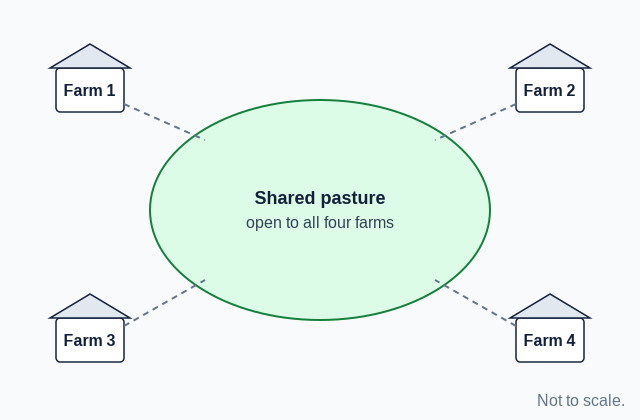 Tap to open the picture full size
Part 1 Think first One more cow
Commit to a guess first. Being wrong now makes the right idea stick better.
Predict first
Ten herders graze their cows on one village pasture that none of them owns. The grass is already getting thin. One herder is deciding whether to add one more cow anyway. What do you predict is the main reason the herder adds it?
In short. The tragedy of the commons is the idea that a resource many people share can be used up when each user decides alone how much to take.
- A commons is a resource many people can use and no one person controls, such as an open ocean fishery or a groundwater basin.
- What is best for the whole group over time is called the common good.
- A shared resource is depleted when the total taken each year is more than the resource can replace.
Part 2 Learn it How a shared resource runs down
2a. Shared resources and self-interest
A shared resource, often called a commons, is one that many people can use and no one person owns or controls: a village pasture, an ocean fishery, a groundwater basin, the air.
The tragedy of the commons suggests that individuals will use shared resources in their own self-interest. Acting in your own self-interest means choosing what benefits you.
Look at the herder's choice in numbers. One more cow brings its owner the full value of the cow. The grass that cow eats is gone for everyone, so if ten herders share the pasture, the owner of the new cow bears only about one tenth of that loss. To the herder, the gain is bigger than the cost. Adding the cow makes sense for the herder.
Nothing in that choice needs the herder to be careless or unaware. A herder who understands exactly what is happening can still come out ahead by adding the cow.
Quick check · Multiple choice
Twelve farms pump irrigation water from one groundwater basin that no one owns, and the water table has fallen for years. One farmer drills a second well anyway. Which best explains the farmer's choice?
2b. Self-interest against the common good
The idea goes further: individuals use shared resources in their own self-interest rather than in keeping with the common good. The common good is what is best for the whole group of users over time.
For the group, the best plan is to keep the total use at a level the resource can sustain, so every user can keep using it year after year. For each user alone, the best move is to take a little more. Each choice looks small and sensible on its own. Added together, the choices pull against the common good.
The idea needs a resource that is shared. When one person or family owns and controls a resource, such as a fenced pasture or a private woodlot, that owner bears the whole cost of overusing it, and no other user's choices can use it up. An owner can still overuse a resource, but that is not the tragedy of the commons.
Quick check · Decide and justify
Twenty people fish a lake that no one owns. The lake's fish can replace about 400 fish a week. Each person could catch 30 a week, but they agree that each will keep no more than 20. A student says the agreement serves the common good even though each person catches less than they could. Is the student right?
Which reason supports your answer?
2c. Depletion
The last part of the statement is the tragedy itself: users acting in their own self-interest end up depleting the resources. To deplete a resource is to use it up faster than it is replaced, until little or none is left.
Many shared resources renew: grass regrows, fish breed, rain recharges groundwater. A renewing resource holds steady when the total taken each year is no more than what it replaces. When every user takes a little more, the total passes that level, and the stock shrinks year after year. Signs of it are easy to see: fishers travel farther for smaller catches, wells must be drilled deeper, grazed land turns bare.
The word tragedy fits because everyone loses, including the users who took the most. Once the pasture is bare, no herder has grass.
Quick check · Select all
Many families gather firewood from a forest that no one owns. Which two observations would show that the forest is being depleted? Pick two.
Select 2 answers, then check.
Part 3 Watch it done How long will the pasture last?
Open each step in turn, answer the why, then finish the calculation yourself.
A made-up village pasture holds 1,800 metric tons of grass. Each year the grass regrows by 600 metric tons, and the herds now eat 720 metric tons. If nothing changes, how many years until the grass is gone?
Step 1 · Name the stock and the flows
The stock is the 1,800 metric tons of grass. Regrowth adds 600 metric tons a year; grazing takes 720 metric tons a year.
Step 2 · Find the yearly change
metric tons a year. The pasture loses 120 metric tons each year.
Why this step?
Why use the difference and not the 720 metric tons eaten?
The grass regrows as it is eaten. Only the amount eaten beyond the regrowth comes out of the stock each year.
Step 3 · Set up the time
Divide the stock by the amount it loses each year.
Your step · Calculate
Finish it. A made-up pasture holds 1,800 metric tons of grass, regrows 600 metric tons a year, and the herds eat 720 metric tons a year. How many years until the grass is gone?
years
Fifteen years, and every herder loses the pasture at once. Had the herds eaten no more than the 600 metric tons that regrow, the stock would hold steady.
Part 4 Try it From open access to empty
First put the steps of a tragedy of the commons in order. Then find where a student's account of a shared lake goes wrong.
Try it · Put it in order
Put these steps of a tragedy of the commons in order, first to last.
Try it · Spot the error
A student explains how a tragedy of the commons could happen at a lake. Tap the first line that goes wrong.
Part 5 Explain it A shared aquifer
Write your answer first. Nothing you type here leaves this page. Then compare it with the model and each scoring point.
Free response is 40% of the exam score. This one is shaped like Question 3, Analyze an environmental problem doing calculations.
Free-response practice · Question 3 style
Thirty made-up farms pump irrigation water from one aquifer, an underground layer of rock and sediment that holds water. No one owns the aquifer or limits pumping. Each farm pumps 0.2 million cubic meters a year. Rain and snowmelt recharge the aquifer by 2.4 million cubic meters a year, and it holds 90 million cubic meters of water the farms can reach.
(a) Describe how the farms' use of the aquifer is an example of the tragedy of the commons.
(b) Calculate how much the water the farms can reach falls each year. Show your work.
(c) Calculate how many years it will take for that water to run out if pumping does not change. Show your work.
(d) Propose one way the farms could limit their use, and explain how it would slow the depletion.
(e) Explain why a farm that pumped less than the others would still be harmed.
Model answer
(a) The aquifer is a shared resource no one controls. Each farm gains the whole value of the water it pumps, while the cost of the falling supply is shared by all thirty, so each acts in its own self-interest rather than for the common good, and together they deplete the aquifer.
(b) The farms pump million cubic meters a year. million cubic meters a year is lost.
(c) years.
(d) The farms could agree on a limit for each farm so that their total pumping is no more than the 2.4 million cubic meters of recharge. Then the water taken each year would be replaced, and the supply would stop falling.
(e) The aquifer is shared, so when the water runs out it runs out for every farm, including one that took less.
Score your own answer. This is a self-check, not a grade. Tick each point your answer makes.
Part 6 Check yourself A shared fishing ground
The first two questions use the table.
Boats from several towns fish a bay that no one owns, with no limit on catch. The table shows the number of boats and the total catch over five years. The numbers are made up for practice.
| Year | Boats | Total catch (metric tons) |
|---|---|---|
| 1 | 20 | 400 |
| 2 | 30 | 540 |
| 3 | 45 | 630 |
| 4 | 60 | 480 |
| 5 | 60 | 300 |
Case question 1 · Multiple choice
Using the table: which explanation for the change in total catch after year 3 do the data best support?
Case question 2 · Calculate
Using the table: by what percent did the total catch fall from year 3 to year 5?
The rest stand on their own and do not use the case.
Check yourself · Sort it
Is each resource shared, open to many users with no one in control? Tap a card, then its group.
Shared resource
Not a shared resource
Check yourself · Fill the statement
Complete the account of a shared bay.
Twenty boats fish a bay that no one owns, and each crew keeps its whole catch. Each crew acts in rather than for the common good, and over the years the bay's fish are .
Part 7 Keep it Bring back earlier ideas
Two questions from earlier topics: a student's account of an El Niño year, and a student's account of a town's sunniest day.
First find where a student's description of an El Niño year goes wrong. Then match five made-up records to the problem each one points to.
From 4.9 El Niño and La Niña · Spot the error
A student describes a made-up El Niño year. Tap the first line that goes wrong.
First rank four places by the solar radiation they receive. Then find where a student's account of one town's year goes wrong.
From 4.7 Solar Radiation and Earth’s Seasons · Spot the error
A student describes the solar radiation a made-up town at 40° N receives through the year. Tap the first line that goes wrong.
In three lines
- A shared resource, or commons, is one many people can use and no one person controls.
- The tragedy of the commons suggests individuals use shared resources in their own self-interest rather than for the common good: each keeps the whole gain of taking more and shares the cost.
- Together their choices deplete the resource, and every user loses it.
Exam strategy for this topic
- Section I, Multiple Choice: 80 questions in 90 minutes.
- Section II, Free Response: 3 questions in 70 minutes.
- This lesson's Explain it is shaped like free-response question 3, Analyze an environmental problem doing calculations.
- A four-function, scientific, or graphing calculator is allowed on both sections of the exam.
When a question describes many users of a resource no one controls, name the tragedy of the commons and say who gets the gain and who shares the cost. Then name the result: the resource is depleted.
Questions students ask
What is the tragedy of the commons?
The idea that individuals use shared resources in their own self-interest rather than in keeping with the common good, and so deplete the resources.
Why would a user who understands the problem still take more?
That user keeps the whole gain from taking more and bears only a share of the cost, which is spread over every user.
What are examples of a commons?
An ocean fishery, a groundwater basin many farms pump from, a village pasture open to every herder, and the air.
Course alignment, for teachers
AP Environmental Science topic 5.1, Unit 5: Land and Water Use.
- Skill 1.B: Explain environmental concepts and processes.
This lesson maps the one essential knowledge statement of the topic to the part that teaches each one: 1 is checked by a scored question. The map is in the lesson file.