Unit 9 · Topic 9.3 · about 30 minutes · 7 parts · 11 scored checks, 2 of them multiple choice, plus 2 from earlier lessons
AP Environmental Science 9.3: The Greenhouse Effect
Unit 9: 15 to 20% of the multiple-choice section
What you'll be able to do
- Identify the greenhouse gases.
- Identify the sources and potency of the greenhouse gases.
Key vocabulary
| Term | What it means | The exam trap |
|---|---|---|
| Greenhouse effect | The warming of Earth's surface by gases in the atmosphere that trap heat. | The name compares the atmosphere to a greenhouse; the gases do not form a glass roof. |
| Greenhouse gas | A gas in the atmosphere that traps heat given off by Earth's surface. | Trapping heat does not mean a gas feels warm to the touch. |
| Global warming potential (GWP) | A number that compares how much a gas warms the climate with the same mass of carbon dioxide, over the same time. | GWP is a comparison number with no units, not a temperature. |
 Tap to open the picture full size
Part 1 Think first Steam from the towers
Commit to a guess first. Being wrong now makes the right idea stick better.
Predict first
Power plant cooling towers, boiling kettles and drying laundry put water vapor into the air every day. Do you predict that this water vapor is a major cause of global climate change?
In short. The greenhouse effect is the warming of Earth's surface by gases in the atmosphere that trap heat, called greenhouse gases.
- The greenhouse effect gives Earth's surface the temperature that life needs to exist.
- The principal greenhouse gases are carbon dioxide, methane, water vapor, nitrous oxide and CFCs.
- Gases are compared by global warming potential (GWP), with carbon dioxide as the reference at a GWP of 1.
Part 2 Learn it Gases that keep Earth warm
2a. The greenhouse effect
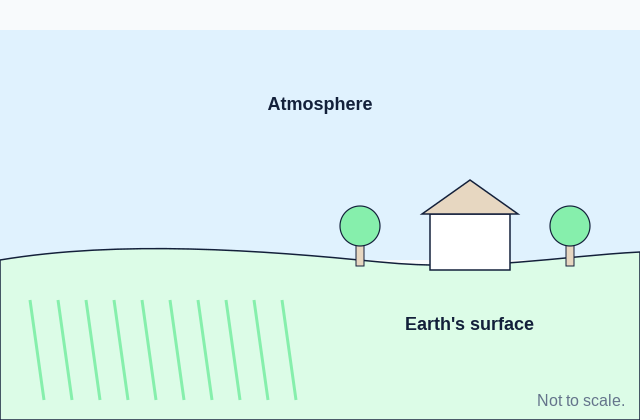
Background: sunlight passes through the atmosphere and warms the ground, and the warm ground gives off heat. Some gases in the atmosphere absorb part of that heat and send some of it back toward the ground, so the surface stays warmer than it would be without them. These are greenhouse gases, gases in the atmosphere that trap heat, and their warming of the surface is the greenhouse effect.
The greenhouse effect results in the surface temperature necessary for life on Earth to exist. Without it, the surface would be too cold for life as it is on Earth.
So the greenhouse effect itself is not the problem. The concern in this unit is what happens when people add more of these gases and the surface warms beyond what life has been used to.
For example, a made-up planet the same distance from its sun as Earth, but with only gases that do not trap heat in its air, would have a surface too cold for Earth's kind of life.
Quick check · Multiple choice
A student writes that Earth would be better off with no greenhouse effect at all. Which response corrects the student?
2b. The principal greenhouse gases
The principal greenhouse gases are carbon dioxide, methane, water vapor, nitrous oxide and chlorofluorocarbons (CFCs).
Earlier topics named where some of them come from. Burning fossil fuels, such as coal, oil and gasoline, releases carbon dioxide (Topics 1.4 and 5.10). Natural gas is mostly methane (Topic 6.3), meat production adds methane to the air (Topic 5.7), and landfills give off methane, which a sanitary landfill collects (Topics 8.9 and 8.10). CFCs are gases people made (Topic 9.1).
For example, a made-up rice-growing town lists the carbon dioxide from its tractors' fuel and the methane from its compost heaps among its greenhouse gases.
Quick check · Decide and justify
A made-up city's climate report lists the methane given off by its landfill as one of its greenhouse gases. Is the report right to list it?
Which reason supports your answer?
2c. Water vapor, a special case
Water vapor traps heat, so it is a greenhouse gas. While water vapor is a greenhouse gas, it doesn't contribute significantly to global climate change because it has a short residence time in the atmosphere.
Residence time is how long a molecule of a gas stays in the atmosphere before it leaves. Water vapor that enters the air soon leaves it again, as rain or snow. Because it does not build up and stay, the water vapor people add does little to change the climate, even though it traps heat while it is there.
For example, the steam from a made-up laundry's dryers is a greenhouse gas, but it is back on the ground as rain long before it could add much to climate change.
Quick check · Select all
A made-up city's fountains and lawn sprinklers add water vapor to the air, and its buses release carbon dioxide. Which two statements fit? Pick two.
Select 2 answers, then check.
2d. Comparing gases: global warming potential
Greenhouse gases differ in how much each ton of them warms the climate. Global warming potential (GWP) compares how much a gas warms the climate with the same mass of carbon dioxide over the same time.
Carbon dioxide, which has a GWP of 1, is used as a reference point for the comparison of different greenhouse gases and their impacts on global climate change. Chlorofluorocarbons (CFCs) have the highest GWP, followed by nitrous oxide, then methane.
A gas's GWP lets you turn tons of it into tons of carbon dioxide equivalent: multiply the tons by the GWP. That gives how many tons of carbon dioxide would warm the climate as much.
For example, if a made-up gas had a GWP of 40, then 2 tons of it would count as tons of carbon dioxide equivalent.
Quick check · Rank it
Rank these three greenhouse gases by global warming potential.
Highest GWP first
Give each one a place, 1 for first. Give two the same place if they are equal.
Your ranking: none yet
Part 3 Watch it done Tons of carbon dioxide equivalent
Open each step in turn, answer the why, then finish the calculation yourself.
A made-up farm's fertilizer releases 3 tons of nitrous oxide a year. Suppose nitrous oxide's GWP is 300. How many tons of carbon dioxide equivalent is that each year? The numbers, including the GWP, are made up for practice.
Step 1 · Recall what GWP compares
A GWP of 300 means each ton of this gas warms the climate as much as 300 tons of carbon dioxide.
Why this step?
Why multiply the tons by the GWP instead of dividing?
Each ton of the gas counts as many tons of carbon dioxide, so the carbon dioxide equivalent is larger than the tons of the gas itself.
Step 2 · Multiply
Multiply the 3 tons of nitrous oxide by its GWP.
Your step · Calculate
Finish it. The farm releases 3 tons of nitrous oxide a year, with a GWP of 300 in this problem. How many tons of carbon dioxide equivalent is that each year? Give a whole number.
tons of CO2 equivalent a year
900 tons of carbon dioxide equivalent a year. Three tons of this gas warm the climate as much as 900 tons of carbon dioxide would.
Part 4 Try it Name two gases, then check a town's report
First complete a sentence about where two greenhouse gases come from. Then find where a student's account of a made-up town's report goes wrong.
Try it · Fill the statement
Complete the sentence about where two greenhouse gases come from.
A cattle feedlot and a leaking natural gas pipe both release , and a coal power plant's smokestack releases . Both are principal greenhouse gases.
Try it · Spot the error
A student describes a made-up town's report. Tap the first line that goes wrong.
Part 5 Explain it Methane from a dairy farm
Write your answer first. Nothing you type here leaves this page. Then compare it with the model and each scoring point.
Free response is 40% of the exam score. This one is shaped like Question 3, Analyze an environmental problem doing calculations.
Free-response practice · Question 3 style
A made-up dairy farm's cattle release 60 tons of methane a year. In this problem, methane's GWP is 25. A new feed would cut the cattle's methane by 40%. The numbers, including the GWP, are made up for practice.
(a) Calculate the farm's methane each year in tons of carbon dioxide equivalent. Show your work.
(b) Calculate how many tons of methane a year the new feed would avoid. Show your work.
(c) Calculate how many tons of carbon dioxide equivalent a year the new feed would avoid. Show your work.
(d) Explain why, in this problem, a ton of methane counts for more than a ton of carbon dioxide.
(e) Identify the gas that is the reference for global warming potential, and give its GWP.
Model answer
(a) tons of carbon dioxide equivalent a year.
(b) tons of methane a year.
(c) tons of carbon dioxide equivalent a year.
(d) Methane's GWP here is 25 and carbon dioxide's is 1, so each ton of methane warms the climate as much as 25 tons of carbon dioxide.
(e) Carbon dioxide, with a GWP of 1.
Score your own answer. This is a self-check, not a grade. Tick each point your answer makes.
Part 6 Check yourself One town's greenhouse gases
The first two questions use the table.
A made-up town measures how many tons of four greenhouse gases it releases in a year. The table gives each gas's tons and a GWP for each gas. The numbers, including the GWPs, are made up for practice, and they keep the real order: CFCs highest, then nitrous oxide, then methane, with carbon dioxide at 1.
| Gas | Tons a year | GWP (made up; the order is real) |
|---|---|---|
| Nitrous oxide | 9 | 300 |
| Carbon dioxide | 4,000 | 1 |
| CFC | 0.2 | 5,000 |
| Methane | 120 | 25 |
Case question 1 · Multiple choice
Using the table, which statement about the town's gases, measured in tons of carbon dioxide equivalent, is correct?
Case question 2 · Calculate
Using the table: the town wants to cut its yearly emissions by 1,000 tons of carbon dioxide equivalent by cutting methane alone. How many tons of methane a year must it cut? Give a whole number.
The rest stand on their own and do not use the case.
Check yourself · Put it in order
Put the steps of the greenhouse effect, as this lesson's background describes it, in order, first to last.
Check yourself · Match
Match each term to the description that fits it.
Part 7 Keep it Bring back earlier ideas
Two questions from earlier topics, to bring them back before they fade.
First complete a sentence about what a swap from CFCs to HFCs does. Then find where a student's account of a made-up city's swap goes wrong.
From 9.2 Reducing Ozone Depletion · Fill the statement
Complete the sentence about replacing CFCs with HFCs.
Replacing CFCs with HFCs eases , but some HFCs add to .
First complete an account of two made-up outbreaks. Then find where a student's account of a neighborhood goes wrong.
From 8.15 Pathogens and Infectious Diseases · Spot the error
A student describes a made-up neighborhood. Tap the first line that goes wrong.
In three lines
- The greenhouse effect gives Earth's surface the temperature life needs; the principal greenhouse gases are carbon dioxide, methane, water vapor, nitrous oxide and CFCs.
- Water vapor is a greenhouse gas but adds little to climate change, because its residence time in the atmosphere is short.
- Carbon dioxide is the GWP reference at 1; CFCs have the highest GWP, then nitrous oxide, then methane.
Exam strategy for this topic
- Section I, Multiple Choice: 80 questions in 90 minutes.
- Section II, Free Response: 3 questions in 70 minutes.
- This lesson's Explain it is shaped like free-response question 3, Analyze an environmental problem doing calculations.
- A four-function, scientific, or graphing calculator is allowed on both sections of the exam.
When a question asks about greenhouse gases, name the five principal ones, say that water vapor adds little to climate change because of its short residence time, and compare gases by GWP with carbon dioxide as the reference at 1.
Questions students ask
What are the principal greenhouse gases?
Carbon dioxide, methane, water vapor, nitrous oxide and chlorofluorocarbons (CFCs).
Is the greenhouse effect bad?
Not in itself. The greenhouse effect results in the surface temperature necessary for life on Earth to exist. The concern is the extra warming from adding more greenhouse gases.
Why doesn't water vapor contribute much to climate change?
It is a greenhouse gas, but it has a short residence time in the atmosphere, so it does not build up.
What is global warming potential?
A comparison of how much a gas warms the climate with carbon dioxide, which has a GWP of 1. CFCs have the highest GWP, followed by nitrous oxide, then methane.
Course alignment, for teachers
AP Environmental Science topic 9.3, Unit 9: Global Change.
- Skill 1.B: Explain environmental concepts and processes.
This lesson maps all 4 essential knowledge statements of the topic to the part that teaches each one: 4 are checked by a scored question. The map is in the lesson file.