Unit 1 · Topic 1.7 · about 30 minutes · 7 parts · 10 scored checks, 1 of them multiple choice, plus 2 from earlier lessons
AP Environmental Science 1.7: The Hydrologic (Water) Cycle
Unit 1: 6 to 8% of the multiple-choice section
What you'll be able to do
- Explain the steps and reservoir interactions in the hydrologic cycle: how water changes phase as it moves, and which reservoirs act as sources and sinks.
Key vocabulary
| Term | What it means | The exam trap |
|---|---|---|
| Hydrologic cycle | The movement of water in its solid, liquid and gaseous phases between sources and sinks. | At each step, name the phase water is in before and after, not only the step's name. |
| Phase | The physical form of water: solid ice, liquid water, or water vapor, a gas. | Read what a question shows you, such as a cloud or a frozen lake, and decide its phase from what you were taught, not from how it looks. |
| Reservoir | A place where water is stored for a time, such as an ocean, a lake, an ice cap, soil or the air. | A reservoir can be a source in one budget and a sink in another, so compare its flows each time. |
| Groundwater | Water held underground in the spaces in soil and rock. | Groundwater moves slowly, so read the time a question covers before deciding what happens to it. |
| Ice cap | A thick, lasting sheet of ice covering a large area of land. | Covering a large area is not the same as holding the most water; compare reservoirs by the water they hold. |
 Tap to open the picture full size
Part 1 Think first The wet windshield
Commit to a guess first. Being wrong now makes the right idea stick better.
Predict first
A car sits outside all night under a clear sky. No rain falls, but by sunrise its windshield is covered in tiny drops of water. What do you predict is the source of the water?
In short. The hydrologic cycle, or water cycle, is the movement of water in its solid, liquid and gaseous phases between sources and sinks.
- The hydrologic cycle is powered by the sun.
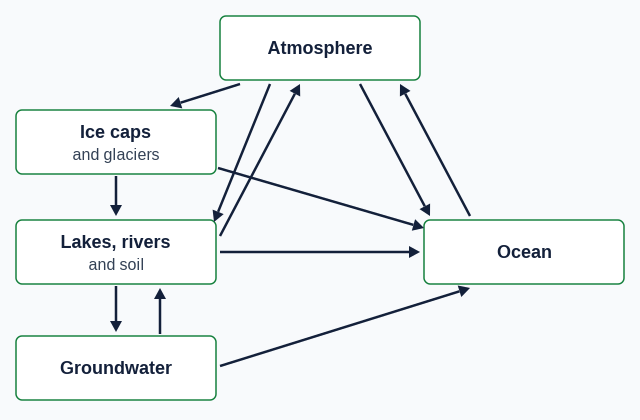
- Water moves between reservoirs such as the oceans, the atmosphere, ice caps, lakes and rivers, soil and groundwater.
- The oceans are the primary reservoir of water at Earth's surface, with ice caps and groundwater acting as much smaller reservoirs.
Part 2 Learn it The hydrologic cycle
2a. Powered by the sun, in three phases
The hydrologic cycle, or water cycle, is the movement of water in its solid, liquid and gaseous phases between sources and sinks. It is powered by the sun.
- Evaporation: energy from sunlight turns liquid water at the surface of oceans, lakes and wet soil into water vapor, a gas. Plants also release water vapor from their leaves.
- Condensation: as water vapor rises, it cools and turns back into tiny liquid droplets, which gather as clouds. Vapor near the ground can condense on cool surfaces too.
- Precipitation: the droplets and ice crystals in clouds grow and fall as rain, which is liquid, or as snow and hail, which are solid.
- Freezing and melting: water freezes into ice in glaciers and ice caps, and melts back into liquid when it warms.
The sun's energy lifts water into the air as vapor. Gravity brings it back down as precipitation and pulls it downhill over and under the land.
Quick check · Match
Match each everyday event to the step of the hydrologic cycle it shows.
2b. Sources, sinks and the water budget
Water is held in reservoirs: the oceans, the atmosphere, ice caps and glaciers, lakes and rivers, soil, groundwater and living things. Precipitation that reaches land can take more than one path:
- Runoff flows over the surface into streams, rivers and lakes, and on toward the ocean.
- Infiltration is water soaking into the soil. Plant roots take up some of it. Some seeps deeper and becomes groundwater, held in the spaces in soil and rock. Groundwater moves slowly and feeds springs, streams and lakes.
As in the carbon cycle, a reservoir is a sink when it takes in more water than it releases, and a source when it releases more than it takes in. To tell which, write a water budget: add every flow in, add every flow out over the same time, and subtract the flows out from the flows in.
A wetland that soaks up more floodwater in spring than it lets drain away is acting as a sink. The water is not used up when a reservoir loses it. It moves to another reservoir, such as a river or the air.
Quick check · Decide and justify
A town's wells pump water out of the ground faster than rain soaks back in to replace it. A student says the groundwater under the town is acting as a sink. Is the student right?
Which reason supports your answer?
2c. Where the water is
Water is not spread evenly among the reservoirs. The oceans are the primary reservoir of water at Earth's surface. They hold far more water than any other reservoir.
Ice caps and groundwater also store large amounts, but each is a much smaller reservoir than the oceans. An ice cap holds water in its solid phase, sometimes for thousands of years. Groundwater holds liquid water underground. Lakes, rivers, soil, the atmosphere and living things also hold water.
Ocean water is salt water, so people draw most of their drinking water from the smaller freshwater reservoirs, such as lakes, rivers and groundwater. That is one reason a change in a small reservoir, such as a falling water table, matters so much.
Quick check · Select all
A coastal town needs more fresh water. It can pump more groundwater from under the town, or remove the salt from ocean water. Which two statements about the two sources are correct? Pick two.
Select 2 answers, then check.
Part 3 Watch it done Is the lake gaining or losing?
Open each step in turn, answer the why, then finish the calculation yourself.
Suppose a lake's yearly water budget, in millions of cubic meters per year, is as follows. The numbers are made up for practice. In: a river flowing in 34, precipitation onto the lake 10, groundwater seeping in 5. Out: evaporation 22, a river flowing out 27, water pumped out for a town 6. Does the lake gain or lose water each year, and how much?
Step 1 · Add the flows in
The inflowing river, precipitation and groundwater all add water to the lake: million cubic meters per year.
Step 2 · Add the flows out
Evaporation, the outflowing river and the town's pumping all remove water from the lake: million cubic meters per year.
Step 3 · Set up the net change
Net change = flows in minus flows out, over the same year: million cubic meters per year. A positive answer means the lake gains water; a negative one means it loses water.
Why this step?
Why does evaporation count as a flow out, when the water still exists?
Evaporation turns the lake's liquid water into water vapor, which leaves the lake for the atmosphere. The water is not destroyed, but it is no longer in this reservoir, so it counts against the lake's budget.
Your step · Calculate
Finish it. In a made-up budget, water flows into a lake from a river (34), precipitation (10) and groundwater (5), and out of it by evaporation (22), a river flowing out (27) and pumping for a town (6), all in millions of cubic meters per year. What is the lake's net change in water each year? Give your answer in millions of cubic meters per year, positive for a gain and negative for a loss.
million m³/yr
Evaporation removes 22 million cubic meters a year here, and the lake cannot see it go. Leave it out and the lake would seem to gain 16 million cubic meters a year when it is really losing 6.
Part 4 Try it A frozen reservoir, and the cycle drawn
The same budget works for any reservoir, in any phase. Decide what flows into and out of the reservoir in the question, not of a lake. Then read a drawing of the cycle.
Try it · Calculate
Suppose a glacier gains 14 million cubic meters of water a year as snowfall that turns to ice. It loses 11 million cubic meters a year as meltwater flowing away in streams, and 5 million cubic meters a year as ice that breaks off into the sea. The numbers are made up for practice. What is the glacier's net change in water each year? Give your answer in millions of cubic meters per year, positive for a gain and negative for a loss.
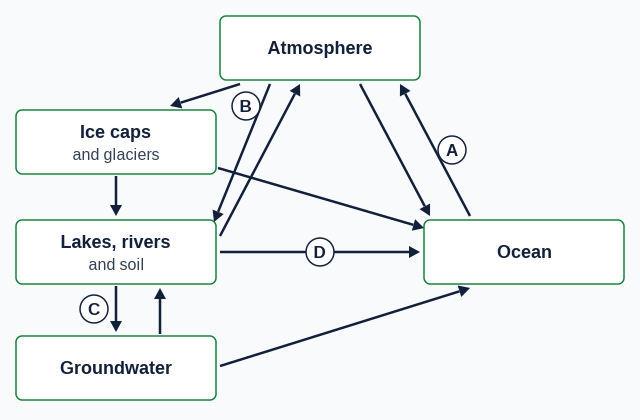
Try it · Match
Use the drawing of the water cycle with lettered arrows. Match each lettered arrow to the step that moves water that way.
Part 5 Explain it Design an investigation of evaporation
Write your answer first. Nothing you type here leaves this page. Then compare it with the model and each scoring point.
Free response is 40% of the exam score. This one is shaped like Question 1, Design an investigation.
Free-response practice · Question 1 style
A student wants to test the idea that the sun's energy drives evaporation, the step that lifts water from the surface into the atmosphere. The student has eight identical shallow pans, a measuring cup, and a sunny spot and a shaded spot in the same schoolyard.
(a) Identify a testable hypothesis for the investigation.
(b) Describe an investigation the student could carry out with these materials.
(c) Identify the independent variable, the dependent variable, and one variable the student should hold constant.
(d) Explain how a result that supports the hypothesis connects to the claim that the hydrologic cycle is powered by the sun.
Model answer
(a) If pans of water are set in direct sunlight, then more water will evaporate from them than from the same pans set in the shade.
(b) Fill all eight pans with the same volume of water, measured with the cup. Put four pans in the sunny spot and four in the shaded spot at the same time, on the same kind of surface and equally open to the wind, so sunlight is the only planned difference. After two days, measure the water left in each pan and subtract it from the starting volume to find how much evaporated. Compare the average for the sunny pans with the average for the shaded pans.
(c) The independent variable is whether a pan is in sunlight or shade. The dependent variable is the volume of water that evaporated. The starting volume of water must be held constant, along with the size and shape of the pans and the length of time.
(d) More evaporation in the sun would show that energy from sunlight turns liquid water into water vapor. Evaporation is the step that carries water from oceans, lakes and soil up into the atmosphere, where it condenses and falls as precipitation, so the sun's energy is what keeps water moving through the cycle.
Score your own answer. This is a self-check, not a grade. Tick each point your answer makes.
Part 6 Check yourself Where the rain goes
The first two questions use the table.
Suppose students follow the rain that falls in one year on two plots of the same size, side by side: a patch of forest and a paved parking lot. The numbers below are made up for practice.
| Plot | Precipitation | Returns to the air as vapor | Runs off to a stream | Soaks into the ground |
|---|---|---|---|---|
| Forest | 1,000 | 350 | 100 | 550 |
| Parking lot | 1,000 | 300 | 680 | 20 |
Case question 1 · Multiple choice
Using the table of the two plots: the parking lot sends 680 millimeters of water to the stream as runoff, against 100 millimeters from the forest. Which best explains the difference?
Case question 2 · Decide and justify
In the table of the two plots, 550 millimeters soaks into the ground under the forest. A student says that this water is still part of the hydrologic cycle. Is the student right?
Which reason supports your answer?
The rest stand on their own and do not use the case.
Check yourself · Spot the error
A student describes how ocean water becomes rain. Tap the first line that goes wrong.
Check yourself · Fill the statement
Complete the description of three everyday events. Tap a blank, then an answer.
Wet laundry on a sunny line dries because energy from the turns its water into a . The snowpack on a mountain stores water as a until spring.
Part 7 Keep it Bring back earlier ideas
Two questions from earlier topics: where phosphorus is held, and a carbon budget for a forest.
From 1.6 The Phosphorus Cycle · Fill the statement
Follow the phosphate that washes off a farm field in a storm. Tap a blank, then an answer.
The phosphate travels down rivers to the , settles to the bottom, and becomes part of the , a major reservoir that holds it for millions of years. It does not come back to the field as a gas, since the phosphorus cycle lacks a significant component.
The same bookkeeping works for any reservoir. Decide what flows in and what flows out of the reservoir in the question, not of the atmosphere.
From 1.4 The Carbon Cycle · Calculate
Suppose a young forest takes in 12 metric tons of carbon per hectare per year by photosynthesis. The trees respire 5, decomposers in the forest's soil and litter respire 4, and small fires release 1, all in metric tons of carbon per hectare per year. The numbers are made up for practice. What is the forest's net change in carbon each year? Give your answer in metric tons per hectare per year, positive for a gain.
In three lines
- The hydrologic cycle moves water in its solid, liquid and gaseous phases between sources and sinks, and it is powered by the sun.
- A water budget adds the flows into a reservoir and the flows out over the same time: more in than out is a sink, more out than in is a source.
- The oceans are the primary reservoir of water at Earth's surface, with ice caps and groundwater acting as much smaller reservoirs.
Exam strategy for this topic
- Section I, Multiple Choice: 80 questions in 90 minutes.
- Section II, Free Response: 3 questions in 70 minutes.
- This lesson's Explain it is shaped like free-response question 1, Design an investigation.
- A four-function, scientific, or graphing calculator is allowed on both sections of the exam.
When a question gives flows into and out of a water reservoir, total each side over the same time, subtract the flows out from the flows in, and say whether the reservoir is acting as a source or a sink.
Questions students ask
What powers the hydrologic cycle?
The sun. Its energy evaporates water from the surface into the atmosphere, and gravity brings the water back down as precipitation.
What are the phases of water in the hydrologic cycle?
Solid (ice and snow), liquid (rain, lakes, rivers, oceans and groundwater) and gas (water vapor in the air).
What is the largest reservoir of water at Earth's surface?
The oceans are the primary reservoir. Ice caps and groundwater are much smaller reservoirs.
How can a reservoir be a source of water?
A reservoir is a source when it releases more water than it takes in over the same time, such as groundwater pumped out faster than rain soaks in.
Is water used up in the hydrologic cycle?
No. Water changes phase and moves between reservoirs, but it is not destroyed.
Course alignment, for teachers
AP Environmental Science topic 1.7, Unit 1: The Living World: Ecosystems.
- Skill 2.B: Explain relationships between different characteristics of environmental concepts, processes, or models represented visually:
This lesson maps all 2 essential knowledge statements of the topic to the part that teaches each one: 2 are checked by a scored question. The map is in the lesson file.