Unit 3 · Topic 3.8 · about 35 minutes · 7 parts · 11 scored checks, 2 of them multiple choice, plus 2 from earlier lessons
AP Environmental Science 3.8: Human Population Dynamics
Unit 3: 10 to 15% of the multiple-choice section
What you'll be able to do
- Explain how human populations experience growth and decline: the four rates, the factors and limits that act on them, and how to calculate the rate of natural increase and estimate doubling time.
Key vocabulary
| Term | What it means | The exam trap |
|---|---|---|
| Crude birth rate | The number of births in a year for every 1,000 people in a population. | It counts births against the whole population, not against the number of women. |
| Crude death rate | The number of deaths in a year for every 1,000 people in a population. | It counts every death, at any age, not only the deaths of infants. |
| Rate of natural increase (RNI) | The crude birth rate minus the crude death rate, typically expressed as a percentage. | Natural increase can be negative, when deaths outnumber births. |
| Density-dependent factor | A factor whose effect on a population depends on how crowded it is, such as access to clean water and air, food availability, disease transmission or territory size. | Ask whether the factor itself grows as more people share the same place. |
| Density-independent factor | A factor whose effect on a population does not depend on how crowded it is, such as a major storm, fire, heat wave or drought. | A drought or a storm comes whether few or many people live there, even when it harms many. |
 Tap to open the picture full size
Part 1 Think first A town growing 2% a year
Commit to a guess first. Being wrong now makes the right idea stick better.
Predict first
Suppose a made-up town's population grows by 2% every year, and the rate does not change. About how many years do you predict it takes for the town's population to double?
In short. Human population growth and decline are determined by the rates of birth, death, immigration, and emigration.
- Birth and death rates are affected by factors such as access to education, family planning, healthcare, and nutrition.
- Population growth can be affected by both density-independent and density-dependent factors.
- The rate of natural increase is the crude birth rate minus the crude death rate, typically expressed as a percentage.
Part 2 Learn it Human population dynamics
2a. Four rates
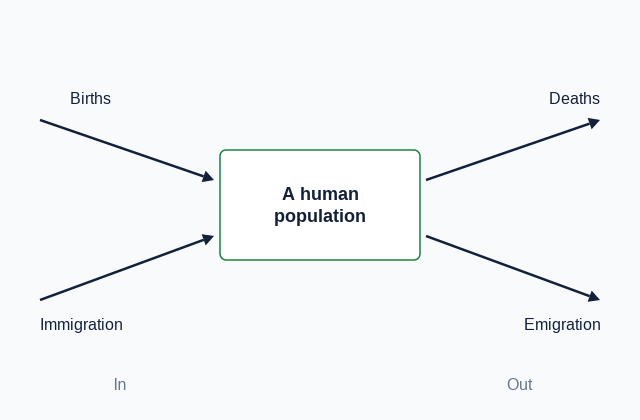
Human population growth and decline are determined by the rates of birth, death, immigration, and emigration.
- Births and immigration, people moving in, add people.
- Deaths and emigration, people moving out, remove people.
A population grows when what comes in is larger than what goes out, and declines when it is smaller. Births minus deaths alone is not the whole story.
Suppose a made-up island of 20,000 people has 300 births, 120 deaths, 50 people moving in and 400 moving out in one year. Births beat deaths by 180, but : the island lost 170 people.
Quick check · Decide and justify
Births outnumber deaths in a made-up country every year. A student says the country's population could still be falling. Is the student right?
Which reason supports your answer?
2b. What moves the rates, and what limits growth
Birth rates and death rates are affected by factors such as access to education, family planning, healthcare, and nutrition. A new clinic, a school that girls can reach, or a better food supply can change how many people are born or die each year.
Factors limiting global human population include the Earth's carrying capacity and the basic factors that limit human population growth as set forth by Malthusian theory.
- Earth's carrying capacity for humans is the largest population its resources can support over time, the idea from topic 3.4 applied to the whole planet.
- Malthusian theory holds that a population can grow faster than its food supply, so basic needs such as food limit its growth.
A population that is still growing has not shown that no limit exists.
Quick check · Select all
Which two changes in a made-up country are factors that affect its birth or death rate? Pick two.
Select 2 answers, then check.
2c. Density-dependent and density-independent factors
Population growth can be affected by both density-independent factors and density-dependent factors. Density means how crowded a population is.
- Density-independent factors, such as major storms, fires, heat waves, or droughts. A hurricane strikes a coast whether a few people live there or many.
- Density-dependent factors, such as access to clean water and air, food availability, disease transmission, or territory size. The more people share a place, the more these press on each person: water and food are split more ways, an illness passes more easily, and each family has less land.
Suppose a made-up valley's towns double in size. Each household's share of the river water shrinks, and measles moves through the crowded schools faster. Both effects grew with crowding, so both are density-dependent.
A drought itself is density-independent: it comes whether few or many people live there. What crowding changes is each person's access to the water that is left, and that access is the density-dependent factor.
Quick check · Sort it
Each card describes something that affects a made-up human population. Tap a card, then the kind of factor it is.
Density-dependent
Density-independent
2d. Rate of natural increase and doubling time
The crude birth rate is births per 1,000 people in a year; the crude death rate is deaths per 1,000 people in a year.
The rate of natural increase (RNI) is a demographic metric measuring population growth or decline, calculated by subtracting the crude death rate from the crude birth rate, typically expressed as a percentage. Per 1,000 to percent means dividing by 10.
Suppose a made-up country has a crude birth rate of 20 and a crude death rate of 12. Its RNI is per 1,000, or . A negative RNI means decline.
One way to estimate the doubling time of a population is by dividing 70 by the annual population growth rate expressed as a percentage. A population growing 1% a year doubles in about years.
RNI leaves out immigration and emigration. Use it as the growth rate only when no one moves in or out, or when the two cancel.
Quick check · Calculate
A made-up country has a crude birth rate of 24 per 1,000 people per year and a crude death rate of 9 per 1,000 people per year. What is its rate of natural increase, as a percent?
Part 3 Watch it done From birth and death rates to doubling time
Open each step in turn, answer the why, then finish the calculation yourself.
Suppose a made-up country has a crude birth rate of 32 and a crude death rate of 7, both per 1,000 people per year, and no one moves in or out. If its growth rate stays the same, about how many years will its population take to double?
Step 1 · Find the rate of natural increase
per 1,000 people per year.
Step 2 · Write it as a percent
per year.
Why this step?
Why can the rate of natural increase stand in for the growth rate here?
No one moves in or out, so births and deaths are the only changes. The growth rate is then the rate of natural increase.
Step 3 · Set up the estimate
Doubling time annual growth rate in percent.
Your step · Calculate
Finish it. A made-up country with no one moving in or out has a crude birth rate of 32 and a crude death rate of 7, both per 1,000 people per year. Its growth rate is 2.5% per year. If that rate stays the same, about how many years will its population take to double?
years
About 28 years. A growth rate that sounds small, 2.5% a year, doubles the population within a generation, because each year's growth is taken of a larger total.
Part 4 Try it A claim about limits, and a fast-growing city
First find where an argument about limits to growth goes wrong. Then estimate a doubling time the lesson has not shown.
Try it · Spot the error
A student argues about the world's human population. Tap the first line that goes wrong.
Try it · Multiple choice
A made-up city's population grows by 3.5% per year, and the rate does not change. About how long will the population take to double?
Part 5 Explain it A country growing fast
Write your answer first. Nothing you type here leaves this page. Then compare it with the model and each scoring point.
Free response is 40% of the exam score. This one is shaped like Question 3, Analyze an environmental problem doing calculations.
Free-response practice · Question 3 style
Suppose a made-up country of 40 million people has a crude birth rate of 40 and a crude death rate of 12, both per 1,000 people per year. Almost no one moves in or out. The numbers are made up for practice.
(a) Calculate the country's rate of natural increase, as a percent. Show your work.
(b) Calculate about how many years the population will take to double if this rate stays the same. Show your work.
(c) Identify one density-dependent factor that could limit the population's growth as it doubles.
(d) Identify one density-independent factor that could raise the country's death rate in a single year.
(e) Identify one factor affecting birth rates that the country's government could change.
Model answer
(a) per 1,000, and .
(b) years.
(c) Disease transmission: as towns grow more crowded, illnesses spread more easily. (Access to clean water or air, food availability or territory size also earns the point.)
(d) A major heat wave. (A major storm, a fire, a drought, a flood or a cold snap also earns the point.)
(e) Access to family planning, for example by opening clinics. (Access to education, healthcare or nutrition, or a policy such as a minimum marriage age or payments per child, also earns the point.)
Score your own answer. This is a self-check, not a grade. Tick each point your answer makes.
Part 6 Check yourself Four countries' rates
The first two questions use the table.
The table gives each made-up country's yearly rates, all per 1,000 people. The numbers are made up for practice.
| Country | Crude birth rate | Crude death rate | Immigrants | Emigrants |
|---|---|---|---|---|
| Q | 30 | 10 | 1 | 9 |
| R | 22 | 8 | 2 | 2 |
| S | 12 | 10 | 12 | 1 |
| T | 15 | 5 | 6 | 1 |
Case question 1 · Multiple choice
Using the table: which country's population is growing fastest when births, deaths, immigration and emigration are all counted?
Case question 2 · Calculate
Using the table: country R has as many immigrants as emigrants, so its growth rate is its rate of natural increase. If that rate stays the same, about how many years will R's population take to double?
The rest stand on their own and do not use the case.
Check yourself · Fill the statement
Complete the account of a made-up island. Tap a blank, then an answer.
A made-up island had 50,000 people. In one year 900 babies were born, 400 people died, 300 people moved to the island and 600 moved away. Its natural increase was people, but its population grew by only , because more people left by than arrived.
Check yourself · Put it in order
A made-up country has no immigration or emigration. Put the steps for estimating its doubling time from its birth and death rates in order.
Part 7 Keep it Bring back earlier ideas
Two questions from earlier topics: a country's fertility after a new policy, and what a drought does to a plain's gazelles.
First describe what a country's data show after a new policy. Then find where a planner's reasoning about replacement level goes wrong.
From 3.7 Total Fertility Rate · Multiple choice
A made-up country's total fertility rate was 1.6 in 2005. In 2006 its government began paying families a large sum for each child born. Its total fertility rate was 1.6 in 2006, 1.8 in 2008 and 2.0 in 2010. Which statement do the data support?
Two situations the lesson has not shown: a resource that regrows, and a resource base that shrinks.
From 3.5 Population Growth and Resource Availability · Spot the error
A student explains what a drought will do to a made-up population of gazelles. Tap the first line that goes wrong.
In three lines
- Human population growth and decline are determined by birth, death, immigration and emigration; education, family planning, healthcare and nutrition affect birth and death rates.
- Earth's carrying capacity and Malthusian limits limit global population; density-independent and density-dependent factors affect growth.
- RNI is the crude birth rate minus the crude death rate as a percent; doubling time is about 70 divided by the annual growth rate in percent.
Exam strategy for this topic
- Section I, Multiple Choice: 80 questions in 90 minutes.
- Section II, Free Response: 3 questions in 70 minutes.
- This lesson's Explain it is shaped like free-response question 3, Analyze an environmental problem doing calculations.
- A four-function, scientific, or graphing calculator is allowed on both sections of the exam.
Show every step of a population calculation: subtract the death rate from the birth rate, divide by 10 to get a percent, then divide 70 by that percent for the doubling time. Say when you assume no one moves in or out.
Questions students ask
What determines human population growth and decline?
The rates of birth, death, immigration and emigration.
How is the rate of natural increase calculated?
By subtracting the crude death rate from the crude birth rate. It is typically expressed as a percentage.
How can a population's doubling time be estimated?
One way is to divide 70 by the annual population growth rate expressed as a percentage.
What are density-dependent and density-independent factors?
Density-independent factors include major storms, fires, heat waves and droughts. Density-dependent factors include access to clean water and air, food availability, disease transmission and territory size.
Course alignment, for teachers
AP Environmental Science topic 3.8, Unit 3: Populations.
- Skill 7.A: Describe environmental problems.
This lesson maps all 4 essential knowledge statements of the topic to the part that teaches each one: 4 are checked by a scored question. The map is in the lesson file.