Unit 6 · Topic 6.8 · about 30 minutes · 7 parts · 10 scored checks, 2 of them multiple choice, plus 2 from earlier lessons
AP Environmental Science 6.8: Solar Energy
Unit 6: 10 to 15% of the multiple-choice section
What you'll be able to do
- Describe the use of solar energy in power generation.
- Describe the effects of the use of solar energy in power generation on the environment.
Key vocabulary
| Term | What it means | The exam trap |
|---|---|---|
| Photovoltaic cell | A thin wafer, usually of silicon, the small unit that solar panels are built from. | One cell is small; a panel is many cells wired together, and an array is many panels. |
| Collector | A dark, flat box or set of tubes that absorbs sunlight and warms the air or water passing through it. | A collector heats; it does not make electricity. |
| Kilowatt-hour (kWh) | A unit of electrical energy: the energy used by a 1,000-watt device running for one hour. | A kilowatt-hour is an amount of energy, not a rate of power. |
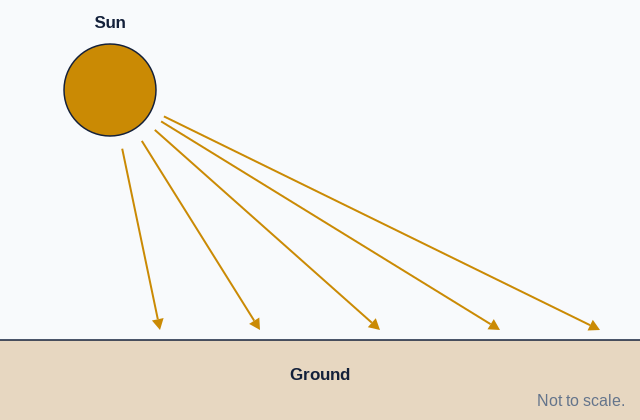 Tap to open the picture full size
Part 1 Think first A house with no pumps
Commit to a guess first. Being wrong now makes the right idea stick better.
Predict first
A made-up house has large windows facing the sun and dark tile floors. It has no solar panels, pumps, fans or tanks. How do you predict it can use sunlight?
In short. Solar energy systems turn sunlight into electricity or heat, each in its own way, with their own limits and effects.
- How photovoltaic cells turn sunlight into electricity, and what limits them.
- How active and passive systems differ in the equipment they use and in what they can do with the heat.
- What solar power means for the environment, for the budget, and for the land it covers.
Part 2 Learn it Three ways to use sunlight
2a. Solar cells
Photovoltaic solar cells capture light energy from the sun and transform it directly into electrical energy. Their use is limited by the availability of sunlight.
A photovoltaic (PV) cell is a thin wafer, usually of silicon, that gives off an electric current when light strikes it. Many cells wired together make a solar panel, and many panels make an array.
"Directly" is the key word. A PV cell has no fuel, no boiling water, no steam and no turbine. Light goes in and electricity comes out.
The limit is the light itself. A PV cell makes electricity only while light falls on it, so it makes none at night and less under clouds, in the short days of winter, or in places with few sunny days. Background: homes and power companies add batteries or other sources to keep power flowing when the sun is down.
Quick check · Multiple choice
A made-up town installs photovoltaic panels on its library roof. Which statement best describes what the panels do?
2b. Active and passive systems
Active solar energy systems use solar energy to heat a liquid through mechanical and electric equipment to collect and store the energy captured from the sun. Passive solar energy systems absorb heat directly from the sun without the use of mechanical and electric equipment, and energy cannot be collected or stored.
| | Active system | Passive system | |---|---|---| | Equipment | Pumps, fans, controls, collectors | None | | What it heats | A liquid, such as water | The building directly | | Collect and store? | Yes, in a tank | No |
An active system might pass water through dark collectors on a roof and pump it to an insulated tank. A passive design lets sunlight in through windows that face the sun and uses overhangs or shades to block it in summer. Nothing moves, so nothing is pumped into storage: the heat is used where and when the sun delivers it.
Quick check · Decide and justify
A made-up school pumps water through black panels on its roof into an insulated tank, and the warm water runs the showers the next morning. A student calls this an active solar system. Is the student right?
Which reason supports your answer?
2c. Clean, costly, and land-hungry
Solar energy systems have low environmental impact and produce clean energy, but they can be expensive. Large solar energy farms may negatively impact desert ecosystems.
- Low impact, clean: panels and collectors burn nothing, so they release no air pollutants or carbon dioxide while they run.
- Expensive: buying and installing panels or collectors costs a lot up front, even though sunlight itself is free. A system can take years to repay its cost through lower energy bills.
- Desert ecosystems: deserts get strong sunlight, so large solar farms are often built there. A farm can cover many square kilometers, and clearing, grading, fencing and shading that ground can harm the plants and animals that live on it.
So solar power is cleaner than burning fuel, but not free and not without effects on the land.
Quick check · Select all
A made-up company plans a solar farm covering 20 square kilometers of desert. Which two statements about the plan are accurate? Pick two.
Select 2 answers, then check.
Part 3 Watch it done How long to repay the panels?
Open each step in turn, answer the why, then finish the calculation yourself.
A made-up family pays 12,600 dollars to install photovoltaic panels. The panels cut the family's electricity bills by 1,050 dollars a year. How many years will the savings take to repay the cost?
Step 1 · Name the two amounts
The cost up front is 12,600 dollars. The savings are 1,050 dollars each year.
Why this step?
Why does a family pay so much at the start for energy that comes from free sunlight?
Solar energy systems can be expensive: the panels and their installation cost a lot up front, even though the sunlight costs nothing.
Step 2 · Choose the operation
Each year repays 1,050 dollars, so divide the cost by the savings per year: .
Your step · Calculate
Finish it. The panels cost 12,600 dollars and save 1,050 dollars a year. How many years until the savings repay the cost?
years
Twelve years of savings repay the panels. The cost up front is one of solar energy's drawbacks, even though the energy itself is clean.
Part 4 Try it Sort the systems, then check a plan
First sort made-up solar setups into the three kinds. Then find where a student's account of a family's solar plan goes wrong.
Try it · Sort it
Which kind of solar system is each made-up setup? Tap a card, then its group.
Photovoltaic cells
Active solar heating
Passive solar heating
Try it · Spot the error
A student describes a made-up family's solar plan. Tap the first line that goes wrong.
Part 5 Explain it Shade on a solar cell
Write your answer first. Nothing you type here leaves this page. Then compare it with the model and each scoring point.
Free response is 40% of the exam score. This one is shaped like Question 1, Design an investigation.
Free-response practice · Question 1 style
A class wants to test how the share of a solar cell's surface that gets light affects how much electricity it produces. They have a small photovoltaic cell, a lamp, a meter that measures the cell's electrical output, a ruler, and squares of black card that can cover a quarter, a half or three-quarters of the cell.
(a) Identify a testable hypothesis for the investigation.
(b) Identify the independent variable and the dependent variable.
(c) Describe one variable the class should keep the same for every trial, and why.
(d) Describe the results the class would expect if your hypothesis is correct.
(e) Explain how the results relate to where and when photovoltaic panels are most useful.
Model answer
(a) If less of the cell's surface is covered, so more of it gets light, then the cell will produce more electricity.
(b) Independent variable: the share of the cell's surface left uncovered (all of it, three-quarters, a half, a quarter). Dependent variable: the electrical output shown on the meter.
(c) The distance from the lamp to the cell, measured with the ruler for every trial, because a cell closer to the lamp gets more light whatever share is covered. (The same lamp, the same cell and the same time before reading the meter also fit.)
(d) The cell produces the most electricity with nothing covered, and its output falls as more of it is covered.
(e) A photovoltaic cell transforms light directly into electricity, so its output depends on the light it receives. Its use is limited by the availability of sunlight: panels are most useful in sunny places and seasons, and they produce less under clouds or shade and nothing at night.
Score your own answer. This is a self-check, not a grade. Tick each point your answer makes.
Part 6 Check yourself A school's solar array through the year
The first two questions use the table.
A made-up school records its photovoltaic array's electricity and the hours of sunshine in four months of one year. The numbers are made up for practice.
| Month | Electricity produced (kWh) | Hours of sunshine |
|---|---|---|
| March | 630 | 210 |
| June | 1,020 | 340 |
| September | 750 | 250 |
| December | 360 | 120 |
Case question 1 · Multiple choice
Which statement do the data best support?
Case question 2 · Calculate
Using the table: what percent of the electricity the array produced in the four months came in June?
The rest stand on their own and do not use the case.
Check yourself · Rank it
A made-up region can build one of three plants to meet the same demand for electricity. Recall from the fuel types topic that natural gas is the cleanest of the fossil fuels. Rank the plants by the air pollution each releases while it runs.
Least air pollution first
Give each one a place, 1 for first. Give two the same place if they are equal.
Your ranking: none yet
Check yourself · Fill the statement
Complete the account of a made-up library.
The library's tall windows face the sun and warm its reading room with no pumps or fans, a solar design, so the heat it gains in the afternoon cannot be for the evening.
Part 7 Keep it Bring back earlier ideas
Two questions from earlier topics: sorting biomass and fossil fuels, and a student's account of a coal plant's day.
First sort made-up fuels into biomass and fossil fuels. Then find where a student's account of a village's wood use goes wrong.
From 6.7 Energy from Biomass · Sort it
Is each made-up fuel a biomass fuel or a fossil fuel? Tap a card, then its group.
Biomass fuel
Fossil fuel
First put a made-up gas plant's steps in order. Then find where a student's account of a coal plant goes wrong.
From 6.5 Fossil Fuels · Spot the error
A student describes a day at a made-up coal plant. Tap the first line that goes wrong.
In three lines
- Photovoltaic cells transform light directly into electricity, and their use is limited by the availability of sunlight.
- Active systems use equipment to heat a liquid and store the energy; passive systems absorb heat directly, with no equipment and no storage.
- Solar systems have low environmental impact and produce clean energy, but can be expensive, and large farms may harm desert ecosystems.
Exam strategy for this topic
- Section I, Multiple Choice: 80 questions in 90 minutes.
- Section II, Free Response: 3 questions in 70 minutes.
- This lesson's Explain it is shaped like free-response question 1, Design an investigation.
- A four-function, scientific, or graphing calculator is allowed on both sections of the exam.
Name the system before you describe it: photovoltaic cells make electricity directly; active systems use equipment to heat a liquid and store the energy; passive systems absorb heat directly and cannot store it.
Questions students ask
How do solar cells make electricity?
Photovoltaic cells capture light energy from the sun and transform it directly into electrical energy, so their use is limited by the availability of sunlight.
What is the difference between active and passive solar systems?
Active systems use mechanical and electric equipment to heat a liquid and to collect and store the energy; passive systems absorb heat directly without equipment, and the energy cannot be collected or stored.
What are the drawbacks of solar energy?
Solar energy systems can be expensive, and large solar farms may negatively impact desert ecosystems, though the energy they produce is clean.
Course alignment, for teachers
AP Environmental Science topic 6.8, Unit 6: Energy Resources and Consumption.
- Skill 5.C: Explain patterns and trends in data to draw conclusions.
This lesson maps all 4 essential knowledge statements of the topic to the part that teaches each one: 4 are checked by a scored question. The map is in the lesson file.