Unit 6 · Topic 6.5 · about 30 minutes · 7 parts · 11 scored checks, 2 of them multiple choice, plus 2 from earlier lessons
AP Environmental Science 6.5: Fossil Fuels
Unit 6: 10 to 15% of the multiple-choice section
What you'll be able to do
- Describe the use and methods of fossil fuels in power generation.
- Describe the effects of fossil fuels on the environment.
Key vocabulary
| Term | What it means | The exam trap |
|---|---|---|
| Seam | A layer of coal lying between layers of other rock. | A seam can be thinner than a hand or many meters thick. |
| Groundwater | Water held underground in soil and in the cracks and pores of rock, which wells and springs draw on. | Groundwater is not only underground rivers; most of it fills tiny spaces in rock and soil. |
| Extraction | Taking a fuel or other resource out of the ground. | Finding a deposit is not extracting it: a survey shows where a fuel lies, and extraction takes it out. |
 Tap to open the picture full size
Part 1 Think first From a lump of coal to a light switch
Commit to a guess first. Being wrong now makes the right idea stick better.
Predict first
A power plant burns coal, and a town miles away gets electricity. Nothing in the plant is a giant battery. How do you predict the burning becomes electricity?
In short. Fossil fuels are burned to make electricity, after people extract them from the earth by several methods.
- The lesson starts with what happens, as a chemical reaction, when a fossil fuel burns.
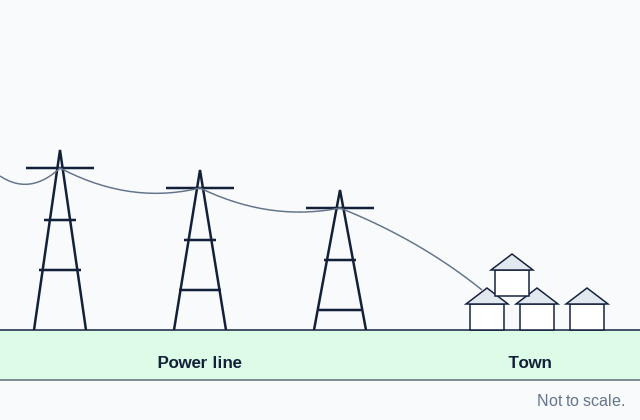
- It follows the energy from the fire in a power plant to the power lines.
- It ends with the methods used to extract fossil fuels and what one of them, hydraulic fracturing, can do to its surroundings.
Part 2 Learn it From the ground to the power line
2a. What burning is
The combustion of fossil fuels is a chemical reaction between the fuel and oxygen that yields carbon dioxide and water and releases energy.
Combustion is burning. Coal, oil and natural gas are made mostly of carbon and hydrogen. When one of them burns, it reacts with oxygen from the air. The carbon ends up in carbon dioxide gas, the hydrogen ends up in water, which leaves the flame as vapor, and the reaction releases energy as heat and light.
For natural gas, which is mostly methane, the reaction can be written in words:
methane + oxygen → carbon dioxide + water + energy
Two things follow. A fire needs a supply of oxygen; shut off the air and the burning stops. And burning does not make the fuel's carbon disappear: it leaves as carbon dioxide.
Quick check · Multiple choice
A made-up factory's furnace burns oil to heat the factory. Sensors compare the air going into the furnace with the gas coming out of its chimney. Which result best fits the reaction in the furnace?
2b. Heat, steam, turbine, generator
Energy from fossil fuels is produced by burning those fuels to generate heat, which then turns water into steam. That steam turns a turbine, which spins a generator, producing electricity.
Follow the energy through a plant:
- The fuel burns in a boiler, and the heat passes into water in pipes.
- The water boils into steam under high pressure.
- The steam rushes past the blades of a turbine, a wheel of blades on a shaft, and turns it.
- The turbine's shaft spins a generator, which turns that spinning into electricity.
The fuel only supplies heat. The steam does the turning, and the generator makes the electricity. Background: after the turbine, the steam is cooled back to water, often with water from a river, lake or cooling tower, and much of the fuel's heat leaves the plant that way rather than as electricity.
Quick check · Decide and justify
A made-up power plant stops burning coal and burns natural gas in the same boiler, with the same turbine and generator. A student says the plant still makes its electricity by turning water into steam. Is the student right?
Which reason supports your answer?
2c. Getting the fuel out
Humans use a variety of methods to extract fossil fuels from the earth for energy generation.
To extract a fuel is to take it out of the ground. The method depends on the fuel and on where it lies:
- Surface mining strips away the soil and rock above a coal seam that lies near the surface, then digs the coal.
- Subsurface mining digs shafts and tunnels to reach coal that lies deep underground.
- Drilling bores a well into rock that holds oil or natural gas, on land or from a platform at sea, and the fuel flows or is pumped up the well.
- Hydraulic fracturing (fracking) pumps water, sand and chemicals down a well under high pressure to crack rock such as shale and free the oil or gas held in it.
Extraction is only the first stage. Refining crude oil into fuels, and carrying fuel by pipeline, train or ship, come after it.
Quick check · Select all
A made-up energy company lists four projects. Which two extract a fossil fuel from the earth? Pick two.
Select 2 answers, then check.
2d. Fracking's effects
Hydraulic fracturing (fracking) can cause groundwater contamination and the release of volatile organic compounds.
- Groundwater is water held in the soil and in cracks and pores of rock underground, the water that wells and springs draw on. Fracking fluid and the salty, chemical-laden wastewater that comes back up the well can reach it, contaminating a well that a farm or a town uses.
- Volatile organic compounds (VOCs) are carbon-based chemicals that evaporate easily into the air at ordinary temperatures. They can escape from a fracked well, its storage tanks and its wastewater, and enter the air around the site.
Background: contamination is often traced to leaks, such as a cracked well lining or a spill at the surface, rather than to the cracks deep in the shale.
One effect lands in water underground; the other in the air.
Quick check · Sort it
Which effect of fracking does each made-up observation show? Tap a card, then its group.
Groundwater contamination
Release of volatile organic compounds
Part 3 Watch it done How much heat became electricity?
Open each step in turn, answer the why, then finish the calculation yourself.
In one hour, a made-up coal plant's boiler receives 7,200 gigajoules (GJ) of heat from burning coal. In the same hour its generator delivers 2,448 GJ of electricity. What percent of the heat became electricity?
Step 1 · Name the two amounts
The heat released by the burning coal is 7,200 GJ. The electricity delivered is 2,448 GJ. The heat is the whole; the electricity is the part.
Why this step?
Why does the heat have to pass through steam before any electricity is made?
The heat turns water into steam, the steam turns the turbine, and the turbine spins the generator, which produces the electricity. The fuel's heat cannot spin the generator on its own.
Step 2 · Set up the fraction
Divide the part by the whole, then multiply by 100: .
Your step · Calculate
Finish it. The plant turned 7,200 GJ of heat into 2,448 GJ of electricity. What percent of the heat became electricity?
%
Only 34% of this plant's heat became electricity; the rest left the plant, much of it in the water that cooled the steam. The rest of the lesson goes back to the start of the chain: how the fuel is taken from the ground.
Part 4 Try it Order the plant, then check an account
First put a made-up gas plant's steps in order. Then find where a student's account of a coal plant goes wrong.
Try it · Put it in order
Put the steps in a made-up natural gas power plant in order, first to last.
Try it · Spot the error
A student describes a day at a made-up coal plant. Tap the first line that goes wrong.
Part 5 Explain it More fuel, more heat?
Write your answer first. Nothing you type here leaves this page. Then compare it with the model and each scoring point.
Free response is 40% of the exam score. This one is shaped like Question 1, Design an investigation.
Free-response practice · Question 1 style
A class wants to test how the mass of a fossil fuel burned affects the amount of heat it releases. They have a supply of paraffin wax, a fuel made from crude oil, cut into blocks of different masses, a balance, a metal can, a measuring cylinder, a thermometer, a stand that holds the can a set height above the burning block, and water.
(a) Identify a testable hypothesis for the investigation.
(b) Identify the independent variable and the dependent variable.
(c) Describe one variable the class should keep the same for every trial, and why.
(d) Describe the results the class would expect if your hypothesis is correct.
(e) Explain how the results relate to the amount of carbon dioxide a power plant releases as it burns more fuel.
Model answer
(a) If a larger mass of paraffin is burned, then the water above it will warm more, because more fuel reacting with oxygen releases more energy.
(b) Independent variable: the mass of paraffin burned in each trial (for example 1, 2 and 3 grams, found by weighing the block before and after). Dependent variable: the rise in temperature of the water in the can.
(c) The volume of water in the can, such as 200 milliliters measured with the cylinder every time, because the same heat warms a larger volume of water less. (The height of the can above the flame, the same can and the starting water temperature also fit.)
(d) The water warms the most in the trial that burns the most paraffin, and the temperature rise grows as the mass burned grows.
(e) Combustion is a reaction between the fuel and oxygen that yields carbon dioxide and water as it releases energy. Burning more fuel releases more heat, as the trials show, and it also yields more carbon dioxide, so a plant that burns more fuel to make more steam and electricity releases more carbon dioxide.
Score your own answer. This is a self-check, not a grade. Tick each point your answer makes.
Part 6 Check yourself Wells near a gas field
The first two questions use the table.
A made-up county's water agency tests four groundwater wells around a new gas field, the year before fracking began and two years after. Each well is a different distance from the nearest fracked well. The chemical measured is one used in the fracking fluid, in micrograms per liter. The numbers are made up for practice.
| Well | Distance from nearest fracked well (km) | Before fracking | Two years after |
|---|---|---|---|
| Pine Road | 3.0 | 7 | 10 |
| Oak Farm | 0.4 | 6 | 41 |
| Fern Creek | 6.0 | 7 | 7 |
| Birch Lane | 1.5 | 8 | 21 |
Case question 1 · Multiple choice
Which statement do the data best support?
Case question 2 · Calculate
Using the table: by what percent did the chemical in the Birch Lane well rise from before fracking to two years after?
The rest stand on their own and do not use the case.
Check yourself · Fill the statement
Complete the account of a made-up gas company.
To free gas held in shale a mile down, the company uses , and families nearby ask for their wells to be tested because the method can contaminate .
Check yourself · Match
Match each made-up scene to what it shows.
Part 7 Keep it Bring back earlier ideas
Two questions from earlier topics: sorting explanations of where resources lie, and a student's account of a country's energy use.
First sort made-up explanations of where resources lie. Then find where a student's account of a country's resources goes wrong.
From 6.4 Distribution of Natural Energy Resources · Sort it
Does each made-up explanation of where a resource lies rest on the region's geologic history? Tap a card, then its group.
Rests on geologic history
Does not
First match made-up observations to the trend each one shows. Then find where a student's account of a country's development goes wrong.
From 6.2 Global Energy Consumption · Spot the error
A student describes how a made-up country's energy use changed over 40 years. Tap the first line that goes wrong.
In three lines
- Burning a fossil fuel is a reaction with oxygen that yields carbon dioxide and water and releases energy.
- In a power plant the heat turns water into steam, the steam turns a turbine, and the turbine spins a generator that produces electricity.
- Fossil fuels are extracted by a variety of methods, and fracking can cause groundwater contamination and the release of volatile organic compounds.
Exam strategy for this topic
- Section I, Multiple Choice: 80 questions in 90 minutes.
- Section II, Free Response: 3 questions in 70 minutes.
- This lesson's Explain it is shaped like free-response question 1, Design an investigation.
- A four-function, scientific, or graphing calculator is allowed on both sections of the exam.
When a question asks how a fossil fuel plant makes electricity, name every step: burning, heat, steam, turbine, generator. When it asks about fracking, name groundwater contamination or the release of volatile organic compounds.
Questions students ask
What does burning a fossil fuel produce?
Combustion is a reaction between the fuel and oxygen that yields carbon dioxide and water and releases energy.
How does a fossil fuel power plant make electricity?
Burning the fuel generates heat that turns water into steam. The steam turns a turbine, which spins a generator, producing electricity.
What environmental problems can fracking cause?
Hydraulic fracturing can cause groundwater contamination and the release of volatile organic compounds.
Course alignment, for teachers
AP Environmental Science topic 6.5, Unit 6: Energy Resources and Consumption.
- Skill 7.A: Describe environmental problems.
This lesson maps all 4 essential knowledge statements of the topic to the part that teaches each one: 4 are checked by a scored question. The map is in the lesson file.