Unit 1 · Topic 1.6 · about 30 minutes · 7 parts · 10 scored checks, 2 of them multiple choice, plus 2 from earlier lessons
AP Environmental Science 1.6: The Phosphorus Cycle
Unit 1: 6 to 8% of the multiple-choice section
What you'll be able to do
- Explain the steps of the phosphorus cycle and how its reservoirs interact, including why phosphorus is so often a limiting nutrient.
Key vocabulary
| Term | What it means | The exam trap |
|---|---|---|
| Phosphorus cycle | The movement of atoms and molecules containing phosphorus between sources and sinks. | Trace each move with what carries the phosphorus: water, soil, organisms or slow geologic change. |
| Weathering | The slow breakdown of rock by rain, frost and other forces, which releases minerals into soil and water. | Weathering is slow, so read the time scale a question asks about. |
| Runoff | Water that flows over the land into streams, rivers and lakes, carrying what it picks up along the way. | Ask what the land upstream holds, since runoff carries it. |
| Sediment | Particles that settle to the bottom of a body of water and build up over time. | Sediments hold phosphorus for very long times, so they act as a sink, not a quick source. |
| Limiting nutrient | The nutrient in shortest supply, so that adding it lets producers grow more while adding others does not. | Different ecosystems can be limited by different nutrients, so use the data a question gives. |
 Tap to open the picture full size
Part 1 Think first The green patches on a bird island
Commit to a guess first. Being wrong now makes the right idea stick better.
Predict first
On a rocky island, thousands of seabirds nest together every summer. They feed on fish they catch in the ocean. The plants growing around the nests are much greener and taller than plants elsewhere on the island. What do you predict explains this?
In short. The phosphorus cycle is the movement of atoms and molecules containing phosphorus between sources and sinks, mostly through rock, soil, water, living things and ocean sediments.
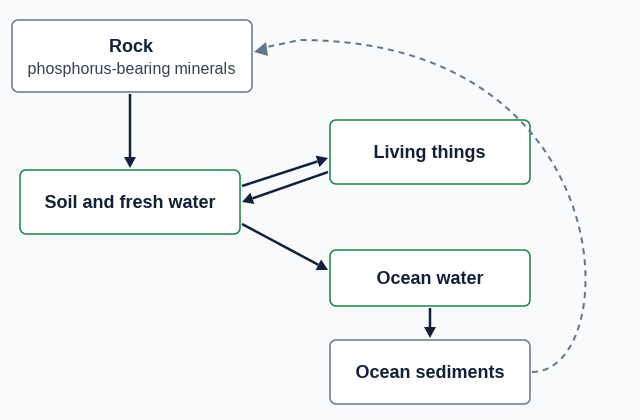
- The major reservoirs of phosphorus are rock and ocean sediments that contain phosphorus-bearing minerals.
- The phosphorus cycle lacks a significant atmospheric component.
- Rocks weather slowly, so phosphorus is relatively scarce in ecosystems and is often a limiting nutrient for producers, particularly in freshwater and some terrestrial ecosystems.
Part 2 Learn it The phosphorus cycle
2a. From rock and back to rock
The phosphorus cycle is the movement of atoms and molecules containing the element phosphorus between sources and sinks. Living things need phosphorus for DNA, for the molecules that carry energy in cells, and, in animals, for bones and teeth.
The major reservoirs of phosphorus are rock and ocean sediments that contain phosphorus-bearing minerals. The cycle runs like this:
- Weathering: rain and other forces slowly break down rock, releasing phosphate into soil and water.
- Uptake: plants and algae take up phosphate, and animals get phosphorus by eating them.
- Decomposition: decomposers return the phosphorus in wastes and dead organisms to the soil as phosphate.
- Runoff: water carries phosphate from the land into rivers, lakes and the ocean.
- Sedimentation: in the ocean, phosphorus settles to the bottom and becomes part of the sediments.
Over millions of years, ocean sediments can become rock, and geologic uplift can raise that rock above the sea, where weathering starts the cycle again.
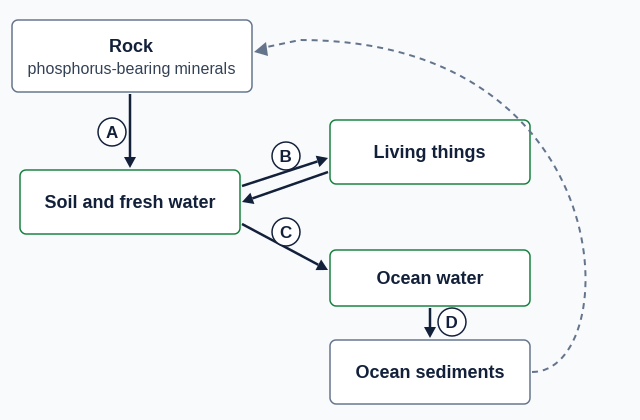
Quick check · Match
Use the drawing of the phosphorus reservoirs with lettered arrows. Match each lettered arrow to the process that moves phosphorus that way.
2b. No real path through the air
Carbon and nitrogen both have gases, carbon dioxide and nitrogen gas, so both can move through the atmosphere. The phosphorus cycle lacks a significant atmospheric component. Phosphorus forms no common gas, so almost none of it travels through the air. Only small amounts are carried on wind-blown dust.
That changes how phosphorus moves. It travels with water, downhill and downstream, in soil, and in living things that move, such as fish swimming upstream or seabirds that feed at sea and nest on land. Phosphorus that washes off a field into the ocean does not come back on the wind or in the rain.
It also means there is no air supply to draw on. A field short of nitrogen can gain nitrogen from bacteria that fix it from the air. A field short of phosphorus can gain it only from slow weathering of rock, from wastes and dead matter, or from fertilizer.
Quick check · Decide and justify
A field has lost much of its soil phosphorus to runoff. A student says that, as with nitrogen, bacteria in the soil will gradually replace it by pulling phosphorus from the air. Is the student right?
Which reason supports your answer?
2c. Scarce, and so often limiting
Phosphorus is relatively scarce in ecosystems because rocks weather slowly. New phosphate trickles out of rock over thousands of years, and phosphorus carried to the ocean floor is out of reach for millions of years.
As a result, phosphorus is often a limiting nutrient for plants and other producers, particularly in freshwater and some terrestrial ecosystems. Recall from the nitrogen cycle that a limiting nutrient is the one in shortest supply: adding it lets producers grow more, and adding a nutrient that is already plentiful does not.
In a lake whose algae are limited by phosphorus, a small amount of phosphate washing in from fertilized lawns, farm fields or animal waste can make the algae grow far faster. Adding nitrogen to the same lake changes little, because the algae already have more nitrogen than the phosphorus lets them use.
Quick check · Rank it
The algae in a lake are limited by phosphorus, and tests show the water already holds far more nitrate than the algae can use. A student fills three jars with the lake's water and algae, adds phosphate to one, nitrate to another and nothing to the third, and sets them all in the same light. Rank the jars by how much the algae will grow in two weeks.
Most algae growth first
Give each one a place, 1 for first. Give two the same place if they are equal.
Your ranking: none yet
Part 3 Watch it done A phosphorus atom's long road
Open each step in turn, answer the why, then finish the trip yourself.
A phosphorus atom sits in a phosphorus-bearing mineral in a mountain's rock. Trace it into a deer and on toward the sea, naming each move.
Step 1 · Out of the rock
Rain and frost slowly break the rock down. Weathering releases the atom into the soil as phosphate. This can take thousands of years.
Step 2 · Into living things
A clover plant's roots take up the phosphate, and a deer eats the clover. The atom is now in the deer, perhaps in a bone.
Step 3 · Back to the soil
The deer dies, and decomposers break its body down, returning the phosphate to the soil.
Why this step?
Why can't the atom take a shortcut through the air to reach the sea?
Phosphorus forms no common gas. The phosphorus cycle lacks a significant atmospheric component, so the atom has to travel with water, soil or living things.
Your step · Put it in order
Finish it. A phosphorus atom has just been returned to a mountain's soil as phosphate by decomposers. Put the rest of its trip in order.
Part 4 Try it Fast moves and slow moves
Some moves in the phosphorus cycle take days and some take millions of years. Sort them first, then decide why phosphorus runs short.
Try it · Sort it
Each card is one move in the phosphorus cycle. Tap a card, then how long that move usually takes.
Days to years
Thousands to millions of years
Try it · Multiple choice
Which fact best explains why phosphorus is relatively scarce in ecosystems?
Part 5 Explain it Read a lake's records
Write your answer first. Nothing you type here leaves this page. Then compare it with the model and each scoring point.
Free response is 40% of the exam score. This one is shaped like Question 2, Analyze and interpret quantitative data.
Free-response practice · Question 2 style
Suppose a town measures phosphate and algae in a small lake each summer for eight years. In year 3, a new housing development begins draining runoff from fertilized lawns into the lake. At the start of year 6, the runoff is redirected away from the lake. The numbers below are made up for practice.
- Phosphate, micrograms per liter, years 1 to 8: 10, 12, 30, 45, 44, 38, 30, 24
- Algae, micrograms of chlorophyll per liter, years 1 to 8: 3, 4, 14, 22, 21, 17, 13, 10
(a) Identify the year with the most algae.
(b) Describe the relationship between phosphate and algae in the data.
(c) Explain why adding phosphate had such a large effect on the algae in this lake.
(d) In some lakes, extra nitrogen can leave the lake as a gas. Explain why the extra phosphate cannot leave this lake the same way.
Model answer
(a) Year 4, with 22 micrograms of chlorophyll per liter.
(b) The two rise and fall together. When phosphate rose from 12 to 45 micrograms per liter between years 2 and 4, algae rose from 4 to 22, and as phosphate fell from 44 to 24 between years 5 and 8, algae fell from 21 to 10.
(c) Phosphorus is relatively scarce in ecosystems because rocks weather slowly, and it is often the limiting nutrient for producers in freshwater. Here the lake's algae were limited by phosphorus, so adding it let them grow much faster.
(d) The phosphorus cycle lacks a significant atmospheric component. Phosphorus forms no common gas, so it stays in the water and sediments or flows out downstream, rather than escaping to the air.
Score your own answer. This is a self-check, not a grade. Tick each point your answer makes.
Part 6 Check yourself Phosphate along a stream
The first two questions use the table.
Suppose students measure phosphate at four points along one stream, from its source in a forest to the lake it flows into. The numbers below are made up for practice.
| Point | What the stream has just passed | Phosphate (micrograms per liter) |
|---|---|---|
| 1 | Forest at the stream's source | 5 |
| 2 | A cattle pasture | 40 |
| 3 | Cornfields treated with fertilizer | 60 |
| 4 | The inlet of a lake | 55 |
Case question 1 · Multiple choice
Using the table of the stream: what most likely added the phosphate between point 1 and point 3?
Case question 2 · Decide and justify
The lake at point 4 in the table had clear water before the farms were built. A student predicts that its algae will now grow more than they used to. Is the student's prediction reasonable?
Which reason supports your answer?
The rest stand on their own and do not use the case.
Check yourself · Fill the statement
Follow the phosphate that washes off a farm field in a storm. Tap a blank, then an answer.
The phosphate travels down rivers to the , settles to the bottom, and becomes part of the , a major reservoir that holds it for millions of years. It does not come back to the field as a gas, since the phosphorus cycle lacks a significant component.
Check yourself · Spot the error
A student explains why a farm field will never run short of phosphorus. Tap the first line that goes wrong.
Part 7 Keep it Bring back earlier ideas
Two questions from earlier topics: the steps of the nitrogen cycle, and what decides where fish are found.
Before you answer, say what form the nitrogen is in at the start and at the end of each move.
From 1.5 The Nitrogen Cycle · Sort it
Each card describes a step in a meadow's nitrogen cycle. Tap a card, then what it does to the nitrogen compounds plants can take up from the soil.
Adds them to the soil
Removes them from the soil
Suppose researchers set the same nets at five sites along one coast and count one species of fish. The numbers below are made up for practice.
| Site | Site depth (m) | Salinity (parts per thousand) | Water temperature (°C) | Depth light reaches (m) | Fish caught per net |
|---|---|---|---|---|---|
| A | 60 | 34 | 18 | 20 | 42 |
| B | 55 | 35 | 17 | 19 | 39 |
| C | 58 | 34 | 18 | 3 | 6 |
| D | 62 | 35 | 26 | 20 | 4 |
| E | 57 | 33 | 17 | 18 | 40 |
From 1.3 Aquatic Biomes · Multiple choice
Using the table of five coastal sites: which condition best explains why so few fish were caught at Site C?
In three lines
- The phosphorus cycle moves phosphorus between sources and sinks: weathering, uptake by producers, decomposition, runoff and sedimentation.
- Its major reservoirs are rock and ocean sediments with phosphorus-bearing minerals, and it lacks a significant atmospheric component.
- Rocks weather slowly, so phosphorus is relatively scarce and often limits producers, particularly in freshwater and some terrestrial ecosystems.
Exam strategy for this topic
- Section I, Multiple Choice: 80 questions in 90 minutes.
- Section II, Free Response: 3 questions in 70 minutes.
- This lesson's Explain it is shaped like free-response question 2, Analyze and interpret quantitative data.
- A four-function, scientific, or graphing calculator is allowed on both sections of the exam.
When a question asks why a nutrient affects algae or plants, name the limiting nutrient, say where it comes from in its cycle, and connect a change in that supply to a change in growth.
Questions students ask
What are the major reservoirs in the phosphorus cycle?
Rock and ocean sediments that contain phosphorus-bearing minerals.
Does phosphorus cycle through the atmosphere?
No. The phosphorus cycle lacks a significant atmospheric component. Phosphorus moves through rock, soil, water and living things.
Why is phosphorus often a limiting nutrient?
Phosphorus is relatively scarce in ecosystems because rocks weather slowly, so it often limits plants and other producers, particularly in freshwater and some terrestrial ecosystems.
How does phosphorus get from land to the ocean?
Runoff washes phosphate from soil into streams and rivers, which carry it to the ocean, where it settles into the sediments.
How is the phosphorus cycle different from the nitrogen cycle?
Nitrogen's largest reservoir is the atmosphere, and bacteria fix it from the air. Phosphorus's major reservoirs are rock and ocean sediments, and it has no significant atmospheric component.
Course alignment, for teachers
AP Environmental Science topic 1.6, Unit 1: The Living World: Ecosystems.
- Skill 2.B: Explain relationships between different characteristics of environmental concepts, processes, or models represented visually:
This lesson maps all 3 essential knowledge statements of the topic to the part that teaches each one: 3 are checked by a scored question. The map is in the lesson file.