Unit 5 · Topic 5.15 · about 30 minutes · 7 parts · 11 scored checks, 2 of them multiple choice, plus 2 from earlier lessons
AP Environmental Science 5.15: Sustainable Agriculture
Unit 5: 10 to 15% of the multiple-choice section
What you'll be able to do
- Describe sustainable agricultural and food production practices.
Key vocabulary
| Term | What it means | The exam trap |
|---|---|---|
| Soil erosion | Soil worn away and carried off by water or wind. | Topsoil can be lost much faster than it forms. |
| Soil fertility | The soil's ability to supply what plants need to grow. | Soil that stays in place can still lose its fertility. |
| Overgrazing | Livestock eating plants faster than the plants can regrow. | It harms the soil as well as the plants. |
 Tap to open the picture full size
Part 1 Think first Rows down the hill
Commit to a guess first. Being wrong now makes the right idea stick better.
Predict first
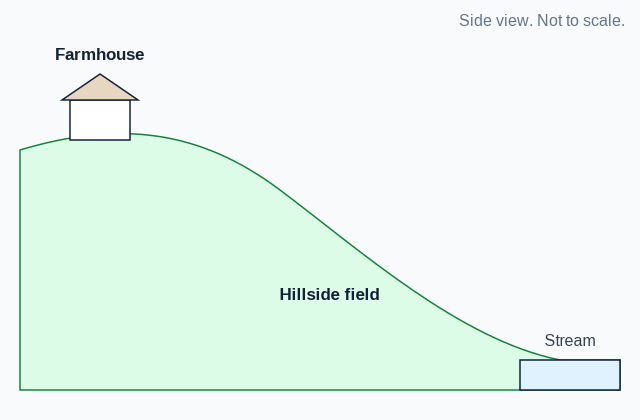
A made-up farmer plows her hillside field in straight rows that run up and down the slope. After every heavy storm, gullies cut down the rows and soil piles up at the bottom of the hill. This year she plows each row across the slope instead, following the hill's curves at one height. What do you predict happens to the rain in the next heavy storm?
In short. Sustainable agriculture keeps soil in place and fertile: soil conservation prevents erosion, other practices restore nutrients, and rotational grazing protects pastures.
- Soil conservation methods include contour plowing, windbreaks, perennial crops, terracing, no-till agriculture and strip cropping.
- Crop rotation and adding green manure and limestone improve soil fertility.
- Rotational grazing moves livestock regularly between pastures to avoid overgrazing any one of them.
Part 2 Learn it Farming so the soil lasts
2a. Keeping soil on a slope
The goal of soil conservation is to prevent soil erosion. Erosion is soil worn away and carried off by water or wind. Background: topsoil lost in a season can take centuries to rebuild.
Different methods of soil conservation include contour plowing, windbreaks, perennial crops, terracing, no-till agriculture, and strip cropping. Three of them work on slopes:
- Contour plowing: plowing and planting across a slope, along lines that stay at one height, so each row slows the water running downhill.
- Terracing: cutting a steep slope into a series of flat steps, so water stands and soaks in on each step instead of running down the whole hill.
- Strip cropping: planting alternating strips of a row crop, such as corn, and a thick, close-growing crop, such as hay, across a slope; background: the thick strips slow the water and catch soil washing off the row-crop strips.
Quick check · Multiple choice
A made-up farmer grows rice on a mountainside so steep that rain sweeps the soil straight downhill. Which practice best fits her field?
2b. Wind, roots and stubble
The other three methods keep the ground covered or sheltered.
- Windbreaks: rows of trees or shrubs planted along the edges of fields. They slow the wind blowing across the field, so less dry topsoil is lifted and blown away.
- Perennial crops: crops that live and produce for many years without replanting, such as alfalfa, fruit trees or some grasses. Background: their roots hold the soil all year, and the field is never left bare between plantings.
- No-till agriculture: planting seeds straight into the stubble of the last crop without plowing. Background: the soil is never turned over and left bare, and the stubble shields it from rain and wind.
Quick check · Decide and justify
On a dry, flat plain, a made-up grower lets a thick hedge of shrubs grow along the side of her melon field that faces the usual wind. A neighbor says the hedge is a soil conservation method. Is the neighbor right?
Which reason supports your answer?
2c. Keeping soil fertile
Soil that stays put can still wear out. Soil fertility is the soil's ability to supply what plants need to grow. Strategies to improve soil fertility include crop rotation and the addition of green manure and limestone.
- Crop rotation: growing a different crop in a field from one season or year to the next. Background: different crops take different nutrients, and some, such as beans and clover, add nitrogen.
- Green manure: a crop, such as clover, grown and then plowed back into the soil, where it breaks down and adds nutrients and organic matter.
- Limestone: crushed rock spread on a field. Background: it makes acidic soil less acidic, which lets plants take up nutrients more easily.
Quick check · Select all
After years of growing corn on the same field, a made-up farmer's harvests are shrinking as the soil wears out. Which two practices would improve the soil's fertility? Pick two.
Select 2 answers, then check.
2d. Moving the herd
Pastures need care too. Overgrazing is livestock eating plants faster than they can regrow.
Rotational grazing is the regular rotation of livestock between different pastures in order to avoid overgrazing in a particular area. A rancher divides the land into several pastures and moves the herd on a schedule. Background: while the herd grazes one pasture, the others rest and regrow, so no single pasture is eaten down to bare, eroding ground.
Quick check · Rank it
Three made-up ranches each keep 200 cattle on the same total area of grassland. Rank them by how likely their grassland is to be overgrazed.
Most likely overgrazed first
Give each one a place, 1 for first. Give two the same place if they are equal.
Your ranking: none yet
Part 3 Watch it done How much soil does no-till save?
Open each step in turn, answer the why, then finish the calculation yourself.
A made-up field loses 16 metric tons of soil per hectare each year when it is plowed before every planting. Farmed with no-till agriculture, it loses 3.2 metric tons per hectare each year. By what percent does no-till reduce the soil lost?
Step 1 · Find the soil saved
metric tons per hectare each year.
Why this step?
Why does the field lose less soil without plowing?
Without plowing, the soil is never turned over and left bare, and the last crop's stubble shields it from rain and wind.
Step 2 · Set up the percent
.
Your step · Calculate
Finish it. No-till saves 12.8 of the 16 metric tons per hectare the plowed field lost each year. By what percent does no-till reduce the soil lost?
%
Four fifths of the soil that plowing lost stays on the field. Over ten years that is 128 metric tons per hectare of topsoil kept in place.
Part 4 Try it Match the methods, then check an account
First match each made-up farm scene to the soil conservation method it shows. Then find where a student's account of strip cropping goes wrong.
Try it · Match
Match each made-up farm scene to the soil conservation method it shows.
Try it · Spot the error
A student explains how strip cropping protects a made-up hillside field. Tap the first line that goes wrong.
Part 5 Explain it Does green manure pay?
Write your answer first. Nothing you type here leaves this page. Then compare it with the model and each scoring point.
Free response is 40% of the exam score. This one is shaped like Question 1, Design an investigation.
Free-response practice · Question 1 style
A made-up farmer's corn harvests have fallen on a field with worn-out soil. A student wants to find out whether adding green manure would improve the field's fertility. The farmer offers eight equal plots on the same field, clover seed, and a scale to weigh the corn harvested from each plot.
(a) Identify a testable hypothesis for the investigation.
(b) Identify the independent variable and the dependent variable.
(c) Describe how the student should treat the plots, including how many get each treatment and what is kept the same.
(d) Describe how the student could measure the dependent variable.
(e) Describe the results that would support the hypothesis, and make a claim about what the farmer should do with the whole field, explaining how it would help.
Model answer
(a) If clover is grown and plowed into the soil as green manure, then the corn grown afterward will yield more than corn on plots without it.
(b) Independent variable: whether the plot gets green manure. Dependent variable: the mass of corn harvested from each plot.
(c) In four plots, grow clover and plow it into the soil before planting; leave the other four plots bare over the same season. Then plant the same corn variety on all eight on the same day, with the same water and no other fertilizer.
(d) Harvest each plot separately at the end of the season and weigh the corn from it on the scale.
(e) The green-manure plots yield more corn than the others. The farmer should grow clover and plow it into the whole field before planting corn: the clover breaks down in the soil and adds nutrients and organic matter, improving soil fertility.
Score your own answer. This is a self-check, not a grade. Tick each point your answer makes.
Part 6 Check yourself Soil lost on a slope
The first two questions use the table.
A made-up research farm grows the same corn on four plots of the same gentle slope and soil, each farmed a different way, and measures the soil lost in a year. Building terraces costs far more than the other practices. The numbers are made up for practice.
| Practice | Soil lost (metric tons per hectare per year) |
|---|---|
| Rows plowed up and down the slope | 20 |
| Contour plowing | 11 |
| Contour plowing with strip cropping | 7 |
| Terracing | 2 |
Case question 1 · Multiple choice
A farmer on a slope like this one wants to cut her soil loss by more than half without the cost of building terraces. Using the table, which claim proposes the best practice for her?
Case question 2 · Calculate
Using the table: by what percent does contour plowing with strip cropping reduce the soil lost, compared with rows plowed up and down the slope?
The rest stand on their own and do not use the case.
Check yourself · Sort it
What is each made-up practice mainly for? Tap a card, then its group.
Preventing soil erosion
Improving soil fertility
Check yourself · Fill the statement
Complete the description of rotational grazing.
A rancher using rotational grazing moves the herd between different pastures, so that no one pasture is .
Part 7 Keep it Bring back earlier ideas
Two questions from earlier topics: which practices fit integrated pest management, and a student's account of two indicators.
First sort farm practices into those that fit integrated pest management and those that do not. Then find where a student's account of an orchard goes wrong.
From 5.14 Integrated Pest Management · Sort it
Does each made-up practice fit integrated pest management? Tap a card, then its group.
Fits IPM
Does not fit IPM
First match each made-up measurement to the indicator it tracks. Then find where a student's account of two indicators goes wrong.
From 5.12 Introduction to Sustainability · Spot the error
A student explains what two indicators show. Tap the first line that goes wrong.
In three lines
- The goal of soil conservation is to prevent soil erosion, through contour plowing, windbreaks, perennial crops, terracing, no-till agriculture and strip cropping.
- Crop rotation and the addition of green manure and limestone improve soil fertility.
- Rotational grazing moves livestock regularly between pastures to avoid overgrazing in any one area.
Exam strategy for this topic
- Section I, Multiple Choice: 80 questions in 90 minutes.
- Section II, Free Response: 3 questions in 70 minutes.
- This lesson's Explain it is shaped like free-response question 1, Design an investigation.
- A four-function, scientific, or graphing calculator is allowed on both sections of the exam.
When a question asks you to propose a sustainable farming practice, match it to the problem: soil washing or blowing away calls for a soil conservation method, worn-out soil for crop rotation, green manure or limestone, and an eaten-down pasture for rotational grazing. Then say how the practice works.
Questions students ask
What are the methods of soil conservation?
Contour plowing, windbreaks, perennial crops, terracing, no-till agriculture and strip cropping. Their goal is to prevent soil erosion.
How can a farmer improve soil fertility?
By crop rotation and by adding green manure and limestone.
What is rotational grazing?
The regular rotation of livestock between different pastures in order to avoid overgrazing in a particular area.
Course alignment, for teachers
AP Environmental Science topic 5.15, Unit 5: Land and Water Use.
- Skill 7.E: Make a claim that proposes a solution to an environmental problem in an applied context.
This lesson maps all 3 essential knowledge statements of the topic to the part that teaches each one: 3 are checked by a scored question. The map is in the lesson file.