Unit 9 · Topic 9.1 · about 30 minutes · 7 parts · 10 scored checks, 2 of them multiple choice, plus 2 from earlier lessons
AP Environmental Science 9.1: Stratospheric Ozone Depletion
Unit 9: 15 to 20% of the multiple-choice section
What you'll be able to do
- Explain the importance of stratospheric ozone to life on Earth.
Key vocabulary
| Term | What it means | The exam trap |
|---|---|---|
| Stratosphere | The layer of the atmosphere above the troposphere, the layer people live in. | Weather and smog are in the troposphere, below the stratosphere. |
| Ozone layer | The ozone gas spread through the stratosphere, high above the ground. | The layer is a thin spread of gas mixed with air, not a solid shell. |
| CFCs (chlorofluorocarbons) | Gases made by people and once widely used, for example to cool refrigerators. | CFCs are not ozone; they are a separate gas that reaches the ozone layer. |
| UV rays | Ultraviolet rays, a kind of sunlight that people cannot see. | UV is not felt as heat, so a cool day can still bring strong UV. |
| Anthropogenic | Caused by people. | Anthropogenic describes where a cause comes from, not how large it is. |
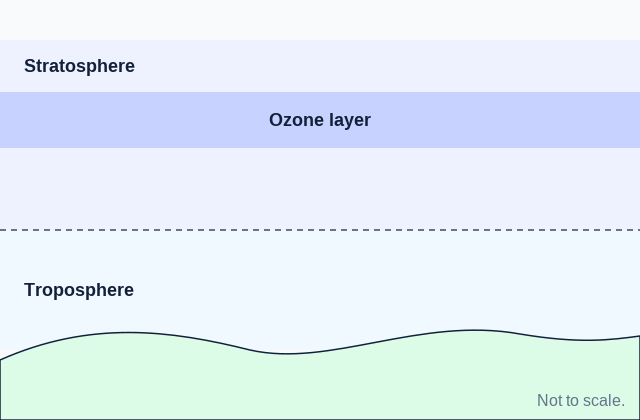 Tap to open the picture full size
Part 1 Think first A yearly thinning
Commit to a guess first. Being wrong now makes the right idea stick better.
Predict first
Each year the ozone layer high above Antarctica thins over a few weeks. In which Antarctic season do you predict that thinning begins?
In short. Stratospheric ozone depletion is the thinning of the ozone layer that sits high in the atmosphere, in the stratosphere.
- The stratospheric ozone layer matters to life on Earth, both to how life evolved and to its health and survival now.
- Human-made chemicals such as CFCs thin the layer, and so do natural factors.
- Less stratospheric ozone lets more UV rays reach the surface, and UV exposure can lead to skin cancer and cataracts.
Part 2 Learn it A thin layer that life depends on
2a. Why ozone high up matters
Ozone is a gas. Near the ground, in the troposphere where people live and breathe, it is a pollutant in smog. Higher up, in the stratosphere, the layer of the atmosphere above the troposphere, ozone forms the ozone layer, and there it does a different job.
The stratospheric ozone layer is important to the evolution of life on Earth and to the continued health and survival of life on Earth. Life evolved beneath this layer over a very long time, and the plants, animals and people alive now still depend on it.
What the layer does is cut the UV rays (ultraviolet rays, a kind of sunlight people cannot see) that reach the ground. A decrease in stratospheric ozone increases the UV rays that reach Earth's surface. So where the layer is thinner, more UV gets through to the living things below.
For example, a made-up science station on a mountain records higher UV readings at noon in the weeks when the ozone above it is thinner.
Quick check · Multiple choice
A student writes that the ozone layer is too high above the ground to matter to living things. Which statement corrects the student?
2b. What thins the layer
Stratospheric ozone depletion is caused by anthropogenic factors and by natural factors. Anthropogenic means caused by people.
One anthropogenic factor is chlorofluorocarbons (CFCs), gases that people made and once used widely, for example to cool refrigerators and to push paint out of spray cans. CFCs released near the ground spread slowly upward until they reach the stratosphere, where they thin the ozone layer.
One natural factor is the melting of ice crystals in the atmosphere at the beginning of the Antarctic spring. That is why the thinning you guessed about in Think first starts when it does: the melting of those ice crystals as spring begins is one of the things that thins the ozone above Antarctica.
For example, a made-up repair shop that let the CFC coolant from old air conditioners escape into the air was adding to the anthropogenic side of the problem.
Quick check · Decide and justify
A made-up appliance company says the CFCs that leaked from its old refrigerators did the ozone layer no harm, since ozone loss is a natural event. Is the company right?
Which reason supports your answer?
2c. More UV, more harm to people
When the ozone layer thins and more UV reaches the ground, people outdoors are exposed to more of it. Exposure to UV rays can lead to skin cancer and cataracts in humans. A cataract is a clouding of the lens of the eye that blurs sight.
The harm builds up with exposure: the more UV a person's skin and eyes take in over the years, the greater the risk.
For example, a made-up eye clinic in a sunny mountain town sees more patients with cataracts after years in which the ozone overhead ran thin.
Quick check · Select all
The ozone layer over a made-up region of farms thins for several weeks one year. Which two statements about those weeks are correct? Pick two.
Select 2 answers, then check.
Part 3 Watch it done How much did the ozone fall?
Open each step in turn, answer the why, then finish the calculation yourself.
A made-up station measures the ozone above it in Dobson units (DU), a unit for how much ozone is in the air above a spot. One year it read 280 DU in August and 112 DU in October. By what percent did the ozone fall? The numbers are made up for practice.
Step 1 · Find the drop
DU.
Why this step?
Why divide the drop by the August reading and not the October one?
A percent decrease compares the drop with where the ozone started, and it started at the August reading.
Step 2 · Divide and change to a percent
Divide the drop by the August reading, then multiply by 100.
Your step · Calculate
Finish it. The ozone above the station fell by 168 DU from 280 DU. By what percent did it fall? Round to the nearest whole percent.
%
A 60% decrease. With that much less ozone overhead, more UV reaches the ground below the station.
Part 4 Try it Name two causes, then check an account
First complete two sentences about causes of ozone loss. Then find where a student's account of a made-up town goes wrong.
Try it · Fill the statement
Complete the two sentences about causes of ozone depletion.
Leaks of CFCs from old refrigerators are causes of ozone depletion. Ice crystals melting in the atmosphere at the beginning of the Antarctic spring are causes.
Try it · Spot the error
A student describes a made-up town. Tap the first line that goes wrong.
Part 5 Explain it A model of the ozone layer
Write your answer first. Nothing you type here leaves this page. Then compare it with the model and each scoring point.
Free response is 40% of the exam score. This one is shaped like Question 1, Design an investigation.
Free-response practice · Question 1 style
A student wants to model the ozone layer with sheets of a clear plastic film that blocks some UV rays. Beads that turn from white to purple in UV light, darker with more UV, will be placed under 0, 1, 2, 3 or 4 sheets of the film beneath a UV lamp. The student will rate each bead's color on a scale from 0 (white) to 5 (darkest purple).
(a) Identify a testable hypothesis for the investigation.
(b) Identify the independent variable and the dependent variable.
(c) Identify one variable that should be kept the same for every bead.
(d) Describe one way to make the results more reliable.
(e) In the model, fewer sheets stand for a thinner ozone layer. Explain what the model suggests about the health of people living under a thinning ozone layer.
Model answer
(a) If fewer sheets of film cover a bead, then the bead will turn a darker purple under the UV lamp.
(b) Independent variable: the number of sheets of film over the bead. Dependent variable: the bead's color rating from 0 to 5.
(c) The time each bead spends under the lamp. (The distance from the lamp, the kind of bead, or the same lamp for every trial also fit.)
(d) Test several new beads at each number of sheets, or repeat the whole test, and average the ratings.
(e) Fewer sheets let more UV reach the beads, as a thinner ozone layer lets more UV reach Earth's surface. People under a thinning layer would be exposed to more UV, which can lead to skin cancer and cataracts.
Score your own answer. This is a self-check, not a grade. Tick each point your answer makes.
Part 6 Check yourself Four towns on one clear day
The first two questions use the table.
A made-up team measures two things in four towns at about the same latitude, at noon on the same clear day: the ozone in the air above each town, in Dobson units (DU), and the UV index, a number that is higher when more UV reaches the ground. The numbers are made up for practice.
| Town | Ozone (DU) | UV index |
|---|---|---|
| W | 310 | 4 |
| X | 190 | 8 |
| Y | 260 | 6 |
| Z | 140 | 10 |
Case question 1 · Multiple choice
Which statement describes the data in the table?
Case question 2 · Calculate
Using the table: how many times as high was town Z's UV index as town W's? Round to the nearest tenth.
The rest stand on their own and do not use the case.
Check yourself · Put it in order
Put the events of a made-up story about spray paint in order, first to last.
Check yourself · Match
Match each term to the made-up example that fits it.
Part 7 Keep it Bring back earlier ideas
Two questions from earlier topics, to bring them back before they fade.
First complete an account of two made-up outbreaks. Then find where a student's account of a neighborhood goes wrong.
From 8.15 Pathogens and Infectious Diseases · Fill the statement
Complete the account of two made-up outbreaks.
Families in a low-income district with no sanitary waste disposal drink from a stream that carries waste, and the district becomes a haven for , a bacterial disease caught from infected water. Far to the north, milder winters let infected mosquitoes bring virus into towns where it was never known before.
First complete an account of a made-up test. Then find where a student's reading of a curve goes wrong.
From 8.13 Dose Response Curve · Spot the error
A student reads a made-up dose response curve for a weed killer on tadpoles. Tap the first line that goes wrong.
In three lines
- The stratospheric ozone layer matters to the evolution of life and to its health and survival today.
- CFCs made by people thin it, and so does the melting of ice crystals in the atmosphere at the start of the Antarctic spring.
- Less stratospheric ozone means more UV at the surface, and UV exposure can lead to skin cancer and cataracts.
Exam strategy for this topic
- Section I, Multiple Choice: 80 questions in 90 minutes.
- Section II, Free Response: 3 questions in 70 minutes.
- This lesson's Explain it is shaped like free-response question 1, Design an investigation.
- A four-function, scientific, or graphing calculator is allowed on both sections of the exam.
When a question names stratospheric ozone, link a thinner layer to more UV at the surface and more UV to skin cancer and cataracts; when it asks for causes, give an anthropogenic one such as CFCs and a natural one.
Questions students ask
Why is the stratospheric ozone layer important?
It is important to the evolution of life on Earth and to the continued health and survival of life on Earth. Less of it lets more UV reach the surface.
What causes stratospheric ozone depletion?
Anthropogenic factors, such as CFCs, and natural factors, such as the melting of ice crystals in the atmosphere at the beginning of the Antarctic spring.
What does more UV do to people?
Exposure to UV rays can lead to skin cancer and cataracts in humans.
Is ozone good or bad?
It depends on the layer. In the stratosphere the ozone layer matters to life; near the ground, in the troposphere, ozone is a pollutant in smog.
Course alignment, for teachers
AP Environmental Science topic 9.1, Unit 9: Global Change.
- Skill 1.A: Describe environmental concepts and processes.
This lesson maps all 3 essential knowledge statements of the topic to the part that teaches each one: 3 are checked by a scored question. The map is in the lesson file.