Unit 1 · Topic 1.10 · about 30 minutes · 7 parts · 14 scored checks, 2 of them multiple choice, plus 2 from earlier lessons
AP Environmental Science 1.10: Energy Flow and the 10% Rule
Unit 1: 6 to 8% of the multiple-choice section
What you'll be able to do
- Determine how energy decreases as it flows up through an ecosystem's trophic levels: calculate it with the 10% rule, with units, and explain the loss with the laws of thermodynamics.
Key vocabulary
| Term | What it means | The exam trap |
|---|---|---|
| Trophic level | An organism's feeding position in an ecosystem: producers are the lowest level, then primary, secondary and tertiary consumers. | A question may name organisms rather than levels, so place each one on its level before you count anything. |
| 10% rule | An approximation: in the transfer of energy from one trophic level to the next, only about 10% of the energy is passed on. | When a question gives measured energy values or percents, they replace the rule. |
| First law of thermodynamics | Energy can be converted from one form to another, but it is never created or destroyed. | When a question says energy is "lost" at a level, ask what form it was converted to and where it went. |
| Second law of thermodynamics | Every energy conversion releases some energy as heat, so no conversion is 100% efficient. | The two laws explain different parts of the same energy loss, so read which one a question asks you to use. |
| Cellular respiration | The process that releases the energy stored in food to power an organism's life processes, giving off heat. | Producers carry out cellular respiration too, not only consumers. |
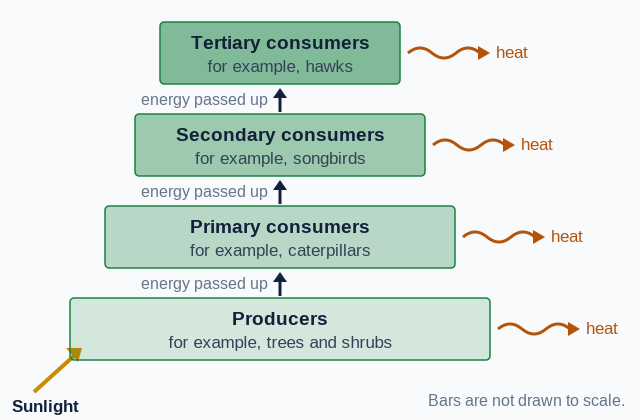 Tap to open the picture full size
Part 1 Think first From the grasses to the snakes
Commit to a guess first. Being wrong now makes the right idea stick better.
Predict first
On a prairie, grasses capture energy from sunlight and store it in their leaves and roots. Grasshoppers eat the grasses, frogs eat the grasshoppers, and snakes eat the frogs. Compare the energy stored in the snakes each year with the energy stored in the grasses. About how much do the snakes get?
In short. Energy decreases at every step up a food chain: the 10% rule approximates that only about 10% of the energy at one trophic level is passed on to the next, and the laws of thermodynamics explain where the rest goes.
- To move energy up one trophic level, multiply by 0.10, and apply it once for each transfer between the two levels you compare.
- The laws of thermodynamics explain the loss: energy changes form at every level, and most of it leaves as heat from cellular respiration.
- Count transfers, not levels, keep the units on every line, and use a measured percent in place of 10% whenever a question gives one.
Part 2 Learn it How energy decreases up a food chain
2a. One step up: about 10% is passed on
Energy enters most ecosystems as sunlight. Producers such as grasses, trees and algae capture it in photosynthesis and store some of it in their tissues. Background from topics 1.8 and 1.9: that stored energy is the producers' net primary productivity, measured in energy per unit area per unit time, such as kcal/m²/yr, and energy flows from producers upward to consumers.
Each feeding position is a trophic level: producers, then primary consumers (herbivores), then secondary consumers, then tertiary consumers. Energy moves up a level when organisms at one level are eaten by organisms at the next.
The 10% rule approximates how much moves: in the transfer of energy from one trophic level to the next, only about 10% of the energy is passed on. To go up one level, multiply by 0.10.
A meadow's producers store 2,000 kcal/m²/yr. The primary consumers that eat them store about
A share of energy is still energy, so the answer keeps the units you started with. The rule says "about" for a reason: real ecosystems pass on somewhat more or less, and when a question gives measured data, the data come first.
Quick check · Fill the statement
A forest's producers store 5,000 kcal/m²/yr. Use the 10% rule. Tap a blank, then an answer.
The primary consumers store about . The secondary consumers, one more level up, store about . At each step, the other of the energy is not passed on.
2b. Several steps up, or back down
A food chain usually has more than one step. Apply the rule once for every transfer, and there is one fewer transfer than there are levels.
Grasses, then grasshoppers, then frogs, then snakes is four trophic levels and three transfers. If the grasses store 2,000 kcal/m²/yr, the snakes store about
That is of the grasses' energy, or 0.1%: the thousandth from Think first.
Sometimes a question runs the other way. It tells you what a higher level stores and asks what the level below must store. Going down a level, divide by 0.10, which is the same as multiplying by 10. Mice that are primary consumers and store 150 kcal/m²/yr need producers that store about kcal/m²/yr.
Two habits catch most mistakes. Count the arrows between the two levels in the question, not the levels themselves. Then ask whether your answer should be smaller than where you started (going up) or bigger (going down).
Quick check · Calculate
In a pond, mayfly larvae (primary consumers that eat algae) store 700 kcal/m²/yr. Bluegill eat the mayfly larvae, and largemouth bass eat the bluegill. Using the 10% rule, how much energy is stored in the bass? Give your answer in kcal/m²/yr.
2c. Percent passed on, from measured data
The 10% rule is an approximation. When researchers measure the energy stored at two levels of an ecosystem, they can work out the actual percent passed on:
Suppose a lake's algae store 5,000 kcal/m²/yr, and the zooplankton that eat them store 600 kcal/m²/yr. The percent passed on is , a little above the rule, which is normal for an approximation.
Keep three things straight. The higher level goes on top, so the answer is under 100%. The percent passed on and the percent not passed on add to 100%, so in the lake 88% was not passed on. And when a question gives you measured percents, use them in place of 10%: multiply by each percent written as a decimal, one transfer at a time. A transfer of 15% means multiply by 0.15.
Quick check · Multiple choice
Suppose researchers measure that the grass in a field stores 2,400 kcal/m²/yr and the grasshoppers that eat it store 180 kcal/m²/yr. What percent of the grass's energy was passed on to the grasshoppers?
2d. Where the other 90% goes
The energy that is not passed on is not destroyed. The laws of thermodynamics explain what happens to it.
The first law of thermodynamics says energy can be converted from one form to another, but it is never created or destroyed. So the 90% still exists somewhere.
The second law of thermodynamics says every energy conversion releases some energy as heat that spreads into the surroundings, so no conversion is 100% efficient. Living things convert energy constantly.
Follow the energy in the clover a rabbit eats. Much of it powers cellular respiration, which runs the rabbit's muscles, keeps its body warm and builds new cells, and that energy ends up as heat. Some leaves in droppings. Some sits in fur and bones that a fox will not eat or cannot digest; detritivores and decomposers, the organisms that feed on waste and dead matter, use that energy and release it as heat too. When a fox does eat the rabbit, the same thing happens again: the fox uses most of what it digests for its own respiration, and only a small share becomes new fox tissue.
Producers cannot capture heat and use it again, so energy does not cycle the way matter does. It flows one way, and an ecosystem needs a continuous inflow of high-quality energy, which for most ecosystems is sunlight.
Quick check · Decide and justify
In a meadow, only about 10% of the energy stored in the rabbits ends up stored in the foxes that eat them. A classmate says the other 90% is destroyed. Is the classmate right?
Which reason supports your answer?
Part 3 Watch it done How much energy reaches the hawks?
Predict first, then open each step, then finish the problem yourself.
In a salt marsh, cordgrass stores 8,000 kcal/m²/yr. Grasshoppers eat the cordgrass, sparrows eat the grasshoppers, and hawks eat the sparrows. Using the 10% rule, how much energy is stored in the hawks, and what percent of the cordgrass's energy is that?
Predict first
Before you open the first step, predict: about how much energy is stored in the hawks?
Step 1 · Put each organism on a trophic level
Cordgrass makes its own food from sunlight, so it is a producer. Grasshoppers eat it, so they are primary consumers. Sparrows eat the grasshoppers: secondary consumers. Hawks eat the sparrows: tertiary consumers.
Step 2 · Count the transfers
Producers to primary consumers, primary to secondary, secondary to tertiary: three transfers between four levels. The rule applies three times.
Step 3 · Set the calculation up, with units
Writing the starting units in the setup lets you check the units of the answer at the end. College Board's sample calculation questions say "Show your work," and this line is the work.
Why this step?
Why multiply by 0.10 instead of taking 10% away?
Taking 10% away keeps 90% of the energy, which is the share that is not passed on. The rule says the next level gets about 10%, and 10% of an amount is the amount times 0.10.
Your step · Calculate
Finish it. In a salt marsh, cordgrass stores 8,000 kcal/m²/yr. Grasshoppers eat the cordgrass, sparrows eat the grasshoppers, and hawks eat the sparrows. Using the 10% rule, how much energy is stored in the hawks? Give your answer in kcal/m²/yr.
kcal/m²/yr
Now the percent. The hawks store 8 of the cordgrass's 8,000 kcal/m²/yr: . You can also get it straight from the rule: three transfers is , which is 0.1%. Whatever the starting number, the tertiary consumers end up with about 0.1% of the producers' energy.
Part 4 Try it New ecosystems, new numbers
Each question below changes something from the worked example: the levels being compared, the direction you work, or the percent passed on. Decide which before you calculate.
Try it · Rank it
Four ecosystems, each with one group named. Use the 10% rule to work out the energy each group stores. Rank the groups by the energy they store.
Most energy stored first
Give each one a place, 1 for first. Give two the same place if they are equal.
Your ranking: none yet
Try it · Calculate
Owls in a woodland are secondary consumers: they eat mice, which eat plants. The owls store 25 kcal/m²/yr. Using the 10% rule, how much energy must the woodland's plants store to support them? Give your answer in kcal/m²/yr.
Try it · Calculate
Zooplankton in a lake store 1,200 kJ/m²/yr. Suppose researchers measure that 15% of the zooplankton's energy is passed on to the small fish that eat them, and 8% of the small fish's energy is passed on to the trout that eat the small fish. How much energy is stored in the trout? Give your answer in kJ/m²/yr.
Now the other half of the topic: where the energy goes. Sort each energy by whether it can be passed on to the next trophic level.
Try it · Sort it
A rabbit eats clover, and later a fox eats the rabbit. Tap each card, then where that energy ends up.
Can be passed on to a fox that eats the rabbit
Not passed on to the fox
Part 5 Explain it A calculation question, start to finish
Write your answer first, with every setup line shown. Nothing you type here leaves this page. Then compare it with the model and each scoring point.
Free response is 40% of the exam score. This one is shaped like Question 3, Analyze an environmental problem doing calculations.
Free-response practice · Question 3 style
In a coastal ocean, phytoplankton (the producers) store 4,000 kcal/m²/yr. Zooplankton eat the phytoplankton, anchovies eat the zooplankton, and tuna eat the anchovies.
(a) Calculate the energy stored in the anchovies, using the 10% rule. Show your work and include units.
(b) Calculate the percent of the phytoplankton's energy that is stored in the tuna. Show your work.
(c) Explain why less energy is stored at each higher trophic level, using a law of thermodynamics.
(d) A fishing company could harvest either the anchovies or the tuna. Using your answers, justify the claim that harvesting anchovies taps more of this ecosystem's energy each year than harvesting tuna.
Model answer
(a) Phytoplankton to zooplankton to anchovies is two transfers: .
(b) The tuna are three transfers up: kcal/m²/yr, and .
(c) By the second law of thermodynamics, every energy conversion releases some energy as heat, so no transfer is 100% efficient. At each level most of the energy organisms take in is used in cellular respiration and released as heat, and some is never eaten or digested, so only about 10% is stored where the next level can eat it.
(d) The anchovies store about 40 kcal/m²/yr and the tuna about 4 kcal/m²/yr, so harvesting anchovies taps about ten times as much energy each year: one fewer transfer has released energy as heat.
| Trophic level | Organisms | Energy stored (kcal/m²/yr) | Share of the phytoplankton's energy |
|---|---|---|---|
| Producers | Phytoplankton | 4,000 | 100% |
| Primary consumers | Zooplankton | 400 | 10% |
| Secondary consumers | Anchovies | 40 | 1% |
| Tertiary consumers | Tuna | 4 | 0.1% |
Score your own answer. This is a self-check, not a grade. Tick each point your answer makes.
Part 6 Check yourself A prairie field study
All three case questions use the table.
Suppose a class estimates the energy stored each year at each trophic level of a prairie. The numbers below are made up for practice.
| Trophic level | Main organisms | Energy stored (kcal/m²/yr) |
|---|---|---|
| Producers | Grasses and wildflowers | 3,000 |
| Primary consumers | Grasshoppers and other plant-eating insects | 270 |
| Secondary consumers | Spiders and toads | 36 |
| Tertiary consumers | Snakes | 3.0 |
Case question 1 · Calculate
Using the prairie table: how much of the primary consumers' energy is not passed on to the secondary consumers? Give your answer in kcal/m²/yr.
Case question 2 · Multiple choice
Using the prairie table: which transfer passed on the greatest percent of the energy?
Case question 3 · Calculate
Using the prairie table: what percent of the producers' energy is stored in the tertiary consumers? Give your answer to the nearest 0.01%.
The rest stand on their own and do not use the case.
Check yourself · Sort it
Each card describes something that happens to energy in a meadow. Tap a card, then the law of thermodynamics that explains it.
First law of thermodynamics
Second law of thermodynamics
Check yourself · Spot the error
A student works out the energy that reaches a heron, using the 10% rule. Tap the first line that goes wrong.
Part 7 Keep it Bring back earlier ideas
Two questions from earlier topics in this unit, on the energy producers store and the direction energy flows. This lesson started from both.
From 1.8 Primary Productivity · Calculate
In a meadow, the producers' gross primary productivity is 7,000 kcal/m²/yr, and they use 3,000 kcal/m²/yr in their own respiration. What is the meadow's net primary productivity? Give your answer in kcal/m²/yr.
From 1.9 Trophic Levels · Multiple choice
In a near-surface ocean community, which describes the path energy takes?
In three lines
- The 10% rule approximates that only about 10% of the energy at one trophic level is passed on to the next: multiply by 0.10 per transfer going up, and divide going down.
- Percent passed on is the higher level's energy over the lower level's, times 100%, and measured percents replace the rule when a question gives them.
- The rest is not destroyed (first law): every conversion releases heat (second law), and most energy leaves each level as heat from cellular respiration.
Exam strategy for this topic
- Section I, Multiple Choice: 80 questions in 90 minutes.
- Section II, Free Response: 3 questions in 70 minutes.
- This lesson's Explain it is shaped like free-response question 3, Analyze an environmental problem doing calculations.
- A four-function, scientific, or graphing calculator is allowed on both sections of the exam.
On a calculation, write the setup with the starting units before any arithmetic, count transfers rather than levels, and check whether your answer should be smaller (going up) or larger (going down) than the number you started with.
Questions students ask
What is the 10% rule in AP Environmental Science?
It approximates that in the transfer of energy from one trophic level to the next, only about 10% of the energy is passed on. To go up one level, multiply by 0.10.
Where does the other 90% of the energy go?
It is not destroyed, by the first law of thermodynamics. Most is used in cellular respiration and released as heat, and the rest is in food that is not eaten or digested, which detritivores and decomposers use and also release as heat. By the second law, every energy conversion releases some heat.
How do I calculate energy across several trophic levels?
Count the transfers between the two levels, then multiply by 0.10 once per transfer going up, or divide by 0.10 once per transfer going down. Keep the starting units on every line.
Is the share passed on always exactly 10%?
No. The rule is an approximation, and measured ecosystems pass on somewhat more or less. When a question gives measured energy or percents, use them instead of 10%.
Why does energy not cycle the way matter does?
Energy leaves every trophic level as heat, and producers cannot capture heat and use it again. So energy flows one way and ecosystems need a continuous inflow of high-quality energy, which for most ecosystems is sunlight, while matter is reused in biogeochemical cycles.
Course alignment, for teachers
AP Environmental Science topic 1.10, Unit 1: The Living World: Ecosystems.
- Skill 6.C: Calculate an accurate numeric answer with appropriate units.
This lesson maps all 2 essential knowledge statements of the topic to the part that teaches each one: 2 are checked by a scored question. The map is in the lesson file.