Unit 7 · Topic 7.5 · about 35 minutes · 7 parts · 11 scored checks, 2 of them multiple choice, plus 2 from earlier lessons
AP Environmental Science 7.5: Indoor Air Pollutants
Unit 7: 7 to 10% of the multiple-choice section
What you'll be able to do
- Identify indoor air pollutants.
- Describe the effects of indoor air pollutants.
Key vocabulary
| Term | What it means | The exam trap |
|---|---|---|
| Asphyxiant | A substance that keeps the body from getting the oxygen it needs. | An asphyxiant can harm without any smell or smoke to warn of it. |
| Volatile organic compound (VOC) | A carbon-containing compound that evaporates at room temperature. | A VOC can be given off by a solid object for weeks, not only by liquids. |
| Picocuries per liter (pCi/L) | A unit that measures how much radioactivity there is in a liter of air. | A higher number means more radioactivity in the same amount of air. |
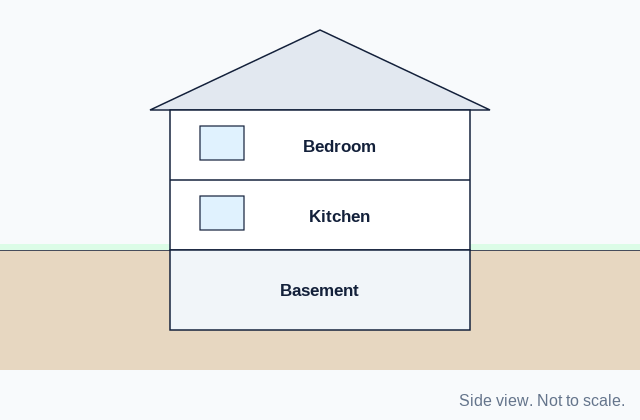 Tap to open the picture full size
Part 1 Think first A gas in a new basement
Commit to a guess first. Being wrong now makes the right idea stick better.
Predict first
A made-up family's new house has electric heat and an electric stove, and no one in it smokes. A test still finds a radioactive gas in the basement air. Where do you predict the gas most likely comes from?
In short. Indoor air pollutants are gases and particles that foul the air inside homes, schools and other buildings.
- Carbon monoxide is an indoor air pollutant classified as an asphyxiant: it keeps the body from getting the oxygen it needs.
- Asbestos, dust and smoke are indoor air pollutants classified as particulates.
- Insulation, VOCs, formaldehyde and lead from paints are common human-made indoor air pollutants.
Part 2 Learn it What pollutes the air inside
2a. Burning indoors
Carbon monoxide is an indoor air pollutant classified as an asphyxiant.
An asphyxiant is a substance that keeps the body from getting the oxygen it needs. Carbon monoxide has no color and no smell. Once breathed in, it takes the place of oxygen in the blood, so less oxygen reaches the brain and heart. A person can be harmed before noticing anything is wrong.
Carbon monoxide comes from burning, one of the three kinds of source of indoor air pollutants (the next part names the other two). Common combustion air pollutants include carbon monoxide, nitrogen oxides, sulfur dioxide, particulates, and tobacco smoke.
For example, a furnace with a cracked vent pipe, or a fireplace whose chimney is blocked, can send its combustion pollutants into the rooms instead of up and out of the house.
Quick check · Multiple choice
During a power cut, a made-up family runs a gasoline generator in their attached garage with the door shut, and carbon monoxide seeps into the house. Which statement describes the danger?
2b. Particles, and pollutants from nature
Indoor air pollutants can come from natural sources, human-made sources, and combustion.
Particulates are tiny bits of solid or liquid small enough to float in the air. Indoor air pollutants that are classified as particulates include asbestos, dust, and smoke.
- Asbestos is a mineral made of thin fibers. It was once used in building materials such as pipe wrap and floor tiles. When the material crumbles or is cut, its fibers float into the air.
- Dust is a mix of fine bits of soil, pollen, skin and fibers.
- Smoke from burning carries fine bits of soot and ash.
Common natural source indoor air pollutants include radon, mold, and dust. Mold is a fungus that grows on damp surfaces and releases spores into the air. Much dust is blown or tracked in from outdoors, from soil. Radon gets its own part below. Background: breathing asbestos fibers over time can scar the lungs.
Quick check · Decide and justify
A student says the smoke drifting from a made-up cabin's leaky wood stove counts as a particulate indoor air pollutant. Is the student right?
Which reason supports your answer?
2c. Pollutants built into a home
Many indoor pollutants come from what a building and its furnishings are made of. Common human-made indoor air pollutants include:
- Insulation: some insulation materials shed fibers or give off fumes into the air.
- Volatile organic compounds (VOCs) from furniture, paneling and carpets. VOCs are carbon-containing compounds that evaporate at room temperature, so they drift out of the things that contain them.
- Formaldehyde, a VOC with a sharp smell, from building materials, furniture, upholstery and carpeting.
- Lead from paints. Older paint can contain lead; as it chips, flakes or is sanded, lead gets into the dust and the air.
For example, a new sofa can give off VOCs for weeks, which is why a new room can have a chemical smell. Opening windows lets the fumes out, but the source keeps releasing them until it has given off most of what it holds.
Quick check · Select all
A made-up family moves into a remodeled house with new carpet, new particleboard kitchen cabinets and a porch whose paint dates from 1950. Which two are human-made indoor air pollutants that come from these materials? Pick two.
Select 2 answers, then check.
2d. Radon
Radon-222 is a naturally occurring radioactive gas that is produced by the decay of uranium found in some rocks and soils. It has no color, smell or taste.
How it gets in:
- Radon moves up through the soil and enters homes through the basement or through cracks in the walls or foundation.
- It also dissolves in groundwater, and can enter a home in water drawn from a well.
Why it matters: exposure to radon gas can lead to radon-induced lung cancer, which is the second leading cause of lung cancer in America. The risk builds over years of breathing it.
Background: the leading cause of lung cancer is smoking. Radon test kits and fans that draw air from under a basement floor are common ways to find and lower it.
Quick check · Fill the statement
Complete the account of radon in a made-up town built on granite.
Radon-222 forms as the in some of the town's rocks and soils decays, and breathing it for years can lead to cancer of the . In America, radon ranks among the causes of that cancer.
Part 3 Watch it done Formaldehyde after new carpet
Open each step in turn, answer the why, then finish the calculation yourself.
A made-up family lays new carpet in a bedroom. The formaldehyde in the room's air is 160 micrograms per cubic meter in the first week and 70.4 micrograms per cubic meter eight weeks later. By what percent did it fall?
Step 1 · Find the fall
micrograms per cubic meter less.
Why this step?
Why does new carpet put formaldehyde into the room's air at all?
Formaldehyde is a human-made indoor pollutant that comes from carpeting, among other materials; it evaporates out of the new carpet into the air.
Step 2 · Choose the operation
A fall is measured from the starting level, so divide the fall by it: .
Your step · Calculate
Finish it. The formaldehyde fell by 89.6 micrograms per cubic meter from a first-week level of 160. By what percent did it fall?
%
The level fell by more than half, but the carpet was still giving off formaldehyde eight weeks on. Try it asks you to sort pollutants by their source, then to check an account of radon.
Part 4 Try it Sort the sources, then check an account
First sort made-up indoor pollutants by the kind of source they come from. Then find where a student's account of radon in a farmhouse goes wrong.
Try it · Sort it
What kind of source does each made-up indoor pollutant come from? Tap a card, then its group.
Natural source
Human-made source
Combustion
Try it · Spot the error
A student describes radon in a made-up farmhouse. Tap the first line that goes wrong.
Part 5 Explain it Radon from basement to bedroom
Write your answer first. Nothing you type here leaves this page. Then compare it with the model and each scoring point.
Free response is 40% of the exam score. This one is shaped like Question 2, Analyze and interpret quantitative data.
Free-response practice · Question 2 style
A made-up town measured radon in 40 homes. The average levels, in picocuries per liter (pCi/L), are made up for practice:
- Basements: 7.5 pCi/L
- First floors: 3.0 pCi/L
- Second floors: 1.8 pCi/L
- Basements, one year after every home sealed the cracks in its foundation: 2.1 pCi/L
(a) Describe the pattern in radon levels from the basement to the second floor.
(b) Calculate the percent by which the average second-floor level was lower than the average basement level. Show your work.
(c) Calculate the percent decrease in the average basement level after the cracks were sealed. Show your work.
(d) Explain why radon levels are highest in basements.
(e) Explain one effect on human health of breathing radon over many years.
Model answer
(a) Radon was highest in basements and fell with each floor up, from 7.5 pCi/L in basements to 1.8 pCi/L on second floors.
(b) lower on the second floor.
(c) decrease.
(d) Radon forms from the decay of uranium in some rocks and soils and moves up through the soil, entering a home through the basement and cracks in the walls or foundation. The basement is the part of the house nearest the soil, so the gas reaches it first.
(e) Exposure to radon can lead to radon-induced lung cancer, the second leading cause of lung cancer in America.
Score your own answer. This is a self-check, not a grade. Tick each point your answer makes.
Part 6 Check yourself Carbon monoxide in four homes
The first two questions use the table.
On one winter evening, a made-up county measures carbon monoxide in the living rooms of four homes, in parts per million (ppm). The table lists what each home burns indoors. The numbers are made up for practice.
| Home | What burns indoors | Carbon monoxide (ppm) |
|---|---|---|
| Q | A gas stove, used with no range hood | 6.5 |
| P | Nothing; heat and cooking are electric | 0.8 |
| S | A wood stove with a leaking door seal | 9.1 |
| R | An unvented kerosene heater | 14.2 |
Case question 1 · Multiple choice
Which statement do the data best support?
Case question 2 · Calculate
Using the table: Home R's carbon monoxide reading was how many times Home P's?
The rest stand on their own and do not use the case.
Check yourself · Match
Match each made-up situation to the indoor air pollutant it most likely releases.
Check yourself · Select all
An air test in a made-up old school finds four pollutants. Which two of them are particulates? Pick two.
Select 2 answers, then check.
Part 7 Keep it Bring back earlier ideas
Two questions from earlier topics in this unit.
First complete a sentence about a made-up place. Then find where a student's account goes wrong.
From 7.4 Atmospheric CO2 and Particulates · Fill the statement
Complete the account of a made-up cove.
On a dark night in the cove, the living kelp while the body of a dead seal on the beach , and both add carbon dioxide to the air.
First complete an account of a smoggy city's problem and its fix. Then find where a student's account of a smoggy day goes wrong.
From 7.2 Photochemical Smog · Spot the error
A student describes a smoggy day in a made-up city. Tap the first line that goes wrong.
In three lines
- Carbon monoxide is an indoor air pollutant classified as an asphyxiant; burning indoors also releases nitrogen oxides, sulfur dioxide, particulates and tobacco smoke.
- Indoor pollutants come from natural sources (radon, mold, dust), human-made sources (insulation, VOCs, formaldehyde, lead from paints) and combustion; asbestos, dust and smoke are particulates.
- Radon-222 forms from decaying uranium in some rocks and soils, enters through basements, cracks and well water, and can lead to radon-induced lung cancer.
Exam strategy for this topic
- Section I, Multiple Choice: 80 questions in 90 minutes.
- Section II, Free Response: 3 questions in 70 minutes.
- This lesson's Explain it is shaped like free-response question 2, Analyze and interpret quantitative data.
- A four-function, scientific, or graphing calculator is allowed on both sections of the exam.
When a question asks you to identify an indoor air pollutant, name its source too: natural, human-made or combustion. For radon, say where it comes from, how it gets in, and that it can cause lung cancer.
Questions students ask
Why is carbon monoxide dangerous indoors?
Carbon monoxide is classified as an asphyxiant: it keeps the body from getting the oxygen it needs, and it has no color or smell.
What are the main sources of indoor air pollutants?
Natural sources such as radon, mold and dust; human-made sources such as insulation, VOCs, formaldehyde and lead from paints; and combustion, which releases carbon monoxide, nitrogen oxides, sulfur dioxide, particulates and tobacco smoke.
How does radon get into a home?
Radon moves up through the soil and enters through the basement or cracks in the walls or foundation. It can also be dissolved in groundwater that enters a home through a well.
Course alignment, for teachers
AP Environmental Science topic 7.5, Unit 7: Atmospheric Pollution.
- Skill 5.C: Explain patterns and trends in data to draw conclusions.
This lesson maps all 9 essential knowledge statements of the topic to the part that teaches each one: 9 are checked by a scored question. The map is in the lesson file.