Unit 6 · Topic 6.4 · about 30 minutes · 7 parts · 10 scored checks, 2 of them multiple choice, plus 2 from earlier lessons
AP Environmental Science 6.4: Distribution of Natural Energy Resources
Unit 6: 10 to 15% of the multiple-choice section
What you'll be able to do
- Identify where natural energy resources occur.
Key vocabulary
| Term | What it means | The exam trap |
|---|---|---|
| Ore | Rock that holds enough of a metal or mineral to be worth mining. | An ore is the rock, not the pure metal taken from it. |
| Reserve | The amount of a resource known to be in the ground that can be extracted with today's methods. | Reserves count what can be extracted, not every trace in the ground. |
| Deposit | A natural concentration of a resource in one place, such as a coal seam. | A deposit is a concentration; a trace spread thinly through rock is not one. |
 Tap to open the picture full size
Part 1 Think first Two neighbors
Commit to a guess first. Being wrong now makes the right idea stick better.
Predict first
A made-up country has no coal, oil or natural gas of its own. The country next door sits on huge oil fields. What do you predict is the main reason for the difference?
In short. Natural energy resources such as ores, coal, crude oil and natural gas are not spread evenly across the globe.
- Some regions hold large deposits of a resource and others hold little.
- A map of deposits shows where each resource is concentrated.
- Counting a map's symbols lets you compare how much each region holds.
Part 2 Learn it Where resources lie
2a. Not spread evenly
The global distribution of natural energy resources, such as ores, coal, crude oil and gas, is not uniform.
Uniform would mean every region holds about the same amount for its size. Instead, resources are concentrated. Background: a handful of regions hold most of the world's oil; coal lies in thick seams in some places and is missing in others; a metal ore may be mined in one mountain range and absent for a thousand kilometers around.
An ore is rock that holds enough of a metal or mineral to be worth mining. Some regions hold several resources at once; many hold none worth extracting.
A deposit is not where people need it most, or where the most people live. It is where nature left it.
Quick check · Multiple choice
A made-up continent has twelve countries. A survey finds that three of them hold nearly all of the continent's crude oil. Which statement best describes this pattern?
2b. Geologic history
The distribution depends on regions' geologic history.
A region's geologic history is what its rocks went through over millions of years: what was laid down there, how deeply it was buried, how it was heated, pressed, folded or broken. Different histories leave different resources.
Background: coal forms where the remains of ancient swamp plants were buried deep; oil and gas form where the remains of tiny sea organisms were buried in thick layers of sediment; many metal ores form where hot fluids from deep in the Earth left minerals behind in cracks. A region that never had those events does not hold those resources.
So neighboring regions can hold very different resources, and regions far apart can hold the same resource if their rocks share a history.
Quick check · Decide and justify
A made-up student says that two regions side by side must hold the same energy resources, since they share a border. Is the student right?
Which reason supports your answer?
2c. Reading a resource map
Maps of energy resources use symbols for each resource, a legend to say what each symbol means, and often a key to how much each symbol stands for.
To read one:
- Find the concentrations. Which regions are crowded with a symbol, and which have none?
- Count and compare. If each symbol stands for a set amount, count them to compare regions or find a region's share of the total.
- Link to geologic history. When the map comes with each region's history, regions with the same history should show the same kinds of resources, wherever they are.
A region with a history like one that holds a resource is a place to look for that resource.
Quick check · Select all
A made-up map labels four regions with their geologic histories. Which two regions are most likely to hold the same kind of fuel deposit? Pick two.
Select 2 answers, then check.
Part 3 Watch it done One region's share of the oil
Open each step in turn, answer the why, then finish the calculation yourself.
A made-up world holds 1,650 billion barrels of known oil reserves. One region holds 792 billion barrels of it. What percent of the world's oil reserves does that one region hold?
Step 1 · Part and whole
The part is the region's 792 billion barrels; the whole is the world's 1,650 billion barrels.
Why this step?
Why can one region hold such a large share?
The distribution of oil is not uniform. It depends on each region's geologic history, and only some regions had the history that leaves oil.
Step 2 · Set up the percent
Divide the part by the whole, then multiply by 100.
Your step · Calculate
Finish it. The region holds 792 of the world's 1,650 billion barrels. What percent is that?
%
One region holds 48% of the made-up world's oil. Shares like this are what "not uniform" looks like in numbers.
Part 4 Try it Sort the explanations, then check an account
First sort made-up explanations of where resources lie. Then find where a student's account of a country's resources goes wrong.
Try it · Sort it
Does each made-up explanation of where a resource lies rest on the region's geologic history? Tap a card, then its group.
Rests on geologic history
Does not
Try it · Spot the error
A student describes where a made-up country's resources lie. Tap the first line that goes wrong.
Part 5 Explain it Gas across five regions
Write your answer first. Nothing you type here leaves this page. Then compare it with the model and each scoring point.
Free response is 40% of the exam score. This one is shaped like Question 2, Analyze and interpret quantitative data.
Free-response practice · Question 2 style
Known natural gas reserves in a made-up world, in trillion cubic meters, made up for practice:
- Northern Shelf: 62
- Desert Basin: 41
- Mountain Belt: 9
- Coastal Plain: 6
- All other regions together: 12
(a) Identify the region with the largest reserves.
(b) Calculate the percent of the world's reserves held by the Northern Shelf and the Desert Basin together. Show your work.
(c) Calculate how many times more gas the Northern Shelf holds than the Coastal Plain. Show your work.
(d) Describe the pattern in how the gas is distributed.
(e) Explain why the regions hold such different amounts of gas.
Model answer
(a) The Northern Shelf.
(b) Total: . .
(c) times as much.
(d) The distribution is not uniform: two regions hold nearly four-fifths of the gas, and the rest of the world holds little.
(e) Where gas occurs depends on a region's geologic history. The Northern Shelf and Desert Basin had the history that leaves gas; regions whose rocks went through other events hold little.
Score your own answer. This is a self-check, not a grade. Tick each point your answer makes.
Part 6 Check yourself A continent's resources
The first two questions use the map and the table.
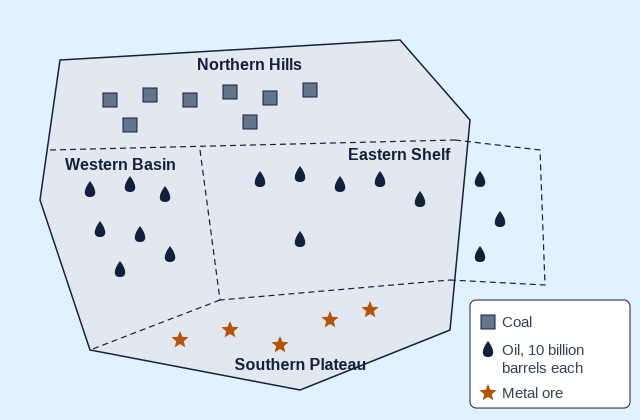
Geologists map the deposits of a made-up continent with four regions and record each region's geologic history. Each oil symbol stands for 10 billion barrels. The map and numbers are made up for practice.
| Region | Geologic history |
|---|---|
| Eastern Shelf | Ancient sea floor buried under thick layers of sediment |
| Southern Plateau | Old volcanic rock cut by veins where hot fluids rose |
| Northern Hills | Ancient coastal swamps buried under thick rock |
| Western Basin | Ancient sea floor buried under thick layers of sediment |
Case question 1 · Multiple choice
Geologists study a fifth region, the Central Lowland, whose geologic history matches the Western Basin's. Which resource do the map and table suggest is most likely there?
Case question 2 · Calculate
Using the map: what percent of the continent's mapped oil lies in the Eastern Shelf?
The rest stand on their own and do not use the case.
Check yourself · Fill the statement
Complete the account of a made-up survey.
The survey found coal, oil and gas packed into a few regions rather than spread , and it traced each deposit to its region's history.
Check yourself · Decide and justify
Two made-up regions on opposite sides of an ocean hold matching coal seams. Their rocks show that both were once swamps buried under thick sediment at about the same time. A team says this shared past explains why both hold coal. Is the team right?
Which reason supports your answer?
Part 7 Keep it Bring back earlier ideas
Two questions from earlier topics: matching fuels to their descriptions, and a student's account of a town's energy sources.
First match made-up descriptions to the fuel each one names. Then find where a student's account of a power company goes wrong.
From 6.3 Fuel Types and Uses · Match
Match each made-up description to the fuel or material it describes.
First sort made-up energy supplies by how each is being used. Then find where a student's account of a town's energy goes wrong.
From 6.1 Renewable and Nonrenewable Resources · Spot the error
A student describes where a made-up town gets its energy. Tap the first line that goes wrong.
In three lines
- The global distribution of ores, coal, crude oil and natural gas is not uniform.
- Where these resources occur depends on regions' geologic history.
- Regions with matching histories can hold the same resources, however far apart, and neighbors can differ.
Exam strategy for this topic
- Section I, Multiple Choice: 80 questions in 90 minutes.
- Section II, Free Response: 3 questions in 70 minutes.
- This lesson's Explain it is shaped like free-response question 2, Analyze and interpret quantitative data.
- A four-function, scientific, or graphing calculator is allowed on both sections of the exam.
When a map or table shows where resources lie, say that the distribution is not uniform and link it to each region's geologic history, never to population, land area or energy use.
Questions students ask
Are energy resources spread evenly around the world?
No. The global distribution of ores, coal, crude oil and gas is not uniform.
What decides where energy resources occur?
Regions' geologic history: what their rocks went through over millions of years.
Can two regions far apart hold the same resource?
Yes, when their geologic histories match.
Course alignment, for teachers
AP Environmental Science topic 6.4, Unit 6: Energy Resources and Consumption.
- Skill 2.B: Explain relationships between different characteristics of environmental concepts, processes, or models represented visually:
This lesson maps the one essential knowledge statement of the topic to the part that teaches each one: 1 is checked by a scored question. The map is in the lesson file.