Unit 5 · Topic 5.7 · about 32 minutes · 7 parts · 11 scored checks, 2 of them multiple choice, plus 2 from earlier lessons
AP Environmental Science 5.7: Meat Production Methods
Unit 5: 10 to 15% of the multiple-choice section
What you'll be able to do
- Identify different methods of meat production.
- Describe the benefits and drawbacks of different methods of meat production.
Key vocabulary
| Term | What it means | The exam trap |
|---|---|---|
| Concentrated animal feeding operation (CAFO) | A farm that raises large numbers of animals in confined spaces and brings their food to them. | A CAFO can be indoors or outdoors; what defines it is confinement. |
| Rotational grazing | Moving a herd from one section of pasture to the next in turn. | It is a pasture-based system, not a kind of feedlot. |
| Free-range grazing | A pasture-based system in which animals roam and feed on grass or other forage. | The term describes how animals feed, not every other practice on the farm. |
| Overgrazing | When the livestock population exceeds the land's capacity to regenerate vegetation. | It is about more animals than the plants can support, not about the kind of animal. |
| Desertification | The change of land in a dry region into desert-like land with little plant cover. | It happens to land that was not desert before. |
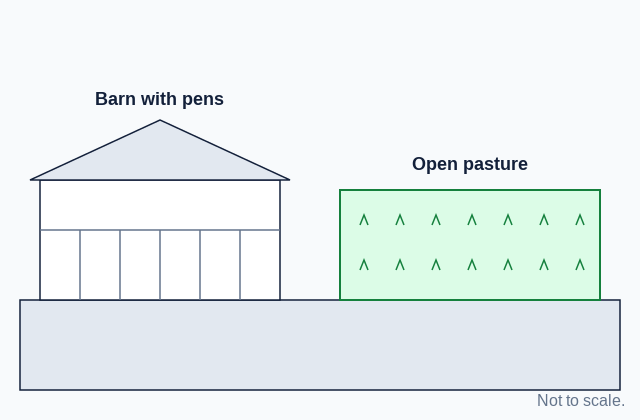 Tap to open the picture full size
Part 1 Think first Beans or beef?
Commit to a guess first. Being wrong now makes the right idea stick better.
Predict first
Two farms each produce the same amount of protein for people to eat. One grows beans. The other raises cattle fed on grain. Which farm do you predict needs more land, water and energy to do it?
In short. Meat is produced in feedlots and concentrated animal feeding operations (CAFOs), or in pasture-based systems such as rotational and free-range grazing, and each method has benefits and drawbacks.
- Confined systems bring food to the animals; pasture-based systems let the animals find it.
- This lesson weighs meat against plant foods, and one way of raising animals against another.
- It also looks at what too many grazing animals can do to dry land.
Part 2 Learn it How meat is produced, and what it costs
2a. Confined or pasture-based
Methods of meat production include feedlots and concentrated animal feeding operations (CAFOs), as well as pasture-based systems, such as rotational grazing and free-range grazing.
- Feedlots and CAFOs keep many animals in confined spaces and bring their food to them. A feedlot is an outdoor yard of pens; a CAFO can be a yard or a set of barns holding thousands of animals.
- Pasture-based systems let animals feed on grass or other plants they find on pasture, called forage, for most of their lives.
- In free-range grazing, animals roam a pasture and graze it.
- In rotational grazing, the herd is moved from one section of pasture to the next in turn, so each section rests between visits.
The difference to watch is where the food comes from: brought to confined animals, or found by grazing animals.
Quick check · Sort it
Which kind of meat production does each scene show? Tap a card, then its group.
Feedlot or CAFO
Pasture-based system
2b. Meat compared with plant foods
Meat production requires more land, water, and energy per gram of protein produced than the production of plant-based foods, and it increases nutrient pollution and emissions of greenhouse gases, such as methane.
Background, from earlier units: most of the food energy an animal eats goes to keeping it alive, not into meat, so many grams of feed crops make one gram of meat protein. Those crops need their own land, water, fuel and fertilizer.
The pollution comes from the animals themselves. Their manure is rich in nutrients such as nitrogen and phosphorus, which can wash into streams. Background: cattle and sheep give off methane as they digest grass, and manure releases more as it breaks down.
The environmental impacts of meat production vary by the type of livestock raised and production practices used. A pound of beef, a pound of chicken and a pound of pork do not cost the land the same, and neither do two farms raising the same animal in different ways.
Quick check · Decide and justify
A county's cattle feedlot grows from 2,000 to 8,000 head. A student says the county's streams are likely to carry more nutrient pollution, and its greenhouse gas emissions to rise. Is the student right?
Which reason supports your answer?
2c. CAFOs and pasture compared
CAFOs can be more economically efficient, which lowers costs for consumers. Animals raised in them are kept in confined spaces and fed grain- and soy-based diets. The drawbacks:
- CAFOs have high concentrations of manure that can contaminate nearby waterways if not properly managed.
- Routine use of antibiotics in CAFOs can contribute to the global risks of antibiotic resistance. Background: this is artificial selection again, in bacteria, as 5.6 showed for pests.
Free-range or pasture-based systems allow animals to feed on grass or forage for most of their lives, and rotational grazing can improve their sustainability. Manure delivers nutrients to pasture soils, but runoff and erosion risks remain if animal density is high. The drawbacks:
- These systems require more land, leading to higher consumer costs.
- Not all free-range systems are antibiotic-free.
Quick check · Select all
Which two are drawbacks of CAFOs? Pick two.
Select 2 answers, then check.
2d. Overgrazing, and lowering the impact
Overgrazing occurs when the livestock population exceeds the land's capacity to regenerate vegetation. It results in reduced plant cover, soil erosion and soil compaction, all of which reduce soil fertility. It also reduces biodiversity and lowers carbon storage. Rotational grazing can help prevent or minimize these impacts.
Overgrazing can lead to desertification in arid and semi-arid regions, as dry land loses its plants and soil. Restoration efforts, soil conservation measures and improved grazing practices can help slow or reverse it.
Meat's impacts can also be lowered. Less consumption of meat, especially from ruminant livestock such as cattle and sheep, can lower greenhouse gas emissions, conserve freshwater resources, and reduce reliance on antibiotics and growth hormones. Advances in feed quality and precision farming technologies can also help. The size of these benefits depends on the production methods used and on how land no longer used for livestock is managed.
Quick check · Multiple choice
On a made-up semi-arid range, ranchers keep more cattle than the grass can regrow for, year after year. Which result is most likely?
Part 3 Watch it done How much more energy is beef protein?
Open each step in turn, answer the why, then finish the calculation yourself.
In a made-up comparison, producing 1 kilogram of protein takes 52 megajoules (MJ, a unit of energy) as beans and 845 MJ as grain-fed beef. How many times as much energy does the beef protein take?
Step 1 · Pick the operation
"How many times as much" asks for a ratio, so divide one amount by the other.
Why this step?
Why would beef protein take so much more energy?
The cattle's grain must be grown first, with fuel and fertilizer of its own, and the cattle use most of the food energy they eat to live, not to build meat.
Step 2 · Pick the order
The question compares beef with beans, so the beef figure goes on top: .
Your step · Calculate
Finish it. In a made-up comparison, 1 kilogram of protein takes 52 MJ of energy as beans and 845 MJ as grain-fed beef. How many times as much energy does the beef protein take?
times
In these made-up figures, beef protein takes about 16 times the energy of bean protein. Meat takes more land, water and energy per gram of protein than plant foods, but no single ratio holds: it varies with the animal and the practice.
Part 4 Try it Read a label, then check an account
First decide whether a shopper reads a meat label rightly. Then find where a student's account of overgrazing goes wrong.
Try it · Decide and justify
A shopper sees "free-range" on a package of beef and concludes the cattle were never given antibiotics. Is the shopper right?
Which reason supports your answer?
Try it · Spot the error
A student explains how overgrazing can lead to desertification. Tap the first line that goes wrong.
Part 5 Explain it Protein, land and water
Write your answer first. Nothing you type here leaves this page. Then compare it with the model and each scoring point.
Free response is 40% of the exam score. This one is shaped like Question 2, Analyze and interpret quantitative data.
Free-response practice · Question 2 style
The data below compare the land and water used to produce 1 kilogram of protein from three foods. They are made up for practice.
- Beans: 20 square meters of land a year; 4 thousand liters of water
- Chicken: 70 square meters of land a year; 12 thousand liters of water
- Grain-fed beef: 330 square meters of land a year; 36 thousand liters of water
(a) Identify the food that uses the least land per kilogram of protein.
(b) Calculate how many times as much water beef protein uses as bean protein. Show your work.
(c) Describe what the data show about chicken compared with beef, and explain it using how the impacts of meat production vary by the type of livestock.
(d) Describe how eating less beef could change the water used to feed a population, using the data.
(e) Identify one way, other than eating less meat, to lower the environmental impact of meat production.
Model answer
(a) Beans, at 20 square meters per kilogram of protein.
(b) , so beef protein uses 9 times as much water.
(c) Chicken uses far less land (70 against 330 square meters) and water (12 against 36 thousand liters) than beef. The environmental impacts of meat production vary by the type of livestock raised, so two meats differ.
(d) Each kilogram of beef protein replaced with bean protein would use 32 thousand fewer liters of water, so eating less beef would conserve fresh water.
(e) Rotational grazing, better feed quality or precision farming technologies.
Score your own answer. This is a self-check, not a grade. Tick each point your answer makes.
Part 6 Check yourself A CAFO and a free-range farm
The first two questions use the table.
Two made-up beef farms each produce 100,000 kilograms of beef a year. One is a CAFO; the other is a free-range farm. The table counts the land each uses, including land that grows any feed brought in, the price consumers pay, and the nitrate in a stream next to each farm. The numbers are made up for practice.
| Farm | Land used (hectares) | Price to consumers (dollars per kg) | Nitrate in the nearby stream (mg per liter) |
|---|---|---|---|
| CAFO | 900 | 9.40 | 8.5 |
| Free-range | 2,300 | 12.80 | 2.4 |
Case question 1 · Multiple choice
Using the table: which statement do the data support?
Case question 2 · Calculate
Using the table: by what percent more land did the free-range farm use than the CAFO?
The rest stand on their own and do not use the case.
Check yourself · Fill the statement
Complete the account of one family's meals.
A family swaps most of its weekly beef for beans and gets the same protein. Its food now takes land, water and energy to produce, and eating less meat from cattle, which are ruminants, can lower its .
Check yourself · Rank it
Three made-up pastures have the same size, slope, soil and grass. Rank them by their likely risk of runoff and erosion.
Greatest risk first
Give each one a place, 1 for first. Give two the same place if they are equal.
Your ranking: none yet
Part 7 Keep it Bring back earlier ideas
Two questions from earlier topics: how rats become resistant to a poison, and a student's account of farming practices and fertilizer.
First put the steps of resistance in order. Then find where a student's account of pest control goes wrong.
From 5.6 Pest Control Methods · Put it in order
A rodenticide is set out in a grain store year after year. Put the steps by which the rats become resistant in order, first to last.
First sort six farm scenes by the practice each shows. Then find where a student's account of fertilizer goes wrong.
From 5.4 Impacts of Agricultural Practices · Spot the error
A student explains how fertilizer can harm the environment. Tap the first line that goes wrong.
In three lines
- Meat is produced in feedlots and CAFOs or in pasture-based systems such as rotational and free-range grazing.
- Meat takes more land, water and energy per gram of protein than plant foods; CAFOs are cheaper but concentrate manure and use routine antibiotics, while pasture needs more land.
- Overgrazing erodes and compacts soil and can lead to desertification, which restoration and better grazing can help slow or reverse.
Exam strategy for this topic
- Section I, Multiple Choice: 80 questions in 90 minutes.
- Section II, Free Response: 3 questions in 70 minutes.
- This lesson's Explain it is shaped like free-response question 2, Analyze and interpret quantitative data.
- A four-function, scientific, or graphing calculator is allowed on both sections of the exam.
When a question compares meat production methods, give a benefit and a drawback for each: CAFOs lower costs but concentrate manure and use routine antibiotics; pasture systems let animals forage but need more land and cost more.
Questions students ask
What are the methods of meat production?
Feedlots and concentrated animal feeding operations (CAFOs), and pasture-based systems such as rotational grazing and free-range grazing.
Why does meat take more resources than plant foods?
Meat production requires more land, water and energy per gram of protein than plant-based foods, since the animals' feed must be grown first.
Can desertification from overgrazing be reversed?
Restoration efforts, soil conservation measures and improved grazing practices can help slow or reverse it.
Course alignment, for teachers
AP Environmental Science topic 5.7, Unit 5: Land and Water Use.
- Skill 5.E: Explain what the data implies or illustrates about environmental issues.
This lesson maps all 7 essential knowledge statements of the topic to the part that teaches each one: 7 are checked by a scored question. The map is in the lesson file.