Unit 1 · Topic 1.2 · about 30 minutes · 7 parts · 11 scored checks, 3 of them multiple choice, plus 2 from earlier lessons
AP Environmental Science 1.2: Terrestrial Biomes
Unit 1: 6 to 8% of the multiple-choice section
What you'll be able to do
- Describe where the major terrestrial biomes are found and their principal environmental features, and explain how climate shapes each biome's communities.
Key vocabulary
| Term | What it means | The exam trap |
|---|---|---|
| Biome | A large region with characteristic communities of plants and animals that result from, and are adapted to, its climate. | A biome is named for its typical plants, so read the plants in a description as well as the weather. |
| Climate | The long-term pattern of temperature and precipitation in a place, including how both change through the year. | Read the months as well as the yearly total, since the same total can fall in one season or all year. |
| Latitude | How far north or south of the equator a place is. | Latitude is measured in degrees from the equator, 0 at the equator and 90 at each pole. |
| Altitude | How high a place is above sea level. | Altitude can differ a great deal within one small region, such as on a single mountain. |
| Nonmineral natural resource | A resource such as water or trees for lumber, taken from the living world or the water cycle rather than from rocks and ores. | Name every factor that shapes where a resource is found, since more than one usually applies. |
 Tap to open the picture full size
Part 1 Think first Two towns, one latitude
Commit to a guess first. Being wrong now makes the right idea stick better.
Predict first
Two towns lie at the same latitude in the middle of a continent, and both have warm summers and cold winters. The first gets rain all year and is surrounded by forest of broad-leaved trees. The second, far from any ocean, gets about a third as much rain. What do you predict covers most of the land around the second town?
In short. A biome is a large region whose characteristic communities of plants and animals result from, and are adapted to, its climate.
- The major terrestrial biomes are taiga, temperate rainforest, temperate seasonal forest, tropical rainforest, shrubland, temperate grassland, savanna, desert and tundra.
- Natural resources such as water and trees for lumber are spread unevenly because of climate, geography, latitude and altitude, nutrient availability and soil.
- Where biomes are is not fixed: it has changed in the past and may shift again as the global climate changes.
Part 2 Learn it How climate builds a biome
2a. Climate makes the biome
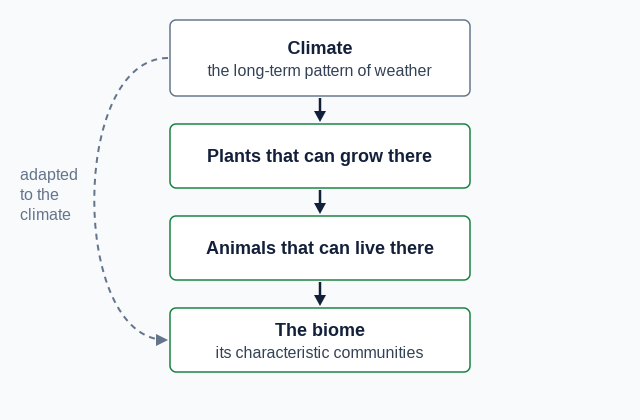
A biome is a large region with characteristic communities of plants and animals that result from, and are adapted to, its climate. Climate is the long-term pattern of temperature and precipitation (rain and snow) in a place: how warm or cold it is, how wet or dry, and how both change through the year.
Climate works on plants first. Temperature sets how long the growing season is, and precipitation sets how much water plants can get. Only plants adapted to those conditions survive. Animals then depend on the plants for food and shelter, so the animals are shaped by the climate too.
That is why a biome is described by its climate and its plants together. It also means that places with similar climates on different continents have similar-looking communities, even when the species in them are different. A hot, dry place in Africa and one in North America both have plants that store water and animals that are active in the cool of the night, because both communities are adapted to the same kind of climate.
Quick check · Decide and justify
Two regions on different continents have nearly the same temperatures and precipitation through the year. A student predicts that their communities of plants and animals will look alike, even though most of the species are different. Is the student right?
Which reason supports your answer?
2b. The nine major terrestrial biomes
Major terrestrial biomes include taiga, temperate rainforests, temperate seasonal forests, tropical rainforests, shrubland, temperate grassland, savanna, desert and tundra. Each is named for its typical plants, and each has its own climate. The table describes them in general terms; real places vary, and the borders between biomes are gradual.
Each biome is found where its climate is. Tropical rainforests lie near the equator, in places such as the Amazon basin, central Africa and Southeast Asia. Savannas lie on either side of them, where the rain comes in one season, as across much of Africa south of the Sahara. The large hot deserts, such as the Sahara and the deserts of Australia, lie in belts near 30 degrees north and south of the equator. Shrubland grows on coasts with mild, wet winters and hot, dry summers, such as around the Mediterranean Sea and in California. Temperate seasonal forests and temperate grasslands cover much of the middle latitudes, the forests where rain falls all year, as in the eastern United States and Europe, and the grasslands in drier continental interiors, such as the Great Plains. Temperate rainforests grow on cool, very wet coasts such as the Pacific Northwest. Taiga stretches across the far north of North America, Europe and Asia, and tundra lies beyond it around the Arctic, and on the tops of high mountains.
| Biome | Temperature | Precipitation | Typical plants |
|---|---|---|---|
| Tundra | Very cold, with a short growing season | Low | Mosses, lichens, grasses and low shrubs; no trees |
| Taiga | Long, cold winters and short summers | Moderate, much of it as snow | Forests of conifers such as spruce and fir |
| Temperate rainforest | Mild all year | Very high | Very tall conifers, mosses and ferns |
| Temperate seasonal forest | Warm summers and cold winters | Moderate, spread through the year | Broad-leaved trees that drop their leaves in fall |
| Tropical rainforest | Warm all year | Very high, in most months | Dense, tall broad-leaved trees in layers |
| Shrubland | Hot, dry summers and mild winters | Moderate, mostly in winter | Shrubs with small, tough leaves |
| Temperate grassland | Hot summers and cold winters | Too low for most trees | Grasses with deep roots |
| Savanna | Warm all year | A rainy season and a long dry season | Grasses with scattered trees |
| Desert | Hot or cold | Very low | Sparse plants that store water, such as cacti |
Quick check · Match
Each plant feature helps a plant survive the climate of one biome. Match each biome to the feature that fits its climate.
2c. Why resources are where they are
Water, and trees for lumber, are nonmineral natural resources: resources from the living world and the water cycle, not from rocks and ores. Their global distribution varies because of some combination of five things:
- Climate: a desert has little fresh water, and a temperate rainforest has plenty.
- Geography: the shape of the land. A mountain range can force moist air to rise and drop its rain on one side, leaving the land beyond it dry. A later topic in the course names this dry land a rain shadow.
- Latitude and altitude: places farther from the equator, and places higher up a mountain, are colder, with shorter growing seasons. Climbing a tall mountain changes the plants much as traveling toward a pole does.
- Nutrient availability: plants grow faster where the nutrients they need are easy to get.
- Soil: deep soil that holds water and nutrients supports bigger trees than thin, rocky soil.
Usually more than one factor is at work, so name each one that applies.
Quick check · Select all
Fresh water is plentiful on the western side of a mountain range and scarce in the valleys just east of it. Both sides are at the same latitude, and the valleys are lower than the mountains. Which two factors best explain the difference? Pick two.
Select 2 answers, then check.
2d. Biomes move
The worldwide distribution of biomes is dynamic: where each biome is found has changed in the past, and it may shift again as a result of global climate changes.
The evidence for past change is in the ground. Pollen grains last for thousands of years in the mud at the bottom of lakes, and each kind of plant has its own pollen. When scientists find tundra plants' pollen deep in the mud under a lake that is now surrounded by forest, the biome there has changed.
The reason is the same idea as in the first chunk: a biome results from, and is adapted to, its climate. If the climate of a place changes, the plants and animals adapted to the old climate may no longer do well there, and others adapted to the new climate can move in. As a climate warms, a biome adapted to cold may retreat toward the poles or up mountainsides, and a biome adapted to warmer conditions may spread into the space.
Quick check · Multiple choice
Near the Arctic, taiga forest gives way to tundra farther north. If the climate there warms over the next century, what could happen to the border between the two biomes?
Part 3 Watch it done Up a mountainside
Open each step in turn, answer the why, then finish the explanation yourself.
A tall mountain stands in a region of temperate seasonal forest. Its lower slopes are covered in broad-leaved trees that drop their leaves in fall. Higher up, the forest changes to spruce and fir. Near the top there are no trees at all, only low plants, mosses and lichens. Explain why the plants change with height on the mountain.
Step 1 · Find the factor that changes
The whole mountain is at one latitude and in one region, so latitude is the same everywhere on it. What changes from the base to the top is altitude, and higher altitudes are colder.
Step 2 · Connect the factor to climate
Colder air higher up means a shorter growing season and a longer, snowier winter. Each band of the mountain has its own climate.
Step 3 · Connect climate to the communities
A biome's communities result from, and are adapted to, its climate. The base has a temperate seasonal forest's climate, the middle slopes a taiga-like one, and the top a tundra-like one, so the plants match each band.
Why this step?
Why does climbing the mountain look like traveling toward a pole?
Both higher altitude and higher latitude make a place colder, with a shorter growing season, so the same sequence of plant communities appears in both directions.
Your step · Put it in order
Finish it. A tall mountain has broad-leaved forest at its base, spruce and fir forest higher up, and no trees near its top. Put the explanation for the treeless top in order, from cause to result.
Part 4 Try it New places to explain
Read each climate before you name a biome: temperature first, then how much precipitation and in which months.
Try it · Sort it
Each card describes the climate and plants of a place. Tap a card, then the biome it describes.
Tropical rainforest
Savanna
Taiga
Desert
Try it · Multiple choice
A desert and a temperate rainforest lie at the same latitude on one continent. Logging companies cut trees for lumber in the rainforest, but there is almost no lumber to cut in the desert. Which factor best explains the difference?
Part 5 Explain it Read a climate record
Write your answer first. Nothing you type here leaves this page. Then compare it with the model and each scoring point.
Free response is 40% of the exam score. This one is shaped like Question 2, Analyze and interpret quantitative data.
Free-response practice · Question 2 style
Suppose a researcher records the average temperature and precipitation each month at one site. The numbers below are made up for practice.
- Average temperature (°C), January to December: 26, 27, 28, 28, 27, 25, 24, 24, 25, 26, 26, 26
- Precipitation (cm), January to December: 1, 1, 2, 5, 14, 20, 23, 22, 15, 6, 2, 1
(a) Identify the month with the most precipitation.
(b) Describe the pattern of precipitation through the year.
(c) The site is covered in grasses with scattered trees. Explain how the site's climate leads to this community, and identify the biome.
(d) Suppose the region's climate changes so that the dry season gets longer and the rainy season shorter. Explain how the community at the site could change.
Model answer
(a) July, with 23 cm.
(b) A rainy season from about May to September, when each month gets 14 cm or more, and a long dry season from about November to March, when each month gets 2 cm or less.
(c) The site is warm all year, so cold does not limit growth, but the long dry season leaves too little water for a dense forest. Grasses survive the dry months and grow back in the rainy season, and only scattered trees can get enough water. This is a savanna.
(d) Biomes follow climate. With a longer dry season, even fewer trees could get enough water, so the trees may thin out and the community may shift toward a drier community with fewer trees, or, if it becomes dry enough, desert.
Score your own answer. This is a self-check, not a grade. Tick each point your answer makes.
Part 6 Check yourself Four mystery sites
The first two questions use the table.
Suppose a class compares the climate at four sites. The numbers below are made up for practice.
| Site | Average yearly temperature (°C) | Yearly precipitation (cm) | Months with average temperature below 0 °C | Trees |
|---|---|---|---|---|
| A | 26 | 260 | 0 | Many |
| B | -12 | 25 | 9 | None |
| C | 22 | 20 | 0 | None |
| D | 0 | 50 | 6 | Many |
Case question 1 · Multiple choice
Using the table of four sites: which site's climate best fits a taiga?
Case question 2 · Decide and justify
Few plants grow at Site C in the table. A student says Site C must be tundra, since few plants grow in tundra. Is the student right?
Which reason supports your answer?
The rest stand on their own and do not use the case.
Check yourself · Put it in order
A traveler crosses Africa by land from the rainforest of the Congo basin, near the equator, north through Nigeria and Algeria to Algeria's Mediterranean coast. Put the biomes in the order the traveler passes through them.
Check yourself · Spot the error
A student explains what a lake's mud shows about a valley. Tap the first line that goes wrong.
Part 7 Keep it Bring back earlier ideas
Two questions from the last topic, on predators and prey, and on sharing a resource.
From 1.1 Introduction to Ecosystems · Match
Each pair of species shares a resource in a lake. Match each pair to the kind of resource partitioning it shows.
From 1.1 Introduction to Ecosystems · Put it in order
In a forest, weasels hunt voles, and voles eat seeds. One year the trees drop very few seeds. Put the events in the order they happen.
In three lines
- A biome's characteristic communities of plants and animals result from, and are adapted to, its climate: temperature and precipitation together.
- Water, lumber and other nonmineral resources are spread unevenly because of climate, geography, latitude and altitude, nutrients and soil.
- The distribution of biomes is dynamic: it has changed in the past and may shift again with global climate change.
Exam strategy for this topic
- Section I, Multiple Choice: 80 questions in 90 minutes.
- Section II, Free Response: 3 questions in 70 minutes.
- This lesson's Explain it is shaped like free-response question 2, Analyze and interpret quantitative data.
- A four-function, scientific, or graphing calculator is allowed on both sections of the exam.
To name a biome from data, describe the temperature and the precipitation first, including how each changes through the year, then name the biome whose climate and plants fit both.
Questions students ask
What are the major terrestrial biomes in AP Environmental Science?
Taiga, temperate rainforest, temperate seasonal forest, tropical rainforest, shrubland, temperate grassland, savanna, desert and tundra.
What decides which biome a place has?
Its climate. A biome's communities of plants and animals result from, and are adapted to, the temperature and precipitation of the place.
Are all deserts hot?
No. A desert is defined by very low precipitation. Some deserts are hot and some have freezing winters.
Why are water and lumber found in some places and not others?
Because of some combination of climate, geography, latitude and altitude, nutrient availability and soil. Usually more than one factor is at work.
Can biomes move?
Yes. The worldwide distribution of biomes is dynamic. It has changed in the past and may shift again as a result of global climate changes.
Course alignment, for teachers
AP Environmental Science topic 1.2, Unit 1: The Living World: Ecosystems.
- Skill 1.B: Explain environmental concepts and processes.
This lesson maps all 4 essential knowledge statements of the topic to the part that teaches each one: 4 are checked by a scored question. The map is in the lesson file.