Unit 2 · Topic 2.2 · about 30 minutes · 7 parts · 11 scored checks, 2 of them multiple choice, plus 2 from earlier lessons
AP Environmental Science 2.2: Ecosystem Services
Unit 2: 6 to 8% of the multiple-choice section
What you'll be able to do
- Describe ecosystem services: the four categories of provisioning, regulating, cultural and supporting services.
- Describe the results of human disruptions to ecosystem services, including their economic and ecological consequences.
Key vocabulary
| Term | What it means | The exam trap |
|---|---|---|
| Ecosystem services | The benefits people get from ecosystems. | Name the benefit first, then decide which category it falls in. |
| Provisioning services | Goods people take from ecosystems, such as food, fiber and medicines. | Paying for something does not by itself make it provisioning. |
| Regulating services | Natural processes that keep conditions in check for people, such as moderating the climate. | Regulating and supporting services are both processes; read what each process does before you sort it. |
| Cultural services | Nonmaterial benefits, such as recreation, tourism, education, spiritual meaning and beauty. | Ask what the visitor takes away before you decide. |
| Supporting services | The basic processes, such as nutrient cycling, that every other service depends on. | A supporting service can be easy to miss because people never see it directly. |
| Anthropogenic | Caused by humans. | Natural events and anthropogenic activities can both disrupt an ecosystem. |
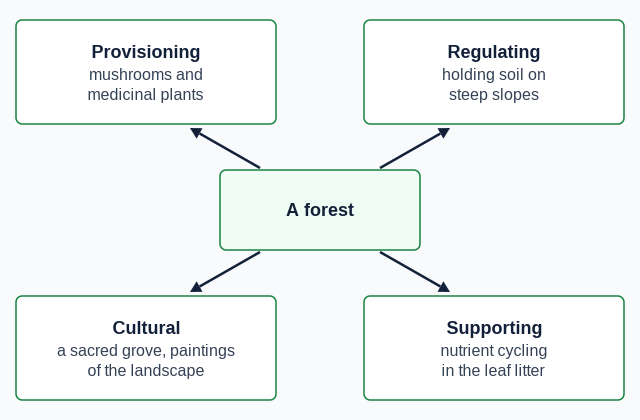 Tap to open the picture full size
Part 1 Think first The marsh nobody used
Commit to a guess first. Being wrong now makes the right idea stick better.
Predict first
A town has a marsh at its low edge, beside a river. Nobody fishes there, farms it or sells anything from it. The town council votes to fill the marsh with soil and build a shopping center on it. What do you predict happens to the town over the next twenty years?
In short. Ecosystem services are the benefits people get from ecosystems, and they fall into four categories: provisioning, regulating, cultural and supporting.
- Provisioning services are goods people harvest from ecosystems, and regulating services are natural processes that keep conditions in check.
- Cultural services are nonmaterial benefits, such as recreation, and supporting services are the processes, such as nutrient cycling, that the other services depend on.
- One ecosystem can provide services in several categories at the same time.
Part 2 Learn it Ecosystem services
2a. Four categories
Ecosystem services are the benefits people get from ecosystems. There are four categories of ecosystem services: provisioning, regulating, cultural and supporting.
- Provisioning services are the goods people take from ecosystems: food such as fish and berries, timber, fiber, fresh water and medicines.
- Regulating services are natural processes that keep conditions in check for people: wetlands slowing floods, plants cleaning water, forests taking up carbon dioxide, and predators keeping crop pests down.
- Cultural services are the nonmaterial benefits: recreation such as hiking and diving, tourism, education, spiritual meaning and beauty.
- Supporting services are the basic processes that every other service depends on: soil formation, nutrient cycling, and producers capturing the sun's energy.
A quick way to start: if people carry it away, it is provisioning. If it protects or cleans, it is regulating. If people go there for the experience, it is cultural. If it is working underneath everything else, it is supporting.
Quick check · Multiple choice
Which of these is a regulating service?
2b. Telling them apart
Most mix-ups come from two places.
Regulating or supporting? Both are processes, not goods. A regulating service acts on conditions people feel directly: a flood that does not happen, cleaner water, a milder climate. A supporting service works underneath and reaches people only through other services: soil formation and nutrient cycling are why a forest can grow timber at all.
Cultural or provisioning? It depends on what people get. A family that catches fish to eat is using a provisioning service. A visitor who pays to watch whales, and takes nothing home but the experience, is using a cultural service. Money changing hands does not decide it.
One ecosystem can provide all four at once. A coral reef provides fish to eat (provisioning), breaks storm waves before they reach the shore (regulating), draws divers (cultural), and cycles nutrients that keep its producers growing (supporting).
Quick check · Match
Each benefit comes from a river and the land around it. Match each benefit to its category of ecosystem service.
2c. People can disrupt services
Storms, droughts and fires can disrupt ecosystem services, but so can people. Anthropogenic activities, the activities of humans, can disrupt ecosystem services. Clearing a forest, draining or filling a wetland, damming a river, overfishing a reef, spraying pesticides or paving over land can each remove a service, or several at once.
A service can be disrupted even when nobody was using the ecosystem for anything they could sell. A wetland that nobody fished or farmed was still slowing floods and cleaning water. When it is gone, those regulating services are gone too.
The disruption is often hidden at first. Timber from a cleared slope is easy to count; the soil that washes off the bare slope in the next storm, and the cleaner water the forest used to provide, show up later and somewhere else.
Quick check · Decide and justify
A town paves over a small wetland to build a parking lot. A student says this cannot disrupt any ecosystem service, because nobody used the wetland for food, timber or anything else they could sell. Is the student right?
Which reason supports your answer?
2d. Economic and ecological consequences
Disrupting an ecosystem service can result in economic and ecological consequences.
- An economic consequence costs people money or income: a harvest that shrinks, a business that loses customers, or a service people now have to pay to replace, such as a treatment plant to clean water a forest once cleaned for free.
- An ecological consequence is a change to the ecosystem itself: species that lose food or habitat, a community that changes, a process that slows.
A disruption can have both. Suppose a pesticide kills the wild insects that pollinate a valley's fruit trees. Growers harvest less fruit, or pay to bring in hives of bees: economic. The wild plants those insects also visited set less seed, and the birds that eat that seed have less food: ecological.
A service that never had a price can still have a large cost once it is gone.
Quick check · Select all
A coastal town lets developers fill in the seagrass meadows in its bay to build a marina. Young fish of many species had sheltered in the seagrass. Which two statements correctly describe consequences of this disruption? Pick two.
Select 2 answers, then check.
Part 3 Watch it done Pricing a lost service
Open each step in turn, answer the why, then finish the calculation yourself.
Suppose a city gets its drinking water from a river that flows out of a forested watershed, and the forest keeps the water clean enough to drink with little treatment. A logging company offers the city 1.5 million dollars to log the watershed. Without the forest, the city would need a treatment plant that costs 6 million dollars to build and 0.4 million dollars a year to run. The numbers are made up for practice. Over the first 10 years, how much more would replacing the forest's service cost than the logging earns?
Step 1 · Name each number
1.5 million dollars is what logging earns, once. 6 million dollars is the cost to build the plant, once. 0.4 million dollars is the cost to run it, every year.
Step 2 · Find the running cost for 10 years
million dollars.
Step 3 · Find the total cost of replacing the service
Build plus run: million dollars over 10 years.
Why this step?
Why is the forest's clean water an ecosystem service, and which category?
It is a benefit the city gets from the ecosystem: the forest keeps the river clean, a condition kept in check for people. The water itself is provisioning; the forest keeping it clean is regulating. Logging is an anthropogenic activity that would disrupt it, and the treatment plant is the economic consequence.
Your step · Calculate
Finish it. In a made-up example, logging a city's forested watershed would earn 1.5 million dollars once. Without the forest, the city would need a treatment plant costing 6 million dollars to build and 0.4 million dollars a year to run. Over the first 10 years, how much more would replacing the forest's service cost than the logging earns? Give your answer in millions of dollars.
million dollars
The forest's clean water never had a price, but replacing it costs far more than the logging brings in. That is an economic consequence of disrupting a regulating service.
Part 4 Try it Underneath and alongside
The two services people most often leave out are the ones they never pay for: the supporting processes underneath, and the experiences they come back for.
Try it · Sort it
Each card is a benefit people get from a prairie, a river or a coast. Tap a card, then its category of ecosystem service.
Cultural
Supporting
Try it · Put it in order
A town lies on a river below steep, forested hills. Put the events in order, from the human activity to its cost for the town.
Part 5 Explain it A reef and its visitors
Write your answer first. Nothing you type here leaves this page. Then compare it with the model and each scoring point.
Free response is 40% of the exam score. This one is shaped like Question 2, Analyze and interpret quantitative data.
Free-response practice · Question 2 style
Suppose runoff from new construction and the anchors of tour boats damage a coral reef off a small island. Scientists record the reef's live coral cover, and the island's tourism office records how many visitors come to dive. The numbers are made up for practice.
- Year: 2000, 2005, 2010, 2015, 2020
- Live coral cover, percent of the reef: 45, 38, 30, 22, 18
- Dive visitors, thousands per year: 60, 52, 41, 30, 24
(a) Describe the trend in live coral cover from 2000 to 2020.
(b) Describe the relationship between live coral cover and the number of dive visitors.
(c) Identify the category of ecosystem service that diving on the reef provides.
(d) Calculate the percent decrease in dive visitors from 2000 to 2020. Show your work.
(e) Describe one economic consequence and one ecological consequence of the damage to the reef.
Model answer
(a) Live coral cover fell every five years, from 45% of the reef in 2000 to 18% in 2020.
(b) As live coral cover decreased, the number of dive visitors decreased too. The two fell together in every interval.
(c) Diving is a cultural service: visitors come for the experience and take nothing away.
(d) decrease.
(e) Economic: dive shops, boat operators and hotels on the island lose customers and income. Ecological: fish and other animals that live on the coral lose their habitat and food, so the reef community changes.
Score your own answer. This is a self-check, not a grade. Tick each point your answer makes.
Part 6 Check yourself A coast without its mangroves
The first two questions use the table.
Suppose a coastal town clears much of its mangrove forest, a forest of salt-tolerant trees along the shore, for shrimp ponds and houses. Young fish shelter among the mangrove roots, and the trees break storm waves before they reach the town. The numbers below are made up for practice.
| Year | Mangrove forest (hectares) | Fish caught by local boats (metric tons) | Yearly storm repair cost (thousand dollars) |
|---|---|---|---|
| 2000 | 900 | 410 | 120 |
| 2005 | 750 | 360 | 160 |
| 2010 | 520 | 270 | 240 |
| 2015 | 380 | 200 | 330 |
| 2020 | 300 | 170 | 390 |
Case question 1 · Multiple choice
Using the table of the coastal town: which two categories of ecosystem service do the data give evidence the town is losing as the mangroves are cleared?
Case question 2 · Calculate
Using the table of the coastal town: by what percent did the fish caught by local boats decrease from 2000 to 2020? Give your answer as a percent.
The rest stand on their own and do not use the case.
Check yourself · Spot the error
A student explains what happened after a river was dammed. Tap the first line that goes wrong.
Check yourself · Fill the statement
Suppose a city fills in the salt marsh along its harbor to build warehouses. The marsh used to soak up storm surges before they reached the streets. Tap a blank, then an answer.
Soaking up storm surges is a service of the kind, so filling the marsh removes it. The city now pays to build a sea wall, which is a consequence of the kind.
Part 7 Keep it Bring back earlier ideas
Two questions from earlier topics: what habitat loss does to species, in order, and what happens to a field when its decomposers die.
From 2.1 Introduction to Biodiversity · Put it in order
Over 30 years, roads and farms cut a large forest into smaller and smaller patches. Put these events in the order they usually happen, first to last.
From 1.9 Trophic Levels · Put it in order
Suppose a chemical spilled on a field kills its decomposers, and the field is farmed for several years afterward. Put the effects in the order they happen.
In three lines
- There are four categories of ecosystem services: provisioning (goods people take), regulating (conditions kept in check), cultural (nonmaterial benefits) and supporting (the processes underneath the others).
- Anthropogenic activities, such as clearing, draining, damming and overfishing, can disrupt ecosystem services.
- Disrupting a service can result in economic consequences, costs to people, and ecological consequences, changes to the ecosystem, even when the service never had a price.
Exam strategy for this topic
- Section I, Multiple Choice: 80 questions in 90 minutes.
- Section II, Free Response: 3 questions in 70 minutes.
- This lesson's Explain it is shaped like free-response question 2, Analyze and interpret quantitative data.
- A four-function, scientific, or graphing calculator is allowed on both sections of the exam.
When a question asks for a consequence of disrupting a service, say what people did, name the service it removed, and give one economic and one ecological consequence if both are asked. Label which is which.
Questions students ask
What are ecosystem services?
The benefits people get from ecosystems. There are four categories: provisioning, regulating, cultural and supporting.
What is the difference between regulating and supporting services?
Regulating services act on conditions people feel directly, such as floods and water quality. Supporting services, such as soil formation and nutrient cycling, work underneath and make the other services possible.
Is tourism a provisioning service?
No. Visitors pay, but they take home an experience, not a good, so tourism and recreation are cultural services.
How do humans disrupt ecosystem services?
Anthropogenic activities such as clearing forests, filling wetlands, damming rivers and overfishing can disrupt ecosystem services, with economic and ecological consequences.
Course alignment, for teachers
AP Environmental Science topic 2.2, Unit 2: The Living World: Biodiversity.
- Skill 1.B: Explain environmental concepts and processes.
This lesson maps all 2 essential knowledge statements of the topic to the part that teaches each one: 2 are checked by a scored question. The map is in the lesson file.