Unit 5 · Topic 5.8 · about 30 minutes · 7 parts · 10 scored checks, 2 of them multiple choice, plus 2 from earlier lessons
AP Environmental Science 5.8: Impacts of Overfishing
Unit 5: 10 to 15% of the multiple-choice section
What you'll be able to do
- Describe causes of and problems related to overfishing.
Key vocabulary
| Term | What it means | The exam trap |
|---|---|---|
| Fish stock | The population of one fish species in an area that people fish. | A stock is one species in one place, not all the fish in the sea. |
| Overfishing | Fishing a stock more heavily than it can sustain. | It can happen while other fish in the same sea are still common. |
| Biodiversity | The variety of life in an area, including the number of species. | It counts kinds of living things, not just the total number of fish. |
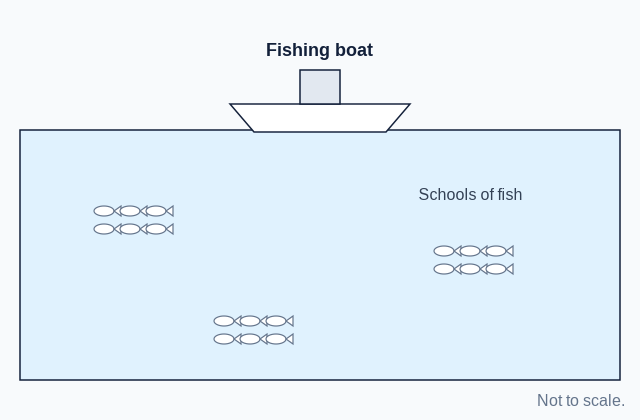 Tap to open the picture full size
Part 1 Think first A reef without its sharks
Commit to a guess first. Being wrong now makes the right idea stick better.
Predict first
Fishing boats take so many of a coral reef's sharks that few are left. What do you predict happens to the rest of the reef's life?
In short. Overfishing is fishing a fish stock more heavily than it can sustain.
- This lesson follows what happens to a fish stock that is fished too hard.
- It traces the effects out into the ocean life around the stock.
- It also looks at the people and towns that rely on the catch.
Part 2 Learn it Too many fish taken
2a. How a fish becomes scarce
A fish stock is the population of one species in an area that people fish. Each year some fish die, some are caught, and young fish grow up to replace them. Overfishing is fishing a stock more heavily than it can sustain: the catch takes more fish than the young can replace, so the stock shrinks year after year.
Overfishing has led to the extreme scarcity of some fish species.
Background: the causes. Three are usually given:
- Open access. Where no one controls a fishing ground, each boat gains by catching more, the tragedy of the commons from 5.1.
- Demand. More people buying fish raises the price, and more boats join.
- Gear. Sonar, larger nets and bigger boats let each crew find and catch more fish.
Quick check · Multiple choice
Which pattern, kept up year after year, would most likely make a fish species extremely scarce?
2b. What scarcity does to ocean life
The extreme scarcity of a fish species can lessen biodiversity in aquatic systems.
Every species has a part in its food web. A scarce predator no longer holds down the animals it ate, so they can multiply and eat more of what they feed on. A scarce prey fish leaves its predators, such as seabirds, seals and larger fish, short of food. Changes like these can spread, and a species may be lost from an area altogether.
Biodiversity, the variety of life in an area, falls when species are lost. It can also fall when one species becomes so rare that it no longer does what it once did in the system.
Background: nets also catch animals the boats are not after, such as turtles and dolphins, which adds to the loss.
Quick check · Select all
A fishery removes most of a sea's cod, which eat smaller fish and shrimp. Which two are likely? Pick two.
Select 2 answers, then check.
2c. What scarcity does to people
Overfishing can also harm people who depend on fishing for food and commerce.
- Food. Many coastal families eat what they catch. When the fish grow scarce, they buy other food or go without.
- Commerce. Each boat lands less, so fishers earn less. Fish markets, processing plants, boatyards and the shops that serve them lose business, and a town built on one fish can lose its main source of jobs.
Background: the harm can outlast the fishing, as a stock that has crashed can take many years to recover, if it recovers at all.
Background: responses. The usual ones are catch limits (a cap on the metric tons caught each year), protected areas closed to fishing, rules on gear and net size, and fishing seasons that spare spawning fish.
Quick check · Decide and justify
A harbor town's boats have overfished its cod until few are left. A student says the collapse harms the cod and the sea, but not the town's people, as long as the boats can still go out. Is the student right?
Which reason supports your answer?
Part 3 Watch it done How far did the stock fall?
Open each step in turn, answer the why, then finish the calculation yourself.
A made-up cod stock fell from 400,000 metric tons to 58,000 metric tons over 25 years of heavy fishing. By what percent did the stock fall?
Step 1 · Find the fall
metric tons.
Why this step?
Why divide by 400,000 and not by 58,000?
A percent fall compares the loss with where the stock started. The stock started at 400,000 metric tons.
Step 2 · Set up the percent
Divide the fall by the starting stock, and multiply by 100.
Your step · Calculate
Finish it. A made-up cod stock fell from 400,000 metric tons to 58,000 metric tons over 25 years of heavy fishing. By what percent did it fall?
%
The stock lost 85.5% of its size, leaving about one fish in seven. That is extreme scarcity, and the boats, buyers and predators that depended on the cod all feel it.
Part 4 Try it Causes and results, then check an account
First sort six statements into causes of overfishing and problems it leads to. Then find where a student's account of a fishing town goes wrong.
Try it · Sort it
Is each statement a cause of overfishing or a problem it leads to? Tap a card, then its group.
Cause
Problem it leads to
Try it · Spot the error
A student explains how overfishing harms a fishing town. Tap the first line that goes wrong.
Part 5 Explain it A fishing village's catch
Write your answer first. Nothing you type here leaves this page. Then compare it with the model and each scoring point.
Free response is 40% of the exam score. This one is shaped like Question 3, Analyze an environmental problem doing calculations.
Free-response practice · Question 3 style
A made-up fishing village's boats fish a shared bay that no one controls. In 2000 they landed 2,400 metric tons of a fish called hake; by 2020 they landed 600 metric tons. Hake sells for 2,000 dollars a metric ton. The hake ate small fish and squid, and seals in the bay ate the hake.
(a) Describe one likely cause of the overfishing of the hake.
(b) Calculate the percent decrease in the hake landed from 2000 to 2020. Show your work.
(c) Calculate how much less money the village earned from hake in 2020 than in 2000. Show your work.
(d) Describe how the hake's scarcity could lessen biodiversity in the bay.
(e) Describe one response the village could take to overfishing, and explain how it would help the hake recover.
Model answer
(a) No one controls the bay, so each boat gains by catching more while the cost of a shrinking stock is shared, and the boats take more hake than young hake replace.
(b) metric tons. decrease.
(c) dollars less a year.
(d) With few hake, the seals that ate them go short of food, and the small fish and squid the hake ate can change in number, so species can be lost from the bay.
(e) Closing part of the bay to fishing would leave hake there to grow and breed, so more young hake would be added each year than the boats take, and the stock could grow back.
Score your own answer. This is a self-check, not a grade. Tick each point your answer makes.
Part 6 Check yourself A catch limit
The first two questions use the table.
A made-up fishing ground was fished with no limit until 2012, when a catch limit of 10 thousand metric tons a year was set and kept. The table shows the stock of fish in the water, the catch and the limit. The numbers are made up for practice.
| Year | Fish stock (thousand metric tons) | Catch (thousand metric tons) | Catch limit |
|---|---|---|---|
| 2004 | 220 | 60 | None |
| 2008 | 120 | 45 | None |
| 2012 | 70 | 30 | Set at 10 |
| 2016 | 95 | 10 | 10 |
| 2020 | 150 | 10 | 10 |
Case question 1 · Multiple choice
Using the table: what do the data suggest about the catch limit as a response to overfishing?
Case question 2 · Calculate
Using the table: by what percent did the fish stock rise from 2012 to 2020?
The rest stand on their own and do not use the case.
Check yourself · Fill the statement
Complete the account of one sea's cod.
Trawlers took most of a sea's cod until only a few were left, so the cod became . The shrimp the cod ate then boomed, and a seal that fed on cod was lost from the area, so the sea's was lessened.
Check yourself · Rank it
A cod stock that three made-up towns fish collapses. Rank the towns by how much harm the collapse is likely to do their people.
Most harm first
Give each one a place, 1 for first. Give two the same place if they are equal.
Your ranking: none yet
Part 7 Keep it Bring back earlier ideas
Two questions from earlier topics: what a free-range label does and does not tell a shopper, and a student's account of salty farm soil.
First decide whether a shopper reads a meat label rightly. Then find where a student's account of overgrazing goes wrong.
From 5.7 Meat Production Methods · Decide and justify
A shopper sees "free-range" on a package of beef and concludes the cattle were never given antibiotics. Is the shopper right?
Which reason supports your answer?
First rank three irrigation types by the water they lose. Then find where a student's account of salty farm soil goes wrong.
From 5.5 Irrigation Methods · Spot the error
A student explains how irrigated soil can turn salty. Tap the first line that goes wrong.
In three lines
- Overfishing, taking more fish than the young replace, has led to the extreme scarcity of some fish species.
- A species' scarcity reaches its predators and prey and can lessen biodiversity in aquatic systems.
- It harms people who depend on fishing for food and commerce; catch limits and closed areas are common responses.
Exam strategy for this topic
- Section I, Multiple Choice: 80 questions in 90 minutes.
- Section II, Free Response: 3 questions in 70 minutes.
- This lesson's Explain it is shaped like free-response question 3, Analyze an environmental problem doing calculations.
- A four-function, scientific, or graphing calculator is allowed on both sections of the exam.
When a question asks about the problems overfishing causes, name all three: the species becomes extremely scarce, biodiversity in the aquatic system can be lessened, and people who depend on fishing for food and commerce are harmed.
Questions students ask
What has overfishing done to fish species?
Overfishing has led to the extreme scarcity of some fish species.
How does overfishing affect biodiversity?
The extreme scarcity of a species can lessen biodiversity in aquatic systems, as its predators and prey are affected.
Who is harmed by overfishing besides the fish?
People who depend on fishing for food and commerce: fishers, fish businesses and families who eat the fish.
Course alignment, for teachers
AP Environmental Science topic 5.8, Unit 5: Land and Water Use.
- Skill 7.B: Describe potential responses or approaches to environmental problems.
This lesson maps the one essential knowledge statement of the topic to the part that teaches each one: 1 is checked by a scored question. The map is in the lesson file.