Unit 3 · Topic 3.1 · about 30 minutes · 7 parts · 10 scored checks, 3 of them multiple choice, plus 2 from earlier lessons
AP Environmental Science 3.1: Generalist and Specialist Species
Unit 3: 10 to 15% of the multiple-choice section
What you'll be able to do
- Identify differences between generalist and specialist species, and explain which kind tends to be advantaged when a habitat remains constant or is changing.
Key vocabulary
| Term | What it means | The exam trap |
|---|---|---|
| Specialist species | A species that needs a narrow range of food or conditions, such as one kind of food or one kind of place to breed. | Read the question for what the species uses before you name it. |
| Generalist species | A species that can use a wide range of food or conditions. | A generalist need not eat everything around it; it needs only a wide range. |
| Habitat | The place and conditions where a species lives and finds what it needs. | Read whether the habitat in a question remains constant or is changing before you decide anything about the species in it. |
 Tap to open the picture full size
Part 1 Think first The town and the two birds
Commit to a guess first. Being wrong now makes the right idea stick better.
Predict first
Suppose a town spreads over the fields around it for 20 years, turning tall grass into streets, lawns and yards. Two kinds of bird lived in the fields. One eats only grasshoppers that live in tall grass. The other eats seeds, insects, berries and food from bird feeders. The situation is made up for practice. Which bird do you predict has kept more of its numbers 20 years later?
In short. Generalist and specialist species differ in how wide a range of food and conditions they can use.
- A specialist needs a narrow range of food or conditions; a generalist can use a wide range.
- Which kind tends to be advantaged depends on whether its habitat remains constant or is changing.
- Both words describe a species' needs, which you read from what it eats and where it lives or breeds.
Part 2 Learn it Generalist and specialist species
2a. Narrow needs or wide needs
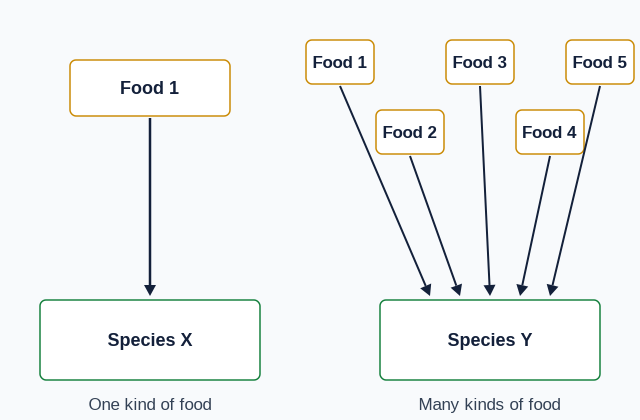
Species differ in how wide a range of food and conditions they can use.
- A specialist species needs a narrow range: one or a few kinds of food, or one kind of place to live or breed. A made-up bee that collects pollen from a single kind of flower is a specialist.
- A generalist species can use a wide range: many kinds of food, many kinds of places. A made-up mouse that eats seeds, insects and fruit, and nests in fields, hedges or sheds, is a generalist.
The difference is about the range of needs, not about numbers. A specialist can be the most common animal in its home, and a generalist can be rare. To decide which kind a species is, count the kinds of food or conditions it can use, not the individuals.
Quick check · Sort it
Each card describes a made-up species. Tap a card, then the kind of species it is.
Specialist
Generalist
2b. When a habitat remains constant
Specialist species tend to be advantaged in habitats that remain constant.
Suppose a spring-fed pool has stayed the same temperature, with the same plants and the same insects, for thousands of years. A made-up fish there eats only one kind of snail on the pool's weeds. Because the pool does not change, the snail keeps being there year after year, and the fish is very good at finding and eating it. Nothing in the pool rewards being able to eat other foods.
Two words matter here. Constant means the habitat's conditions and resources stay about the same over time. Tend to means this is a pattern, not a law: in a constant habitat a specialist is usually, not always, the one that does well.
So before you decide anything about a specialist, read what its habitat is doing.
Quick check · Multiple choice
A cave stream has stayed dark, about 12 degrees C and fed by the same water for thousands of years. Two made-up shrimp live there: one eats only a film of bacteria on the cave rocks, and the other eats bacteria, dead insects and plant bits washed in. Which shrimp tends to be advantaged in this cave?
2c. When a habitat is changing
Generalist species tend to be advantaged in habitats that are changing.
A habitat can change because people clear, plow, build on or drain it, or because of floods, fires and droughts. When it changes, some foods and places disappear and others appear. A specialist whose one food or place is lost has little else to use. A generalist can switch to whatever is left or whatever is new.
Suppose a made-up gull eats fish, insects and garbage, and nests on cliffs, beaches or rooftops. When a harbor is filled in and a city grows around it, the gull eats garbage and nests on roofs, and its numbers hold up.
The same tend to applies. A changing habitat does not doom every specialist; it makes a generalist more likely to come out ahead.
Common mistakes are below.
Quick check · Decide and justify
Over ten years, much of a wetland is drained into farm fields and ditches, though a few bogs are left. A made-up frog there breeds only in one kind of mossy bog. A student says that because the wetland is changing, the frog is certain to disappear from the area. Is the student right?
Which reason supports your answer?
Part 3 Watch it done Two butterflies on a prairie
Open each step in turn, answer the why, then finish it yourself.
Suppose two made-up butterflies live on a prairie. The first one's caterpillars eat only one plant, a flower that grows in the prairie. The second one's caterpillars eat the leaves of more than 20 plants, including garden and roadside plants. Over 15 years, the prairie is plowed bit by bit for farms and roads. Which butterfly tends to be advantaged, and why?
Step 1 · Name the first butterfly
Its caterpillars eat one plant, a narrow range of food, so it is a specialist.
Step 2 · Name the second butterfly
Its caterpillars eat more than 20 plants, a wide range, so it is a generalist.
Why this step?
Why look at the habitat before deciding which one comes out ahead?
Neither kind is advantaged everywhere. Which one tends to be advantaged depends on whether the habitat remains constant or is changing.
Step 3 · Name what the habitat is doing
The prairie is plowed bit by bit for 15 years, so the habitat is changing.
Your step · Multiple choice
Finish it. Two made-up butterflies live on a prairie that is plowed bit by bit for farms and roads over 15 years. One's caterpillars eat only one prairie flower; the other's eat more than 20 plants, including garden and roadside plants. Which butterfly tends to be advantaged, and why?
As the flower is plowed under, the specialist has nowhere else to lay its eggs. The generalist lays them on roadside and garden plants instead. That is a tendency, not a guarantee: the specialist may hang on in patches of prairie that are left.
Part 4 Try it Changing or constant, and an explanation to check
First decide which habitats are changing. Then find where a student's explanation goes wrong.
Try it · Select all
Which two of these are changing habitats, where generalist species tend to be advantaged? Pick two.
Select 2 answers, then check.
Try it · Spot the error
A student explains how a made-up tree frog will fare after its forest is cut down for farms. Tap the first line that goes wrong.
Part 5 Explain it Beetles in changed and unchanged plots
Write your answer first. Nothing you type here leaves this page. Then compare it with the model and each scoring point.
Free response is 40% of the exam score. This one is shaped like Question 1, Design an investigation.
Free-response practice · Question 1 style
Suppose researchers want to test whether a changing habitat favors a generalist species over a specialist species. A grassland holds two made-up ground beetles: one eats only the seeds of one grass, and the other eats the seeds of many plants, insects and dead matter. The researchers have 20 grassland plots of the same size. The situation is made up for practice.
(a) Identify a testable hypothesis for the investigation.
(b) Identify the independent variable and the dependent variable.
(c) Describe the control, and identify one variable that should be held constant.
(d) Describe one way the design makes its results more reliable.
(e) Describe the results that would support your hypothesis.
Model answer
(a) In plots that are plowed and replanted with a different crop each year, the many-food beetle will keep a larger share of its starting numbers than the one-grass beetle.
(b) Independent variable: whether a plot is plowed and replanted each year or left as grassland. Dependent variable: the number of each beetle species in a plot at the end of each year, as a share of its starting count.
(c) Control: plots left as grassland. Held constant: plot size, or counting with the same traps on the same dates in every plot.
(d) Assign 10 plots to each treatment at random, and repeat the counts for several years.
(e) In the changed plots, the many-food beetle keeps a larger share of its starting count than the one-grass beetle, while in the grassland plots the one-grass beetle does at least as well. (This design cannot tell change itself from the loss of the one grass; a stricter design would change the plots in ways that leave some of that grass.)
Score your own answer. This is a self-check, not a grade. Tick each point your answer makes.
Part 6 Check yourself Two birds in two parts of a forest
The first two questions use the table.
Suppose researchers count two made-up bird species in two areas of one forest, ten years apart. Area 1 was left alone. In area 2, much of the forest was cleared for farms and houses. The pine bird nests only in old pines and eats pine seeds. The many-food bird eats seeds, insects, fruit and scraps, and nests in trees, hedges or buildings. The numbers are made up for practice.
| Area | Species | Year 1 | Year 11 |
|---|---|---|---|
| Area 1, left alone | Pine bird | 80 | 84 |
| Area 1, left alone | Many-food bird | 40 | 38 |
| Area 2, cleared | Pine bird | 80 | 20 |
| Area 2, cleared | Many-food bird | 40 | 64 |
Case question 1 · Multiple choice
Using the table of birds counted in two areas: which conclusion is supported by the data?
Case question 2 · Calculate
Using the table of birds counted in two areas: by what percent did the number of pine birds in area 2 fall from year 1 to year 11? Give your answer as a percent.
The rest stand on their own and do not use the case.
Check yourself · Decide and justify
A deep lake's water has stayed the same for 20,000 years. One made-up worm there eats only one kind of alga; another eats many foods. A student says the alga-eating worm can be the one that tends to be advantaged in this lake, even though the other worm can use more foods. Is the student right?
Which reason supports your answer?
Check yourself · Fill the statement
Suppose a mountain bog has had the same cold, acid water and the same mosses for 8,000 years, and a made-up plant there grows only on one kind of moss. Tap a blank, then an answer.
The plant is a species, the bog is a habitat, and in a habitat like this a plant like it tends to be .
Part 7 Keep it Bring back earlier ideas
Two questions from earlier topics: whether a lichen can be an indicator species, and how long different natural disruptions last.
Two new situations: a student's reasoning about an indicator, and a model of the stages of succession.
From 2.7 Ecological Succession · Spot the error
A student reasons about a lichen on trees in two towns. Tap the first line that goes wrong.
Disruptions differ in how long they take, and a slow one can still change a great deal.
From 2.5 Natural Disruptions to Ecosystems · Rank it
Three natural processes change ecosystems. Rank them by the time scale they operate on.
Shortest time scale first
Give each one a place, 1 for first. Give two the same place if they are equal.
Your ranking: none yet
In three lines
- A specialist species needs a narrow range of food or conditions; a generalist species can use a wide range.
- Specialist species tend to be advantaged in habitats that remain constant.
- Generalist species tend to be advantaged in habitats that are changing.
Exam strategy for this topic
- Section I, Multiple Choice: 80 questions in 90 minutes.
- Section II, Free Response: 3 questions in 70 minutes.
- This lesson's Explain it is shaped like free-response question 1, Design an investigation.
- A four-function, scientific, or graphing calculator is allowed on both sections of the exam.
In a question about specialists and generalists, name the kind of species, then say whether the habitat remains constant or is changing, then say which kind tends to be advantaged. Keep the word tends.
Questions students ask
What is the difference between a specialist and a generalist species?
A specialist needs a narrow range of food or conditions. A generalist can use a wide range.
Where do specialist species tend to be advantaged?
In habitats that remain constant.
Where do generalist species tend to be advantaged?
In habitats that are changing.
Is a common species always a generalist?
No. Specialist and generalist describe the range of needs, not the number of individuals.
Course alignment, for teachers
AP Environmental Science topic 3.1, Unit 3: Populations.
- Skill 1.B: Explain environmental concepts and processes.
This lesson maps the one essential knowledge statement of the topic to the part that teaches each one: 1 is checked by a scored question. The map is in the lesson file.