Unit 7 · Topic 7.3 · about 30 minutes · 7 parts · 10 scored checks, 2 of them multiple choice, plus 2 from earlier lessons
AP Environmental Science 7.3: Thermal Inversion
Unit 7: 7 to 10% of the multiple-choice section
What you'll be able to do
- Describe thermal inversion and its relationship with pollution.
Key vocabulary
| Term | What it means | The exam trap |
|---|---|---|
| Temperature gradient | The way air temperature changes as height above the ground increases. | A gradient describes a change from one height to another, not a single reading. |
| Altitude | Height above the Earth's surface or above sea level. | Altitude is a height, not a temperature or a pressure. |
| Particulates | Tiny solid or liquid bits suspended in the air. | Particulates include liquid droplets, not only solid grains. |
 Tap to open the picture full size
Part 1 Think first Smoke that will not rise
Commit to a guess first. Being wrong now makes the right idea stick better.
Predict first
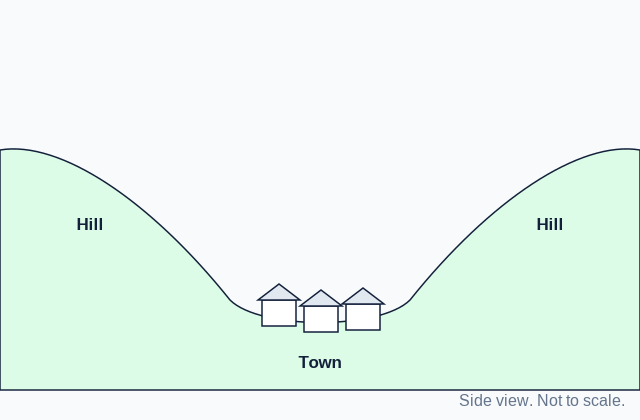
In a made-up valley town, smoke from the chimneys usually rises and drifts away. On some still winter mornings, a thermometer on a hilltop reads warmer than one on the valley floor, and the smoke spreads out in a flat gray layer just above the rooftops for hours. What do you predict keeps the smoke from rising on those mornings?
In short. A thermal inversion is a layer of warmer air sitting over cooler air at the Earth's surface, the reverse of the normal temperature gradient.
- Normally, the air at the surface is the warmest, and it gets cooler with height.
- An inversion traps pollution close to the ground, smog and particulates most of all.
- An inversion adds no pollution of its own; it holds down what cars, chimneys and roads release.
Part 2 Learn it Warm air over cool air
2a. The usual pattern
Normally, the air at the Earth's surface is the warmest, and the air gets cooler as you go higher. That is the normal temperature gradient, the way air temperature changes with height.
The ground soaks up sunlight and warms the air touching it. Warm air is less dense than the cooler air above it, so it rises. As it rises it mixes upward, and it carries smoke, car exhaust and dust up and away from the streets where people breathe.
A hiker who climbs a mountain trail on an ordinary summer afternoon walks into cooler air the higher she goes.
Quick check · Multiple choice
A made-up TV tower carries thermometers 10, 150 and 300 meters above the ground. On an ordinary sunny afternoon, what do they most likely show?
2b. The pattern flips
During a thermal inversion, the normal temperature gradient is altered: the air at the Earth's surface is cooler than the air at higher altitudes.
A layer of warmer air sits on top of a layer of cooler air near the ground. A balloon rising through an inversion reads warmer air as it climbs out of the cool surface layer into the warm layer. Only above the warm layer does the air turn cooler with height again.
An inversion is not the same as a cold day. A freezing morning with the usual pattern, coldest air on top, is no inversion; what matters is whether the surface air is cooler than the air above it.
Background: inversions often form on clear, calm nights, when the ground loses heat fast and chills the air touching it, and they are common in valleys ringed by hills.
Quick check · Decide and justify
At dawn, a made-up weather station reads 4 °C at the ground and 9 °C on a tower 300 meters up. A student says the station is in a thermal inversion. Is the student right?
Which reason supports your answer?
2c. Pollution held down
A thermal inversion traps pollution close to the ground, especially smog and particulates.
The cool surface air is denser than the warm layer above it, so it cannot rise up through that layer. The warm layer works like a lid. Exhaust from cars, smoke from chimneys and dust from roads stay in the thin layer of air where people live, and they build up for as long as the inversion lasts. The inversion makes no pollution of its own; it holds down what is already released.
Smog, from the last topic, and particulates, tiny solid or liquid bits in the air, are the pollution an inversion holds down most of all.
Background: when sunshine warms the ground or a strong wind stirs the layers, the inversion breaks up and the pollution can rise and spread.
Quick check · Select all
A made-up inversion settles over a river city for three days in January. Which two outcomes are most likely? Pick two.
Select 2 answers, then check.
Part 3 Watch it done How fast does the air cool?
Open each step in turn, answer the why, then finish the calculation yourself.
A made-up weather balloon is released on a clear afternoon with no inversion. Its thermometer reads 14 °C at the ground and 6.2 °C at 1,200 meters up. On average, by how many degrees does the air cool for each 100 meters of height?
Step 1 · Find the drop
°C cooler at the top of the climb.
Why this step?
Why is the air at the top cooler than the air at the ground this afternoon?
With no inversion, the normal gradient holds: the ground warms the air touching it, and the air gets cooler with height.
Step 2 · Choose the operation
1,200 meters is 12 steps of 100 meters, so share the drop among them: .
Your step · Calculate
Finish it. The air cooled 7.8 °C over 1,200 meters. How many degrees is that for each 100 meters?
°C per 100 m
That steady cooling with height is the normal gradient. On an inversion morning the same balloon would first read warmer air as it rose, and the rest of the lesson asks what that means for the air people breathe.
Part 4 Try it Order an inversion, then check an account
First put the events of a made-up inversion in order. Then find where a student's account of an inversion goes wrong.
Try it · Put it in order
Put the events over a made-up valley city in order, first to last.
Try it · Spot the error
A student describes a made-up city's winter inversions. Tap the first line that goes wrong.
Part 5 Explain it A winter of inversions
Write your answer first. Nothing you type here leaves this page. Then compare it with the model and each scoring point.
Free response is 40% of the exam score. This one is shaped like Question 3, Analyze an environmental problem doing calculations.
Free-response practice · Question 3 style
A made-up valley city records its air each winter morning. The figures are made up for practice:
- January mornings with a thermal inversion: 12 of 31
- Average particulates at street level on mornings with no inversion: 18 micrograms per cubic meter
- Average particulates at street level on inversion mornings: 54 micrograms per cubic meter
(a) Calculate the percent of January mornings that had a thermal inversion. Show your work.
(b) Calculate the percent increase in average particulates on inversion mornings compared with mornings with no inversion. Show your work.
(c) Describe how air temperature changes with height on a normal morning and on an inversion morning.
(d) Explain why particulates build up near the ground during a thermal inversion.
(e) Identify one other kind of pollution, besides particulates, that a thermal inversion especially traps.
Model answer
(a) of January mornings.
(b) increase.
(c) On a normal morning the air is warmest at the surface and cools with height. On an inversion morning the air at the surface is cooler than the air at higher altitudes, so a warmer layer sits over cooler air near the ground.
(d) The cool surface air is denser than the warm layer above it, so it cannot rise through it. Particulates from traffic, chimneys and roads stay in the air near the ground and build up.
(e) Smog.
Score your own answer. This is a self-check, not a grade. Tick each point your answer makes.
Part 6 Check yourself Two mornings over one city
The first two questions use the graph and the readings.
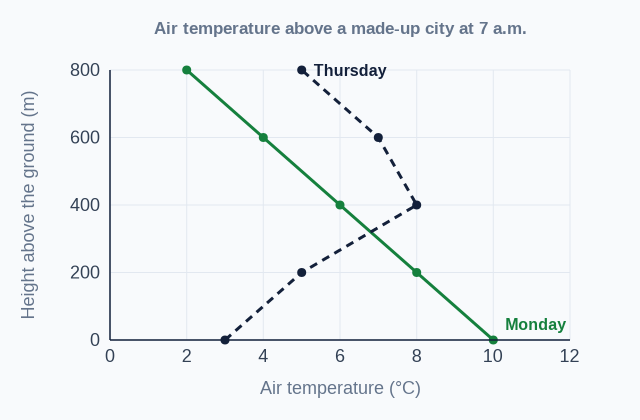
A made-up city sends up a weather balloon at 7 a.m. on two mornings and measures particulates at street level, in micrograms per cubic meter. On Monday, street-level particulates were 14. On Thursday, they were 61. The numbers are made up for practice.
 Tap to open the picture full size
Case question 1 · Multiple choice
Which statement do the graph and the readings best support?
Case question 2 · Calculate
Using the readings: by what percent were street-level particulates higher on Thursday than on Monday? Round to the nearest tenth of a percent.
The rest stand on their own and do not use the case.
Check yourself · Sort it
Each made-up balloon reading gives the air temperature at the ground and higher up at dawn. Which show a thermal inversion? Tap a card, then its group.
Normal temperature gradient
Thermal inversion
Check yourself · Fill the statement
Complete the account of a made-up harbor town's inversion.
On the inversion morning, the air at the docks was than the air on the hilltops above it, so soot from the ships' stacks built up close to the .
Part 7 Keep it Bring back earlier ideas
Two questions from earlier topics: one from the last topic, and one from the end of the energy unit.
First complete an account of a smoggy city's problem and its fix. Then find where a student's account of a smoggy day goes wrong.
From 7.2 Photochemical Smog · Fill the statement
Complete the account of a made-up city's smog.
Smog over the city can cause breathing problems and . The city can reduce it by cutting the two gases it forms from, nitrogen oxides and .
First complete a made-up town's conservation plan. Then find where a student's account of another town's plan goes wrong.
From 6.13 Energy Conservation · Spot the error
A student describes a made-up town's energy plan. Tap the first line that goes wrong.
In three lines
- Normally, the air is warmest at the surface and cools with height.
- During a thermal inversion, the air at the surface is cooler than the air at higher altitudes.
- A thermal inversion traps pollution close to the ground, especially smog and particulates.
Exam strategy for this topic
- Section I, Multiple Choice: 80 questions in 90 minutes.
- Section II, Free Response: 3 questions in 70 minutes.
- This lesson's Explain it is shaped like free-response question 3, Analyze an environmental problem doing calculations.
- A four-function, scientific, or graphing calculator is allowed on both sections of the exam.
When a question shows temperature against height, compare the surface air with the air above it. Cooler at the surface than higher up means an inversion, and an inversion holds smog and particulates near the ground.
Questions students ask
What is a thermal inversion?
A thermal inversion alters the normal temperature gradient: the air at the Earth's surface is cooler than the air at higher altitudes.
How does a thermal inversion affect pollution?
It traps pollution close to the ground, especially smog and particulates.
Why can't the pollution rise during an inversion?
The cool surface air is denser than the warm layer above it, so it cannot rise through that layer, and the pollution in it stays near the ground.
Course alignment, for teachers
AP Environmental Science topic 7.3, Unit 7: Atmospheric Pollution.
- Skill 2.C: Explain how environmental concepts and processes represented visually relate to broader environmental issues.
This lesson maps all 2 essential knowledge statements of the topic to the part that teaches each one: 2 are checked by a scored question. The map is in the lesson file.