Unit 5 · Topic 5.3 · about 30 minutes · 7 parts · 10 scored checks, 2 of them multiple choice, plus 2 from earlier lessons
AP Environmental Science 5.3: The Green Revolution
Unit 5: 10 to 15% of the multiple-choice section
What you'll be able to do
- Describe changes in agricultural practices: the Green Revolution's shift to new methods to increase food production, its positive and negative results, and the effects of mechanization.
Key vocabulary
| Term | What it means | The exam trap |
|---|---|---|
| Green Revolution | The shift to new agricultural strategies and practices to increase food production. | "Green" refers to crops, not to environmental protection. |
| Mechanization | Using machines in place of human or animal labor. | It describes how work is done, not how much the work costs. |
| Genetically modified organism (GMO) | An organism whose genes people have changed in a laboratory. | A crop bred the traditional way, by choosing parent plants, is not a GMO. |
| Efficiency | How much output a farm gets for the work and money it puts in. | More efficient does not mean using less of every input. |
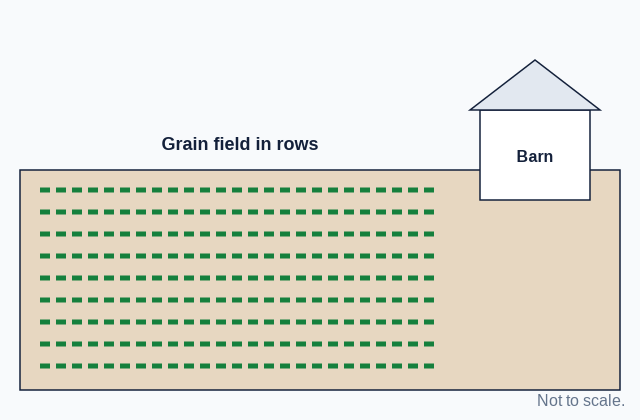 Tap to open the picture full size
Part 1 Think first Horses to tractors
Commit to a guess first. Being wrong now makes the right idea stick better.
Predict first
A farm family replaces its horses and hired hand labor with a tractor and a combine harvester. Besides getting the work done faster, what do you predict changes about what the farm depends on?
In short. The Green Revolution was a shift in the farming strategies and practices of many countries.
- It changed the tools, seeds and supplies that farms used.
- This lesson looks at its methods, what followed from them, and one method, mechanization, up close.
- Later topics in this unit look at several of its methods one by one.
Part 2 Learn it New ways to grow food
2a. A shift in how food is grown
Farms in many countries changed how they grew food. That change is called the Green Revolution. Background: it spread widely from the 1940s to the 1970s, and "green" refers to crops, not to protecting the environment.
The Green Revolution started a shift to new agricultural strategies and practices in order to increase food production, with both positive and negative results.
The goal was more food from farmland. On the positive side, many farms grew far more grain on the same fields. On the negative side, the new methods brought new costs and new kinds of environmental harm, which later topics in this unit look at one by one.
Keep both halves together. A description of the Green Revolution that names only its gains, or only its harms, leaves out half the story.
Quick check · Multiple choice
What were the new strategies and practices of the Green Revolution meant to do?
2b. Its methods
Some of these strategies and methods are mechanization, genetically modified organisms (GMOs), fertilization, irrigation, and the use of pesticides.
- Mechanization: tractors, combines and other machines take over field work.
- GMOs: crop plants with genes altered by scientists, for example to resist insects.
- Fertilization: spreading nitrogen, phosphorus and other nutrients so plants grow larger.
- Irrigation: bringing water to fields from rivers, reservoirs or wells.
- Pesticides: sprays that kill the insects, weeds and fungi that damage crops.
Each one raises yields, and each can carry a cost. Background: fertilizer can wash into streams, pumping can drain groundwater, and pests can become resistant to sprays; topics 5.4 to 5.6 teach these.
Quick check · Select all
Which two are among the Green Revolution's methods named in this lesson? Pick two.
Select 2 answers, then check.
2c. Mechanization
Mechanization of farming can increase profits and efficiency for farms. It can also increase reliance on fossil fuels.
One combine can harvest in a day a field that once took a crew of workers a week. Fewer workers for the same harvest means lower labor costs, and a farm can plant and harvest more land in the short seasons when the weather allows. That is the gain in efficiency (more output for the work and money put in) and in profit.
The machines run on diesel and gasoline, and making the fertilizers and pesticides that often come with them also uses fossil fuels. A mechanized farm's costs therefore rise and fall with fuel prices, and its fuel burning adds carbon dioxide to the air.
Quick check · Decide and justify
A rice farm buys a diesel planting machine that does in one day what took eight workers four days. A student says the machine is likely to raise the farm's profit in a normal year, and that a jump in diesel prices could now cut into it. Is the student right?
Which reason supports your answer?
Part 3 Watch it done How much labor does a combine save?
Open each step in turn, answer the why, then finish the calculation yourself.
On a made-up farm, harvesting the wheat fields by hand took 12 workers 10 days. With a combine, the same fields took 2 workers 3 days. By what percent did the number of worker-days fall?
Step 1 · Count the worker-days by hand
A worker-day is one worker working one day. worker-days.
Step 2 · Count the worker-days with the combine
worker-days.
Why this step?
Why count worker-days instead of comparing 10 days with 3 days?
The crews differ in size. Worker-days count all the labor, so they compare the work done, not only the time it took.
Step 3 · Find the drop and set up the percent
worker-days fewer. Divide the drop by where it started.
Your step · Calculate
Finish it. Harvesting a made-up farm's fields took 120 worker-days by hand and 6 worker-days with a combine. By what percent did the worker-days fall?
%
A 95% cut in labor for the same harvest: the efficiency that can raise a farm's profit. The diesel the combine burns is the other side of it.
Part 4 Try it Five methods, and one account
First match each Green Revolution method with what it does. Then find where a student's account goes wrong.
Try it · Match
Match each Green Revolution method with what it does.
Try it · Spot the error
A student sums up the Green Revolution. Tap the first line that goes wrong.
Part 5 Explain it A region's farms over forty years
Write your answer first. Nothing you type here leaves this page. Then compare it with the model and each scoring point.
Free response is 40% of the exam score. This one is shaped like Question 2, Analyze and interpret quantitative data.
Free-response practice · Question 2 style
Here are made-up averages for the grain farms of one region, made up for practice.
- 1960: yield 1.4 metric tons per hectare, fertilizer 10 kg per hectare, diesel 20 liters per hectare.
- 1980: yield 2.6 metric tons per hectare, fertilizer 60 kg per hectare, diesel 55 liters per hectare.
- 2000: yield 3.5 metric tons per hectare, fertilizer 110 kg per hectare, diesel 80 liters per hectare.
(a) Describe the trend in grain yield from 1960 to 2000.
(b) Calculate the percent increase in grain yield from 1960 to 2000. Show your work.
(c) Identify one Green Revolution method that the data show the region's farms adopting, and the figures that show it.
(d) Explain one negative result for the region that the diesel data suggest.
(e) Explain one positive result for the region that the yield data suggest.
Model answer
(a) Grain yield rose steadily, from 1.4 metric tons per hectare in 1960 to 3.5 in 2000.
(b) . increase.
(c) Fertilization: fertilizer use rose from 10 to 110 kg per hectare. (Mechanization, shown by diesel use rising from 20 to 80 liters per hectare, also fits.)
(d) Rising diesel use shows the farms relying more on fossil fuels, so their costs rise with fuel prices and their fuel burning adds carbon dioxide to the air.
(e) Higher yields mean more food grown on the same land, which raises the region's food production.
Score your own answer. This is a self-check, not a grade. Tick each point your answer makes.
Part 6 Check yourself Two writers on new farming
The first two questions use the two passages.
Two made-up writers, written for practice, describe the new farming methods.
| Writer | Passage |
|---|---|
| Writer 1, a seed company's advertisement | "Our new seed, bred to resist insects, can double your harvest. Add our fertilizer and our spray program, and your fields will feed your family and your town. Modern farming is the answer for every farm, large or small." |
| Writer 2, a letter from a farmer | "Since we started spreading the new fertilizer, our wheat has grown taller and our harvest is the biggest it has ever been. But each season the fertilizer costs us more, and last summer the pond below our fields, where the rain washes it, filled with green scum." |
Case question 1 · Multiple choice
Which assumption does Writer 1 make?
Case question 2 · Decide and justify
A student says Writer 2 sees the new fertilizer as having both positive and negative results for the farm and the land around it. Is the student right?
Which reason supports your answer?
The rest stand on their own and do not use the case.
Check yourself · Sort it
Is each a positive or a negative result of the Green Revolution's methods? Tap a card, then its group.
Positive result
Negative result
Check yourself · Calculate
After a made-up farm began irrigating and fertilizing, its wheat yield rose from 1.6 to 4.4 metric tons per hectare. By what percent did its yield increase?
Part 7 Keep it Bring back earlier ideas
Two questions from earlier topics: the results of a clearcut and their causes, and matching El Niño and La Niña records to the problems they point to.
First match each result of a clearcut with what causes it. Then find where a student's account of a forest's carbon goes wrong.
From 5.2 Clearcutting · Match
Match each result of clearcutting a hillside with its cause.
First find where a student's description of an El Niño year goes wrong. Then match five made-up records to the problem each one points to.
From 4.9 El Niño and La Niña · Match
Each made-up record comes from a place during an El Niño or La Niña year. Match it to the environmental problem it most likely points to.
In three lines
- The Green Revolution started a shift to new agricultural practices to increase food production, with both positive and negative results.
- Its methods include mechanization, GMOs, fertilization, irrigation and pesticides.
- Mechanization can increase farms' profits and efficiency, and it can also increase reliance on fossil fuels.
Exam strategy for this topic
- Section I, Multiple Choice: 80 questions in 90 minutes.
- Section II, Free Response: 3 questions in 70 minutes.
- This lesson's Explain it is shaped like free-response question 2, Analyze and interpret quantitative data.
- A four-function, scientific, or graphing calculator is allowed on both sections of the exam.
When a question asks about the Green Revolution, name the method (mechanization, GMOs, fertilization, irrigation or pesticides) and give one positive and one negative result. For mechanization, the pair is higher profits and efficiency against greater reliance on fossil fuels.
Questions students ask
What was the Green Revolution?
A shift to new agricultural strategies and practices to increase food production, with both positive and negative results.
What methods did the Green Revolution use?
Mechanization, genetically modified organisms (GMOs), fertilization, irrigation and the use of pesticides, among others.
What are the benefits and drawbacks of mechanization?
It can increase farms' profits and efficiency, and it can also increase their reliance on fossil fuels.
Course alignment, for teachers
AP Environmental Science topic 5.3, Unit 5: Land and Water Use.
- Skill 3.B: Describe the author’s perspective and assumptions.
This lesson maps all 2 essential knowledge statements of the topic to the part that teaches each one: 2 are checked by a scored question. The map is in the lesson file.