Unit 9 · Topic 9.6 · about 30 minutes · 7 parts · 10 scored checks, 2 of them multiple choice, plus 2 from earlier lessons
AP Environmental Science 9.6: Ocean Warming
Unit 9: 15 to 20% of the multiple-choice section
What you'll be able to do
- Explain the causes and effects of ocean warming.
Key vocabulary
| Term | What it means | The exam trap |
|---|---|---|
| Ocean warming | The rise in the temperature of the world's oceans over time. | Ocean warming is a change in the water's temperature, not in its saltiness or its acidity. |
| Habitat | The place where a species lives and finds what it needs. | A habitat can be lost while the place itself still exists, if it no longer suits the species. |
| Metabolism | The chemical processes by which an organism uses energy to grow, move and stay alive. | Metabolism goes on in every living organism all the time, not only while it is eating. |
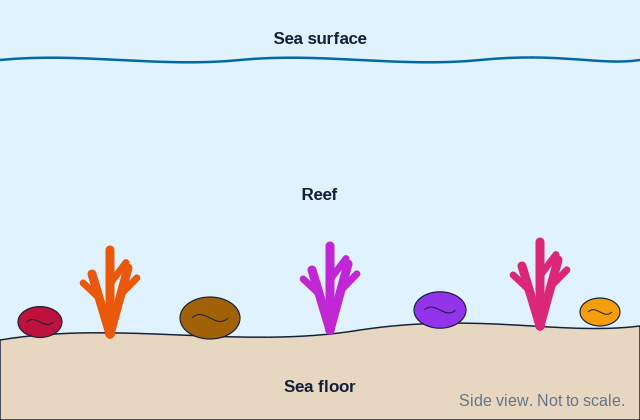 Tap to open the picture full size
Part 1 Think first White patches on a reef
Commit to a guess first. Being wrong now makes the right idea stick better.
Predict first
After an unusually warm summer, divers find that large patches of a made-up reef have turned white. Do you predict that all of the white corals are dead?
In short. Ocean warming is the rise in the temperature of the oceans, caused by the increase in greenhouse gases in the atmosphere.
- Warming can affect marine species through loss of habitat and through metabolic and reproductive changes.
- Ocean warming is causing coral bleaching: corals lose the algae living within them and turn white.
- A species can lose habitat while the sea it lives in stays as large as ever, because the water no longer suits it.
Part 2 Learn it A warmer sea
2a. Why the ocean is warming
Ocean warming is the rise in the temperature of the world's oceans over time.
Ocean warming is caused by the increase in greenhouse gases in the atmosphere. A greenhouse gas is a gas that traps heat in the atmosphere, such as carbon dioxide. As people add more of these gases, the atmosphere holds in more heat, and the oceans warm with it. The change is slow, over decades, and it reaches whole oceans, far from any coast.
Two other problems are easy to mix up with it. Warm water let out by one power plant heats the water near that plant, a local problem. A thinner stratospheric ozone layer lets more UV rays reach the surface, a different problem from the build-up of heat.
For example, a made-up research ship has lowered a thermometer at the same spot in the open sea every August since 1975, and its readings creep up a little each decade.
Quick check · Multiple choice
Scientists in a made-up island nation find that the water around its islands, and across the whole ocean beyond them, has warmed slowly for 40 years. Which is the cause their report should name?
2b. What warming does to marine species
Ocean warming can affect marine species in a variety of ways, including loss of habitat, and metabolic and reproductive changes.
- Loss of habitat. A species' habitat is the place where it lives and finds what it needs. When the water a species lives in warms past what suits it, that place stops being habitat for it, even though the water is still there.
- Metabolic changes. An organism's metabolism is the set of chemical processes by which it uses energy to grow, move and stay alive. Water temperature can change those processes, and with them how much food the organism needs.
- Reproductive changes. Warming can change when a species breeds, or how many of its young survive.
None of these needs the heat to kill an animal outright. A population can shrink because it has lost the places it lives, because its members need more food than they can find, or because fewer young are born.
For example, a made-up clam that lives only in cold water finds fewer beds where the bay is cold enough for it.
Quick check · Decide and justify
In a made-up sea that has warmed over 20 years, divers count as many adult rockfish on a reef as they did before the warming. A student concludes that the warming has had no effect on the rockfish. Is the conclusion justified?
Which reason supports your answer?
2c. Coral bleaching
Reef-building corals have tiny algae living within them, and the algae give a coral much of its color. Algae are simple living things that make their own food from sunlight.
Ocean warming is causing coral bleaching. When the water around a reef gets too warm, corals lose the algae within them, and that loss of algae makes the corals bleach white.
Some corals recover and some die. A white coral is not automatically dead. Some bleached corals regain their color and live on; others die.
For example, during a hot August a made-up lagoon's corals pale to white, and a dive team ties a tag to each white colony so it can check on that colony in the months ahead.
Quick check · Select all
Which two statements about coral bleaching are correct? Pick two.
Select 2 answers, then check.
Part 3 Watch it done What share of a reef bleached?
Open each step in turn, answer the why, then finish the calculation yourself.
A made-up survey tags 400 coral colonies on a reef. After a month of unusually warm water, 260 of the tagged colonies have bleached. What percent of the tagged colonies bleached? The numbers are made up for practice.
Step 1 · Find the part and the whole
The part is the 260 bleached colonies. The whole is all 400 tagged colonies.
Why this step?
Why divide by 400 and not by the 140 colonies that kept their color?
The question asks for a share of all the tagged colonies, so the bleached ones are compared with all 400. Dividing by the 140 colored ones would compare one part of the reef with another part.
Step 2 · Divide, then write it as a percent
. Multiply by 100% to write the fraction as a percent.
Your step · Calculate
Finish it. The fraction of the tagged colonies that bleached is 0.65. What percent is that? Give a whole number.
%
65% of the tagged colonies bleached. A check on the same tags a year later would show how many of them recovered and how many died.
Part 4 Try it Name two changes, then check a diver's account
First fill in what warming did to a small fish in a made-up bay. Then find where a diver's account of a reef goes wrong.
Try it · Fill the statement
Complete the account of a made-up fish in a warming bay.
As a made-up bay warmed, the beds of kelp a small fish hid among died back, so the fish went through a change. It also began to spawn weeks earlier than it used to, a change.
Try it · Spot the error
A diver describes a made-up reef. Tap the first line that goes wrong.
Part 5 Explain it A reef's warming record
Write your answer first. Nothing you type here leaves this page. Then compare it with the model and each scoring point.
Free response is 40% of the exam score. This one is shaped like Question 3, Analyze an environmental problem doing calculations.
Free-response practice · Question 3 style
A made-up reef's average summer water temperature rose between 1985 and 2025. In a 2025 heat wave, divers surveyed coral colonies on the reef. A year later, some of the bleached colonies had died, and every other bleached colony had recovered its color. The numbers are made up for practice.
- Average summer temperature, 1985: 27.8 °C
- Average summer temperature, 2025: 29.0 °C
- Colonies surveyed in 2025: 1,200
- Colonies bleached in 2025: 840
- Bleached colonies dead a year later: 336
(a) Calculate the average rise in summer water temperature per decade from 1985 to 2025. Show your work.
(b) Calculate the percent of surveyed colonies that bleached. Show your work.
(c) Calculate the percent of bleached colonies that recovered. Show your work.
(d) Explain how an increase in greenhouse gases in the atmosphere leads to bleaching on a reef like this one.
(e) Describe one way, other than bleaching, that the warming could affect a fish species living on the reef.
Model answer
(a) °C over 4 decades. °C per decade.
(b) of the surveyed colonies bleached.
(c) recovered. of the bleached colonies recovered.
(d) More greenhouse gases in the atmosphere hold in more heat, and the ocean warms. When the water around the reef gets too warm, the corals lose the algae living within them and bleach white.
(e) The fish could lose habitat if the water on the reef warms past what suits it. (A change in its metabolism, such as needing more food, or in its reproduction, such as when it spawns or how many of its young survive, also fits.)
Score your own answer. This is a self-check, not a grade. Tick each point your answer makes.
Part 6 Check yourself Four reefs after a heat wave
The first two questions use the tables.
During a made-up heat wave, divers surveyed tagged coral colonies at four sites, W, X, Y and Z. The first table gives each site's highest water temperature during the heat wave and the percent of its tagged colonies that bleached. A year later the divers checked the bleached colonies again: every one had either recovered its color or died, and the second table gives the percent of each site's bleached colonies that did each. At site X the divers had tagged 400 colonies. The numbers are made up for practice.
| Site | Peak (°C) | Bleached |
|---|---|---|
| W | 30.1 | 48% |
| X | 31.6 | 91% |
| Y | 29.4 | 22% |
| Z | 30.8 | 67% |
| Site | Recovered | Died |
|---|---|---|
| W | 70% | 30% |
| X | 25% | 75% |
| Y | 85% | 15% |
| Z | 46% | 54% |
Case question 1 · Multiple choice
Which statement do the two tables support?
Case question 2 · Calculate
Using the tables: at site X the divers tagged 400 colonies. How many of them bleached and then died within the year? Give a whole number.
The rest stand on their own and do not use the case.
Check yourself · Put it in order
Put the events on a made-up reef in order, first to last.
Check yourself · Match
Match each made-up observation to what it shows.
Part 7 Keep it Bring back earlier ideas
Two questions from earlier topics, to bring them back before they fade.
First complete an account of a made-up region. Then find where a student's account of a farming valley goes wrong.
From 9.5 Global Climate Change · Fill the statement
Complete the account of a made-up region.
As the region warms, the under its northern towns thaws and buckles their roads, and on its southern coast rising seas force the of families from low villages.
First complete a sentence about where two greenhouse gases come from. Then find where a student's account of a made-up town's report goes wrong.
From 9.3 The Greenhouse Effect · Spot the error
A student describes a made-up town's report. Tap the first line that goes wrong.
In three lines
- Ocean warming is caused by the increase in greenhouse gases in the atmosphere.
- Warming can cost marine species their habitat and change their metabolism and reproduction.
- It is causing coral bleaching, the loss of corals' algae; some bleached corals recover and some die.
Exam strategy for this topic
- Section I, Multiple Choice: 80 questions in 90 minutes.
- Section II, Free Response: 3 questions in 70 minutes.
- This lesson's Explain it is shaped like free-response question 3, Analyze an environmental problem doing calculations.
- A four-function, scientific, or graphing calculator is allowed on both sections of the exam.
When a question asks how ocean warming affects marine life, name the cause, more greenhouse gases in the atmosphere, then a specific effect: loss of habitat, a metabolic or reproductive change, or coral bleaching, the loss of corals' algae.
Questions students ask
What causes ocean warming?
The increase in greenhouse gases in the atmosphere, which hold in more heat.
How does ocean warming affect marine species?
It can cost them habitat and change their metabolism and reproduction.
What is coral bleaching?
Corals turning white when they lose the algae living within them; ocean warming is causing it.
Does a bleached coral always die?
No. Some bleached corals recover and some die.
Course alignment, for teachers
AP Environmental Science topic 9.6, Unit 9: Global Change.
- Skill 7.A: Describe environmental problems.
This lesson maps all 3 essential knowledge statements of the topic to the part that teaches each one: 3 are checked by a scored question. The map is in the lesson file.