Unit 6 · Topic 6.6 · about 35 minutes · 7 parts · 12 scored checks, 2 of them multiple choice, plus 2 from earlier lessons
AP Environmental Science 6.6: Nuclear Power
Unit 6: 10 to 15% of the multiple-choice section
What you'll be able to do
- Describe the use of nuclear energy in power generation.
- Describe the effects of the use of nuclear energy on the environment.
Key vocabulary
| Term | What it means | The exam trap |
|---|---|---|
| Isotope | One form of an element, whose atoms have a particular number of neutrons. | Isotopes of one element have the same number of protons; only the neutrons differ. |
| Neutron | A particle with no electric charge, found in the nucleus of an atom. | A neutron is not a whole atom; it is one of the particles inside a nucleus. |
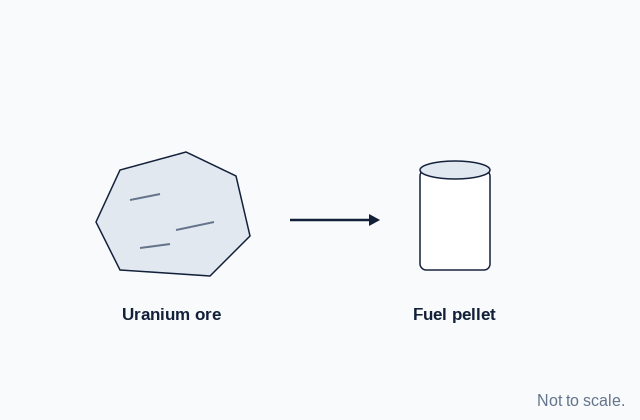
| Fuel rod | A long metal tube packed with pellets of nuclear fuel, placed in a reactor's core. | A fuel rod holds many small pellets; it is not one solid bar of uranium. |
 Tap to open the picture full size
Part 1 Think first No fire, still electricity
Commit to a guess first. Being wrong now makes the right idea stick better.
Predict first
A nuclear power plant burns no coal, oil or gas, yet it sends electricity to a city. How do you predict it makes the electricity?
In short. Nuclear power plants split atoms instead of burning fuel, which changes both what they release and what they leave behind.
- The lesson explains radioactivity and half-life, and how a half-life is used to work out a level at a later time.
- It weighs what a nuclear plant does and does not release into the environment.
- It ends with three named accidents that released radiation and what the releases did to the environment.
Part 2 Learn it Splitting atoms for heat
2a. Fission makes the heat
Nuclear power is generated through fission, where atoms of Uranium-235, which are stored in fuel rods, are split into smaller parts after being struck by a neutron. Nuclear fission releases a large amount of heat, which is used to generate steam, which powers a turbine and generates electricity.
An atom's center, its nucleus, holds particles called protons and neutrons. Uranium-235 (U-235) is a form of uranium whose nucleus can split.
- A neutron strikes a U-235 nucleus in a fuel rod, a long metal tube packed with uranium fuel pellets.
- The nucleus splits into smaller parts and releases a large amount of heat. Background: the split also frees more neutrons, which can strike other U-235 nuclei.
- The heat turns water into steam, the steam powers a turbine, and the turbine drives a generator.
The second half is the same as in a fossil fuel plant. Only the source of the heat differs: no fuel is burned.
Quick check · Multiple choice
In a made-up reactor, what starts the release of heat from the fuel rods?
2b. Radioactivity and half-life
Radioactivity occurs when the nucleus of a radioactive isotope loses energy by emitting radiation. Uranium-235 remains radioactive for a long time, which leads to the problems associated with the disposal of nuclear waste. A radioactive element's half-life can be used to calculate a variety of things, including the rate of decay and the radioactivity level at specific points in time.
An isotope is one form of an element, with its own number of neutrons. A radioactive isotope has an unstable nucleus that gives off radiation, and in doing so it decays into something else.
A half-life is the time it takes for half of the radioactive atoms in a sample to decay. Take a made-up isotope with a half-life of 10 years and a sample giving off 600 units of radiation:
- after 10 years: 300
- after 20 years: 150
- after 30 years: 75
The level halves each half-life; it does not drop by the same amount each time. Used fuel stays radioactive for a long time, so it has to be stored safely far into the future.
Quick check · Decide and justify
A made-up power company says its used fuel rods, which still hold uranium-235, could go to an ordinary landfill five years after leaving the reactor. Is the company right?
Which reason supports your answer?
2c. Cleaner, but not clean
Nuclear power generation is a nonrenewable energy source. Nuclear power is considered a cleaner energy source because it does not produce air pollutants, but it does release thermal pollution and hazardous solid waste.
- Nonrenewable: uranium is mined from ore, and the ore in the ground exists in a fixed amount.
- Cleaner: nothing burns, so no smoke, soot or exhaust gases leave the plant.
- Thermal pollution: the plant's steam is cooled with water drawn from a river, lake or sea, and that water goes back warmer. Warmer water holds less dissolved oxygen, which can stress fish.
- Hazardous solid waste: used fuel rods and other radioactive material must be stored and guarded for a very long time.
So "cleaner" means cleaner air. The plant still changes the water it uses and leaves waste behind.
Quick check · Select all
A made-up nuclear plant runs beside a river. Which two statements about its effects on the environment are accurate? Pick two.
Select 2 answers, then check.
2d. Three accidents
Three Mile Island, Chernobyl, and Fukushima are three cases where accidents or natural disasters led to the release of radiation. These releases have had short- and long-term impacts on the environment.
Background: Three Mile Island, in Pennsylvania in 1979, was a partial meltdown of a reactor core that released a small amount of radiation. Chernobyl, in Ukraine in 1986, was an explosion and fire that spread radiation over large parts of Europe. Fukushima, in Japan in 2011, followed an earthquake and tsunami that cut the cooling to its reactors.
The impacts of a release fall into two groups:
- Short-term: within days, weeks or months, such as evacuating people or banning local food and water.
- Long-term: lasting years or decades, such as soil, water and wildlife that stay contaminated, or land closed to people.
Quick check · Sort it
After a made-up reactor accident releases radiation, which impacts are short-term and which are long-term? Tap a card, then its group.
Short-term impact
Long-term impact
Part 3 Watch it done How much is left after 36 years?
Open each step in turn, answer the why, then finish the calculation yourself.
A made-up radioactive isotope has a half-life of 12 years. A sample of it gives off 720 units of radiation per second today. What will it give off 36 years from now?
Step 1 · Count the half-lives
half-lives pass in 36 years.
Why this step?
Why does the sample give off less radiation as time passes?
Each nucleus that emits radiation decays into something else, so fewer radioactive nuclei remain, and after each half-life only half are left.
Step 2 · Halve once for each half-life
After 12 years: . After 24 years: . One more half-life is left.
Your step · Calculate
Finish it. The sample gave off 720 units per second and has a half-life of 12 years. How many units per second will it give off after 36 years?
units per second
After three half-lives, one-eighth of the radioactivity is left. Halving never reaches zero in a few steps, which is why long-lived waste has to be stored for so long.
Part 4 Try it Match the terms, then check an account
First match made-up scenes to the idea each one shows. Then find where a student's account of a nuclear plant goes wrong.
Try it · Match
Match each made-up scene to the idea it shows.
Try it · Spot the error
A student describes a made-up nuclear plant. Tap the first line that goes wrong.
Part 5 Explain it A river plant's waste
Write your answer first. Nothing you type here leaves this page. Then compare it with the model and each scoring point.
Free response is 40% of the exam score. This one is shaped like Question 3, Analyze an environmental problem doing calculations.
Free-response practice · Question 3 style
A made-up nuclear plant on a river, with figures made up for practice:
- Used fuel removed each year: 25 metric tons
- Years the plant is expected to run: 40
- One isotope in the used fuel has a half-life of 24 years
- Cooling water is returned to the river warmer than it was taken out
(a) Calculate the total mass of used fuel the plant will produce over its 40 years. Show your work.
(b) Calculate the percent of that isotope's radioactivity left 72 years after the fuel leaves the reactor. Show your work.
(c) Describe one way the returned cooling water could harm life in the river.
(d) Explain why nuclear power is considered a cleaner energy source than burning coal.
(e) Explain why the plant's used fuel is a problem to dispose of.
Model answer
(a) metric tons of used fuel.
(b) half-lives. of the radioactivity is left.
(c) The warmer water is thermal pollution: warm water holds less dissolved oxygen, so fish below the plant can be stressed or die.
(d) Nuclear power does not produce air pollutants, because no fuel is burned, so it releases none of the smoke and exhaust gases a coal plant releases.
(e) The used fuel is hazardous solid waste that stays radioactive for a long time, as uranium-235 does, so it must be stored and guarded safely far into the future.
Score your own answer. This is a self-check, not a grade. Tick each point your answer makes.
Part 6 Check yourself A waste sample over 24 years
The first two questions use the graph.
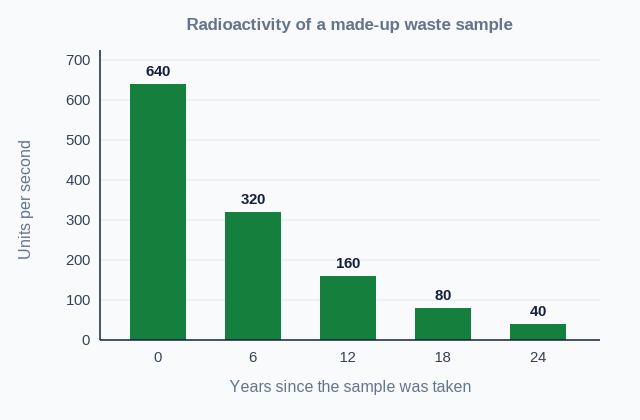
A made-up lab measures the radioactivity of a waste sample holding one made-up isotope, every 6 years for 24 years. The numbers are made up for practice.
 Tap to open the picture full size
Case question 1 · Multiple choice
Which statement does the graph best support?
Case question 2 · Calculate
Using the graph: if the pattern continues, how many units per second will the sample give off 36 years after it was taken?
The rest stand on their own and do not use the case.
Check yourself · Rank it
Three made-up waste samples each start with the same radioactivity, and each holds one made-up isotope. Rank them by how much radioactivity is left after 80 years.
Most radioactivity left first
Give each one a place, 1 for first. Give two the same place if they are equal.
Your ranking: none yet
Check yourself · Fill the statement
Complete the account of a made-up nuclear plant.
The plant's uranium comes from mined ore, and nuclear power is a source; the warmed water the plant returns to the bay is pollution.
Check yourself · Decide and justify
A student says the radiation released at Three Mile Island, Chernobyl and Fukushima harmed the environment only in the days right after each release. Is the student right?
Which reason supports your answer?
Part 7 Keep it Bring back earlier ideas
Two questions from earlier topics: the steps in a gas power plant, and a student's account of a power company's two plants.
First put a made-up gas plant's steps in order. Then find where a student's account of a coal plant goes wrong.
From 6.5 Fossil Fuels · Put it in order
Put the steps in a made-up natural gas power plant in order, first to last.
First match made-up descriptions to the fuel each one names. Then find where a student's account of a power company goes wrong.
From 6.3 Fuel Types and Uses · Spot the error
A student describes a made-up power company's two plants. Tap the first line that goes wrong.
In three lines
- In fission, a neutron strikes a uranium-235 nucleus and splits it, releasing heat that makes steam to turn a turbine and generate electricity.
- A radioactive nucleus emits radiation; half-life gives the rate of decay and the level at a time, and U-235 stays radioactive a long time.
- Nuclear power is nonrenewable and makes no air pollutants, but it releases thermal pollution and hazardous waste, and accidents have released radiation.
Exam strategy for this topic
- Section I, Multiple Choice: 80 questions in 90 minutes.
- Section II, Free Response: 3 questions in 70 minutes.
- This lesson's Explain it is shaped like free-response question 3, Analyze an environmental problem doing calculations.
- A four-function, scientific, or graphing calculator is allowed on both sections of the exam.
For a half-life calculation, divide the time by the half-life to count the half-lives, then halve the starting amount that many times. Write the units on every line.
Questions students ask
How does a nuclear power plant make electricity?
Neutrons split atoms of uranium-235 in the fuel rods. The fission releases heat that makes steam, which powers a turbine and generates electricity.
Why is nuclear waste hard to dispose of?
Uranium-235 remains radioactive for a long time, so the waste must be stored safely far into the future.
Is nuclear power clean?
It is considered cleaner because it produces no air pollutants, but it is nonrenewable and releases thermal pollution and hazardous solid waste.
Course alignment, for teachers
AP Environmental Science topic 6.6, Unit 6: Energy Resources and Consumption.
- Skill 2.B: Explain relationships between different characteristics of environmental concepts, processes, or models represented visually:
This lesson maps all 6 essential knowledge statements of the topic to the part that teaches each one: 6 are checked by a scored question. The map is in the lesson file.