Unit 2 · Topic 2.6 · about 30 minutes · 7 parts · 11 scored checks, 2 of them multiple choice, plus 2 from earlier lessons
AP Environmental Science 2.6: Adaptations
Unit 2: 6 to 8% of the multiple-choice section
What you'll be able to do
- Explain how populations respond to changes in their environment: how natural selection acts on heritable traits over generations, and how individuals respond when a sudden or gradual change threatens a species.
Key vocabulary
| Term | What it means | The exam trap |
|---|---|---|
| Heritable trait | A trait set by genes that is passed from parents to offspring. | Check whether a trait in a question came from the genes or was gained during the organism's life. |
| Natural selection | A process that acts on heritable traits. | Natural selection works only on traits that differ among individuals; check whether the trait in a question varies. |
| Generation | One step in a line of parents and offspring: the parents are one generation, their offspring the next. | Generations can differ in size, so compare shares, not counts. |
 Tap to open the picture full size
Part 1 Think first The drought and the beaks
Commit to a guess first. Being wrong now makes the right idea stick better.
Predict first
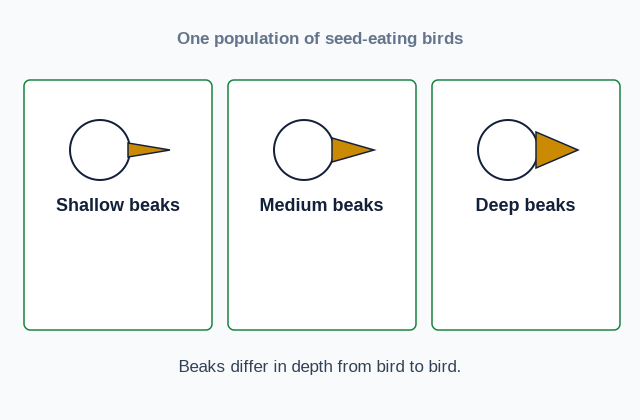
Suppose seed-eating birds live on an island, and their beaks differ in depth. A long drought kills most plants with soft seeds, so mostly hard seeds are left, and deep beaks crack hard seeds best. The situation is made up for practice. What do you predict happens to the birds' beaks?
In short. Populations respond to changes in their environment, and natural selection is one way they do.
- Natural selection acts on heritable traits.
- Environmental changes, sudden or gradual, may threaten a species' survival.
- When that happens, individuals alter their behaviors, move, or perish.
Part 2 Learn it Adaptations
2a. Only heritable traits
Individuals in a population differ. Some of those differences are heritable: they are set by genes and passed from parents to offspring. A rabbit's fur color, a bird's beak depth and a mosquito's resistance to a poison are examples.
Other differences are gained during an organism's life: a scar, muscles built by exercise, a trick a dog learns. They are not in the genes, so offspring do not inherit them.
Natural selection acts on heritable traits. When a heritable trait helps individuals survive and reproduce in their environment, they leave more offspring, and the offspring carry the trait. A trait gained during life can help the individual, but it does not pass to the next generation, so selection cannot build on it.
Quick check · Decide and justify
Mice kept in a cold barn grow thicker fur each winter because of the cold, not because of their genes. A student says natural selection will make the pups of these mice born with thicker fur. Is the student right?
Which reason supports your answer?
2b. Over generations, in small steps
Natural selection acting on heritable traits causes populations to adapt to their environment over generations via incremental changes at the genetic level.
Three words carry the idea.
- Populations adapt, not individuals. A beetle cannot change its own genes. What changes is how common each heritable trait is in the population.
- Over generations. The change shows up in the offspring, then in their offspring, and so on.
- Incremental. The share shifts step by step, generation by generation, not all at once. The share of individuals with a helpful trait might go from 15% to 20% to 26%, not from 15% to 100% at once.
So to see adaptation in data, compare the share of the population carrying a trait, generation by generation. A share is a percent: the number with the trait divided by the number in the population, times 100%.
Quick check · Multiple choice
Which statement describes how a population adapts to its environment by natural selection?
2c. Sudden or gradual
Environmental changes, either sudden or gradual, may threaten a species' survival.
A sudden change happens fast: a wildfire, a flood or a lava flow can change a habitat in a day. A gradual change takes many years: a lake slowly growing saltier, a river warming a little each decade, a forest drying out over centuries.
It is tempting to think only sudden changes are dangerous, because they are easy to see. But a slow change can also push conditions past what a species can survive. A trout that needs cold water is threatened by a river that warms a fraction of a degree each year, just as it is by a sudden spill of hot water, once the river gets warm enough.
May matters too. Not every change threatens a species. Whether it does depends on how much the change alters the conditions the species needs.
Quick check · Fill the statement
Suppose a lake grows a little saltier each year for 300 years. A freshwater snail lives only in the lake. Tap a blank, then an answer.
The change in the lake is , and a change like this threaten the snail's survival.
2d. Behave, move or perish
When a change threatens a species, individuals have to alter their behaviors, move, or perish. An individual cannot evolve a new heritable trait on demand. The responses open to an individual are these three.
- Alter a behavior. Lizards in a warming desert stay in burrows through the hottest hours and feed at dawn.
- Move. Butterflies fly up a mountain to cooler meadows.
- Perish. Fish trapped in a pool that dries up die.
The individuals that survive and reproduce pass on their heritable traits. That is how the individual responses in this chunk connect to the population's slow adaptation in chunk 2b.
Quick check · Select all
A pond dries up over one summer. Which two are responses that individual animals in the pond can make? Pick two.
Select 2 answers, then check.
Part 3 Watch it done Dark beetles on dark soil
Open each step in turn, answer the why, then finish the calculation yourself.
Suppose beetles live on a field where dark soil from a riverbank spreads over the old pale ground. Birds spot pale beetles more easily on dark soil. Color is heritable. In generation 1, 42 of 280 beetles are dark. In generation 5, 180 of 300 beetles are dark. The numbers are made up for practice. By how many percentage points did the share of dark beetles change?
Step 1 · Find the share in generation 1
of the beetles are dark.
Step 2 · Find the share in generation 5
of the beetles are dark.
Why this step?
Why compare the shares, not the counts of dark beetles?
The two generations have different numbers of beetles, 280 and 300. A count can rise just because the population grew. The share says how common the trait is in the population.
Step 3 · Set up the change
A change in percentage points is the later share minus the earlier share, both in percent.
Your step · Calculate
Finish it. In the made-up beetle population, where color is heritable, 42 of 280 beetles are dark in generation 1, and 180 of 300 are dark in generation 5. By how many percentage points did the share of dark beetles change? Give your answer in percentage points.
percentage points
The share of dark beetles rose from 15% to 60% over four generations. No beetle changed color; dark beetles survived the birds more often and left more offspring.
Part 4 Try it The steps, and a count that grows
First put natural selection in order. Then work out a change in a count, which is a different number from a change in a share.
Try it · Put it in order
Grasshoppers in a meadow differ in body color, and color is heritable. Then the meadow turns brown in a long dry period. Put the events in order.
Try it · Calculate
Suppose 18 of 90 lizards on an island have long legs in generation 1, and 54 of 135 have long legs in generation 3. The numbers are made up for practice. What is the percent change in the number of long-legged lizards from generation 1 to generation 3? Give your answer as a percent.
Part 5 Explain it Mice on a new lava field
Write your answer first. Nothing you type here leaves this page. Then compare it with the model and each scoring point.
Free response is 40% of the exam score. This one is shaped like Question 3, Analyze an environmental problem doing calculations.
Free-response practice · Question 3 style
Suppose a lava flow covers the pale sand where a population of mice lives with dark rock, a sudden change. Owls catch the mice they can see easily against the ground, and fur color is heritable. In generation 1, just after the flow, 50 of 500 mice are dark. In generation 6, 260 of 400 mice are dark. The numbers are made up for practice.
(a) Calculate the percent of mice that are dark in generation 1 and in generation 6. Show your work.
(b) Calculate the percent change in the number of dark mice from generation 1 to generation 6. Show your work.
(c) Explain why the share of dark mice rose over the generations.
(d) Describe one response that an individual pale mouse could make to the lava flow.
Model answer
(a) Generation 1: dark. Generation 6: dark.
(b) increase in the number of dark mice.
(c) On dark rock, owls see pale mice more easily, so dark mice survive more often and leave more offspring. Fur color is heritable, so the offspring are dark too. Natural selection acting on this heritable trait raises the share of dark mice step by step, generation by generation; no mouse changes its own color.
(d) A pale mouse could move to an area of pale sand the lava did not cover, or alter its behavior by feeding only at night or under cover.
Score your own answer. This is a self-check, not a grade. Tick each point your answer makes.
Part 6 Check yourself An insecticide, season after season
The first two questions use the table.
Suppose a farm sprays the same insecticide on a field every season. The ability to survive the insecticide is heritable, and the insects that survive each spraying are the parents of the next generation. Each generation, researchers collect 200 insects of one pest species from the field and give each a standard test dose. The numbers below are made up for practice.
| Generation | Insects tested | Insects that survived the dose | Share that survived |
|---|---|---|---|
| 1 | 200 | 10 | 5% |
| 2 | 200 | 24 | 12% |
| 3 | 200 | 50 | 25% |
| 4 | 200 | 84 | 42% |
| 5 | 200 | 118 | 59% |
Case question 1 · Multiple choice
Using the table of insects surviving the test dose: which statement about the relationship between generation and survival is supported by the data?
Case question 2 · Spot the error
A student explains the table of insects surviving the test dose. Tap the first line that goes wrong.
The rest stand on their own and do not use the case.
Check yourself · Sort it
Each card is a trait of an organism. Tap a card, then whether natural selection can act on it.
Natural selection can act on it
Natural selection cannot act on it
Check yourself · Match
An early, hard frost hits a mountain forest in autumn. Match each animal's response to the kind of response it is.
Part 7 Keep it Bring back earlier ideas
Two questions from earlier topics in this unit: what bison did after an eruption, and why a remote island has so many specialist snails.
From 2.5 Natural Disruptions to Ecosystems · Multiple choice
A hurricane floods the coastal marsh where a colony of wading birds feeds. The birds fly to inland lakes 200 km away and stay there for five years, until the marsh plants grow back. Which best describes what the birds did?
Each question puts the ideas on a new island. Ask where the species came from, what resources the island offers, and whether a newcomer uses the same resources.
From 2.3 Island Biogeography · Select all
A remote island has many kinds of snail found nowhere else, and most of them feed on only one or two kinds of plant. Which two statements help explain this? Pick two.
Select 2 answers, then check.
In three lines
- Natural selection acts on heritable traits, the ones passed from parents to offspring; traits gained during life are not passed on.
- Populations adapt to their environment over generations, by incremental changes at the genetic level, so compare the share with a trait from one generation to the next.
- Environmental changes, sudden or gradual, may threaten a species' survival, and individuals then alter their behaviors, move, or perish.
Exam strategy for this topic
- Section I, Multiple Choice: 80 questions in 90 minutes.
- Section II, Free Response: 3 questions in 70 minutes.
- This lesson's Explain it is shaped like free-response question 3, Analyze an environmental problem doing calculations.
- A four-function, scientific, or graphing calculator is allowed on both sections of the exam.
When a table counts a trait across generations, turn each count into a share of its own generation before you compare, and say whether you mean percentage points or percent change.
Questions students ask
What does natural selection act on?
Heritable traits, the ones passed from parents to offspring through genes. Traits gained during an organism's life are not passed on.
Do individuals adapt, or populations?
Populations adapt to their environment over generations, through incremental changes at the genetic level. An individual cannot change its own genes.
What can an individual do when its environment changes?
Alter its behavior, move, or perish.
Can a slow change threaten a species?
Yes. Environmental changes, either sudden or gradual, may threaten a species' survival.
How do you show adaptation in data?
Find the share of the population carrying the trait in each generation, as a percent, and describe how it changes from one generation to the next.
Course alignment, for teachers
AP Environmental Science topic 2.6, Unit 2: The Living World: Biodiversity.
- Skill 5.B: Describe relationships among variables in data represented.
This lesson maps all 2 essential knowledge statements of the topic to the part that teaches each one: 2 are checked by a scored question. The map is in the lesson file.