Unit 2 · Topic 2.5 · about 30 minutes · 7 parts · 11 scored checks, 2 of them multiple choice, plus 2 from earlier lessons
AP Environmental Science 2.5: Natural Disruptions to Ecosystems
Unit 2: 6 to 8% of the multiple-choice section
What you'll be able to do
- Explain how natural disruptions, both short- and long-term, impact an ecosystem: how large their consequences can be, the time scales they work on, how climate and sea level have changed, and how habitats and wildlife respond.
Key vocabulary
| Term | What it means | The exam trap |
|---|---|---|
| Natural disruption | An event or process not caused by people, such as a wildfire, flood or volcanic eruption, that changes an ecosystem. | A natural disruption can be sudden, like a flood, or slow, like a climate that dries over centuries. |
| Periodic | Repeating at a regular interval. | A question may give a record over many years; read the dates before naming the pattern. |
| Episodic | Recurring in episodes, with irregular gaps between them. | Read how often the event appears in the record before you name its pattern. |
| Random | Showing no pattern in the record: it has not recurred, and nothing says when, or whether, it will happen again. | Read whether the event has happened before in the record. |
| Migration | The movement of animals from one area to another, for a short time or a long one. | Not every migration is seasonal; read why and how long the animals move. |
 Tap to open the picture full size
Part 1 Think first The eruption and the logging road
Commit to a guess first. Being wrong now makes the right idea stick better.
Predict first
Suppose a volcano erupts and buries 50,000 hectares of forest under ash in one day. The same year, logging roads nearby clear 12 square kilometers of the same forest. One square kilometer is 100 hectares. The numbers are made up for practice. A student says people always do more damage to habitat than nature does. What do you predict?
In short. Natural disruptions are events and processes not caused by people, from a single storm to changes in climate over geological time, that change ecosystems.
- Earth system processes work on many time scales, and they can be periodic, episodic or random.
- Earth's climate has changed over geological time for many reasons, and sea level has risen and fallen with the amount of glacial ice on Earth.
- Wildlife migrates, for the short or the long term, for many reasons, and natural disruptions are one of them.
Part 2 Learn it Natural disruptions
2a. Natural can be big
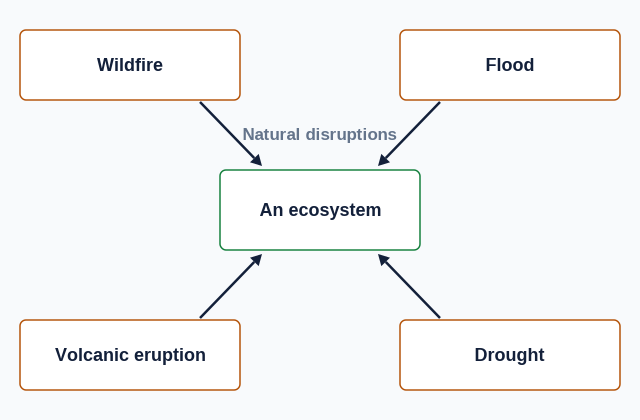
A natural disruption is an event or process, not caused by people, that changes an ecosystem: a wildfire started by lightning, a flood, a hurricane, a volcanic eruption, a long drought.
It is easy to assume that natural events are minor and that people cause the big changes. The evidence says otherwise. Natural disruptions have environmental consequences that may, for a given occurrence, be as great as, or greater than, many human-made disruptions. One eruption can bury forest under ash for many kilometers around. One hurricane can flatten trees along many kilometers of coast.
Two words in that sentence matter. May means not every natural event is large: a small grass fire is minor. Many means not every human-made disruption is smaller: some human changes are huge. So you compare one disruption with another by its consequences, such as how much habitat changed and how many organisms were affected, and not by whether people caused it.
Quick check · Decide and justify
Suppose lightning starts a wildfire that burns 3,000 hectares of a forest in one week. Over ten years in the same region, 15 separate road projects each clear 200 hectares. The numbers are made up for practice. A student says the one fire changed as much habitat as all 15 road projects together. Is the student right?
Which reason supports your answer?
2b. Time scales, and three patterns
Earth system processes operate on a range of scales in terms of time. A thunderstorm is over in hours. A drought can last years. Glacial ice builds up and melts back over thousands of years.
Processes can also be described by their pattern in time. Three patterns matter, and this course reads them this way:
- Periodic: it repeats at a regular interval, so you can say when the next one comes. The tides rise and fall about twice a day.
- Episodic: it recurs in episodes, with irregular gaps between them, each time its cause comes back. Some summers bring a dry spell of wildfires; others do not.
- Random: it shows no pattern in the record. It has not recurred, and nothing in the record says when, or whether, it will happen again. A meteorite strike is one.
To tell them apart, look at a record over time. Has the event recurred? If not, it is random. If it has, is the gap fixed? Then it is periodic. If the gaps differ, it is episodic.
Quick check · Sort it
Each card is a process that changes an ecosystem. Tap a card, then the pattern it follows in time.
Periodic
Episodic
Random
2c. Climate and sea level over geological time
Earth's climate has changed over geological time for many reasons. Long before people, there were warmer periods and colder periods, and no single cause explains all of them.
One of the clearest records of those changes is sea level. Sea level has varied significantly as a result of changes in the amount of glacial ice on Earth over geological time. The water in a glacier or an ice sheet on land came from the ocean: it evaporated, fell as snow and stayed frozen. So when more water is locked up as ice on land, less is in the ocean, and sea level is lower. When that ice melts, the water flows back, and sea level rises.
That link works in both directions, and over long spans of time it has moved coastlines a long way. Some land under shallow sea today may have been dry ground when ice was widespread.
Quick check · Select all
Which two statements about Earth's climate and sea level over geological time are correct? Pick two.
Select 2 answers, then check.
2d. Habitat change and migration
Major environmental change or upheaval commonly results in large swathes of habitat changes. A big eruption does not change only the crater; ash can bury forest for kilometers around. A climate that grows drier over centuries can turn a whole region of forest into grassland. The change covers a wide area, not one patch.
When habitat changes, the animals that lived there respond. Wildlife engages in both short- and long-term migration for a variety of reasons, including natural disruptions.
- A short-term migration is a movement away and back within a season or a few months: geese fly south each autumn and return in spring, or fish leave a flooded stretch of river for a few weeks.
- A long-term migration lasts years or longer: elk leave an ash-covered valley until the grass returns, or a species' range shifts to a new region as the climate changes.
Seasons, food, breeding and natural disruptions can all be reasons to migrate.
Quick check · Multiple choice
A hurricane floods the coastal marsh where a colony of wading birds feeds. The birds fly to inland lakes 200 km away and stay there for five years, until the marsh plants grow back. Which best describes what the birds did?
Part 3 Watch it done Reading a lake's record
Open each step in turn, answer the why, then classify the last process yourself.
Suppose a 50-year record for a mountain lake lists three processes that changed it. The record is made up for practice. Ice covered the lake every winter, from about December to March. Droughts lowered the lake in years 6 to 8, 19 and 20, and 33 to 35. In year 41, a landslide from a hillside slid into the lake, an event nothing in the record could have predicted. Is each process periodic, episodic or random?
Step 1 · Look for a fixed interval
Ice covered the lake every winter, at the same time of year. It repeats at a regular interval, so the winter ice is periodic.
Step 2 · Look for no pattern at all
The landslide happened once, and nothing in 50 years of record says when, or whether, another would come. It has not recurred and shows no pattern, so it is random.
Step 3 · Look at what is left
The droughts came three times. They began in years 6, 19 and 33: 13 years apart, then 14.
Why this step?
Why not call the landslide episodic, since it happened in one episode?
Episodic means the process recurs, in episodes with irregular gaps. The landslide did not recur, and nothing in the record points to when, or whether, another would come. That is what random means here.
Your step · Multiple choice
Finish it. In the made-up lake record, droughts lowered the lake in years 6 to 8, 19 and 20, and 33 to 35. Which term best describes the pattern of the droughts?
One record, three patterns: the winter ice is periodic, the droughts are episodic and the landslide is random.
Part 4 Try it Hours to millennia, and a growing ice sheet
Disruptions differ in how long they take, and a slow one can still change a great deal.
Try it · Rank it
Three natural processes change ecosystems. Rank them by the time scale they operate on.
Shortest time scale first
Give each one a place, 1 for first. Give two the same place if they are equal.
Your ranking: none yet
Try it · Put it in order
Suppose Earth's climate cools for thousands of years. Put the events in order, from the first to the last.
Part 5 Explain it A flood, a drain and the herons
Write your answer first. Nothing you type here leaves this page. Then compare it with the model and each scoring point.
Free response is 40% of the exam score. This one is shaped like Question 2, Analyze and interpret quantitative data.
Free-response practice · Question 2 style
Suppose ecologists record the marsh where herons nest along a river, and the number of heron nests, for eight years. In year 4, a large flood scours the marsh. In year 8, a company drains part of the marsh for a parking lot. The numbers are made up for practice.
- Years: 1, 2, 3, 4, 5, 6, 7, 8
- Marsh habitat, hectares: 120, 122, 121, 40, 55, 70, 85, 65
- Heron nests: 300, 310, 305, 90, 140, 190, 230, 180
(a) Describe the trend in marsh habitat from year 4 to year 7.
(b) Calculate how many times larger the loss of marsh habitat in the flood year was than the loss in the drainage year. Show your work.
(c) Explain how the data support the claim that a natural disruption can have consequences as great as, or greater than, a human-made one.
(d) The nests fell from 305 to 90 in the flood year. Describe one way the herons' behavior could account for part of that fall, other than birds dying.
Model answer
(a) Marsh habitat rose steadily from 40 hectares in year 4 to 85 hectares in year 7, by 15 hectares each year.
(b) Flood year: hectares lost. Drainage year: hectares lost. , so the flood's loss was about 4 times larger.
(c) The flood, a natural disruption, removed 81 hectares of habitat in one year, and the drainage, a human-made one, removed 20. Nests fell by 215 after the flood and by 50 after the drainage. By both measures the natural disruption had the greater consequences.
(d) Many herons could have migrated to marshes elsewhere along the river while the habitat was scoured, a migration caused by a natural disruption, and returned as the marsh grew back. Others could have stayed but not nested that year.
Score your own answer. This is a self-check, not a grade. Tick each point your answer makes.
Part 6 Check yourself Ice and sea level
The first two questions use the table.
Suppose scientists reconstruct the amount of glacial ice on Earth and the sea level for the last 60,000 years. The numbers below are made up for practice.
| Thousands of years ago | Glacial ice (millions of cubic kilometers) | Sea level compared with today (meters) |
|---|---|---|
| 60 | 40 | -45 |
| 50 | 46 | -60 |
| 40 | 50 | -70 |
| 30 | 58 | -90 |
| 20 | 64 | -105 |
| 10 | 44 | -55 |
| 0 | 30 | 0 |
Case question 1 · Fill the statement
Using the table of glacial ice and sea level. Tap a blank, then an answer.
From 60,000 to 20,000 years ago, the amount of glacial ice , while sea level .
Case question 2 · Calculate
Using the table of glacial ice and sea level: by how many meters did sea level rise from 20,000 years ago to today? Give your answer in meters.
The rest stand on their own and do not use the case.
Check yourself · Spot the error
A student explains what a large eruption does to a mountain forest. Tap the first line that goes wrong.
Check yourself · Match
Match each movement of wildlife to the kind of migration it is, and why.
Part 7 Keep it Bring back earlier ideas
Two questions from earlier topics in this unit: what can harm a trout outside its tolerance, and which category of ecosystem service each benefit belongs to.
In each question, a condition changes. Compare its new value with both ends of the organism's range.
From 2.4 Ecological Tolerance · Select all
Suppose a trout species can endure water from 0°C to 24°C, and still water injures it. The numbers are made up for practice. Which two changes to its stream could injure or kill the trout? Pick two.
Select 2 answers, then check.
The two services people most often leave out are the ones they never pay for: the supporting processes underneath, and the experiences they come back for.
From 2.2 Ecosystem Services · Sort it
Each card is a benefit people get from a prairie, a river or a coast. Tap a card, then its category of ecosystem service.
Cultural
Supporting
In three lines
- A natural disruption's consequences may, for a given occurrence, be as great as or greater than many human-made disruptions, and major upheaval commonly changes habitat over large areas.
- Earth system processes work on many time scales and can be periodic, episodic or random; climate has changed over geological time, and sea level has varied with the amount of glacial ice.
- Wildlife migrates for the short or the long term for many reasons, natural disruptions among them.
Exam strategy for this topic
- Section I, Multiple Choice: 80 questions in 90 minutes.
- Section II, Free Response: 3 questions in 70 minutes.
- This lesson's Explain it is shaped like free-response question 2, Analyze and interpret quantitative data.
- A four-function, scientific, or graphing calculator is allowed on both sections of the exam.
When a question gives a record over time, describe the pattern with numbers from it: say what rose or fell, between which times, and by how much.
Questions students ask
What is a natural disruption to an ecosystem?
An event or process not caused by people, such as a wildfire, flood, hurricane, drought or volcanic eruption, that changes an ecosystem.
Can a natural disruption be worse than a human-made one?
Yes. For a given occurrence, a natural disruption's environmental consequences may be as great as, or greater than, many human-made disruptions.
What is the difference between periodic, episodic and random?
A periodic process repeats at a regular interval, an episodic one recurs with irregular gaps, and a random one shows no pattern in the record and has not recurred.
How is sea level related to glacial ice?
Sea level has varied with the amount of glacial ice on Earth over geological time. Water held as ice on land is not in the ocean, so more ice means lower sea level.
Why do animals migrate after a natural disruption?
A disruption can change habitat over large areas, so wildlife moves to find food and shelter, for a short time or a long one.
Course alignment, for teachers
AP Environmental Science topic 2.5, Unit 2: The Living World: Biodiversity.
- Skill 5.A: Describe patterns or trends in data.
This lesson maps all 6 essential knowledge statements of the topic to the part that teaches each one: 6 are checked by a scored question. The map is in the lesson file.