Unit 5 · Topic 5.14 · about 30 minutes · 7 parts · 10 scored checks, 2 of them multiple choice, plus 2 from earlier lessons
AP Environmental Science 5.14: Integrated Pest Management
Unit 5: 10 to 15% of the multiple-choice section
What you'll be able to do
- Describe integrated pest management.
- Describe the benefits and drawbacks of integrated pest management (IPM).
Key vocabulary
| Term | What it means | The exam trap |
|---|---|---|
| Pest | An organism people consider harmful to crops, livestock or health, such as an insect, a weed or a rodent. | Whether an organism is a pest depends on where it is and what it eats. |
| Pesticide | A chemical used to kill or control pests. | Insecticides, herbicides and rodenticides are all pesticides. |
| Natural predator | An animal that hunts and eats another species in the wild. | A predator of a pest can be as small as a ladybug. |
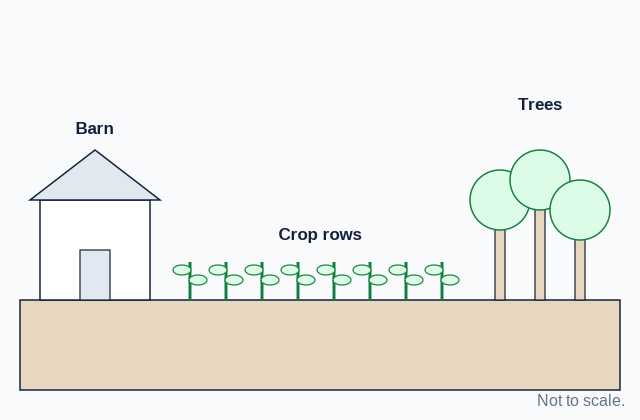 Tap to open the picture full size
Part 1 Think first Switching how pests are fought
Commit to a guess first. Being wrong now makes the right idea stick better.
Predict first
For years a made-up grower has sprayed her apple orchard with insecticide every two weeks, pests or no pests. She switches to integrated pest management and hangs traps that catch the moths whose caterpillars eat her apples. When do you predict she sprays now?
In short. Integrated pest management (IPM) combines biological, physical and limited chemical methods to control pests while minimizing disruption to the environment.
- IPM methods include biocontrol, intercropping, crop rotation and natural predators of the pests.
- IPM reduces the risk that pesticides pose to wildlife, water supplies and human health.
- IPM minimizes disruptions to the environment and threats to human health, but it can be complex and expensive.
Part 2 Learn it Controlling pests with less harm
2a. What integrated pest management is
Integrated pest management (IPM) is a combination of methods used to effectively control pest species while minimizing the disruption to the environment. These methods include biological, physical, and limited chemical methods.
The key words are combination and limited. IPM does not rely on one tool. It mixes living controls (biological), changes to how and where crops are grown or barriers and traps (physical), and pesticides used sparingly, where and when other methods are not enough.
Background: many IPM growers scout their fields, count the pests, and spray only when the count passes a set level, called a threshold, instead of spraying on a calendar.
Quick check · Multiple choice
Which made-up farm's plan is integrated pest management?
2b. The methods
Such as biocontrol, intercropping, crop rotation, and natural predators of the pests.
- Biocontrol: using a living organism to control a pest, such as a fungus or a virus that infects only one kind of pest insect.
- Natural predators of the pests: animals that eat the pest, such as ladybugs eating aphids or owls hunting mice. A grower can release them or give them places to live.
- Intercropping: growing two or more crops together in the same field, such as alternating rows. Background: a pest that feeds on one crop has a harder time finding and spreading through it.
- Crop rotation: growing a different crop in a field from one season or year to the next. Background: pests that depend on one crop lose their food when it moves.
Quick check · Select all
A made-up vegetable farmer adopts integrated pest management. Which two of these are IPM methods? Pick two.
Select 2 answers, then check.
2c. Benefits and drawbacks
The use of integrated pest management (IPM) reduces the risk that pesticides pose to wildlife, water supplies, and human health. Less pesticide means fewer birds, fish, bees and other animals poisoned, less washing into the streams and wells people draw water from, and less for farm workers and neighbors to breathe or touch.
Integrated pest management (IPM) minimizes disruptions to the environment and threats to human health but can be complex and expensive. A grower has to learn the life cycles of pests and their enemies, check the fields often, keep records, and pay for traps, predators and advice. Spraying on a calendar takes less thought.
Quick check · Decide and justify
A county official says integrated pest management costs nothing extra and is as simple as spraying on a schedule, so every farm should switch overnight. Is the official right?
Which reason supports your answer?
Part 3 Watch it done How much pesticide does IPM save?
Open each step in turn, answer the why, then finish the calculation yourself.
A made-up 120-hectare farm sprays 2.5 kilograms of insecticide per hectare each year on a schedule. With integrated pest management, it uses 0.6 kilograms per hectare. How many kilograms less insecticide does the farm use each year?
Step 1 · Insecticide on a schedule
kilograms a year.
Why this step?
Why does IPM still use some insecticide?
IPM includes limited chemical methods alongside its other methods: some spraying, used sparingly, not none.
Step 2 · Insecticide with IPM, then the difference
Multiply the farm's area by 0.6 the same way, then subtract that from 300.
Your step · Calculate
Finish it. On a schedule the farm uses 300 kilograms a year. How many kilograms less does it use with IPM at 0.6 kilograms per hectare on its 120 hectares?
kilograms a year
That is 228 kilograms a year that never reach the farm's birds, its stream or its workers, about three quarters of what it used to spray. The farm still uses 72 kilograms: limited, not none.
Part 4 Try it Sort the practices, then check an account
First sort farm practices into those that fit integrated pest management and those that do not. Then find where a student's account of an orchard goes wrong.
Try it · Sort it
Does each made-up practice fit integrated pest management? Tap a card, then its group.
Fits IPM
Does not fit IPM
Try it · Spot the error
A student explains how a made-up apple grower's switch to integrated pest management works out. Tap the first line that goes wrong.
Part 5 Explain it An orchard weighs IPM
Write your answer first. Nothing you type here leaves this page. Then compare it with the model and each scoring point.
Free response is 40% of the exam score. This one is shaped like Question 3, Analyze an environmental problem doing calculations.
Free-response practice · Question 3 style
A made-up 80-hectare orchard beside a stream sprays insecticide 12 times a year, at 1.5 kilograms per hectare each time. Under integrated pest management it would spray 3 times a year at the same rate. Pest control now costs 95 dollars per hectare a year; under IPM it would cost 130 dollars per hectare a year. The numbers are made up for practice.
(a) Calculate the kilograms of insecticide the orchard now sprays in a year. Show your work.
(b) Calculate the percent reduction in insecticide under IPM. Show your work.
(c) Calculate the extra cost per year for the whole orchard under IPM. Show your work.
(d) Describe one benefit of IPM for the stream beside the orchard.
(e) Explain one reason, other than cost, that the grower might be slow to adopt IPM.
Model answer
(a) kilograms a year.
(b) Under IPM: kilograms. Reduction: ; .
(c) dollars more per hectare; dollars more a year.
(d) Less insecticide is sprayed, so less washes or drifts into the stream, reducing the risk to its fish and other wildlife and to anyone who uses its water.
(e) IPM can be complex: the grower must learn the pests' life cycles and their natural enemies, scout the orchard and keep counts, instead of spraying on a calendar. Another reason earns the point too, such as a fear of losing part of a harvest while she learns the new method.
Score your own answer. This is a self-check, not a grade. Tick each point your answer makes.
Part 6 Check yourself A two-year trial
The first two questions use the table.
A made-up county pays six corn farms to try integrated pest management for two years while six nearby corn farms keep spraying on a schedule. It records the average for each group. The numbers are made up for practice.
| Measure | Scheduled spraying | Integrated pest management |
|---|---|---|
| Insecticide applied (kilograms per hectare per year) | 3.2 | 0.8 |
| Corn harvested (metric tons per hectare) | 7.1 | 6.9 |
| Insecticide in the nearest stream (micrograms per liter) | 4.0 | 0.9 |
| Pest control cost (dollars per hectare per year) | 140 | 175 |
Case question 1 · Multiple choice
The county must decide whether to encourage IPM. Which use of the data best supports doing so?
Case question 2 · Calculate
Using the table: by what percent was the IPM farms' pest control cost higher than the scheduled-spray farms' cost?
The rest stand on their own and do not use the case.
Check yourself · Fill the statement
Complete the description of two IPM methods on a made-up farm.
Planting squash between the rows of corn in the same field is ; planting soybeans next year where the corn grew this year is .
Check yourself · Match
A made-up farm switches to integrated pest management. Match each change to the benefit or drawback it shows.
Part 7 Keep it Bring back earlier ideas
Two questions from earlier topics: ways to increase water infiltration, and a student's comparison of two footprints.
First sort city projects by the method each uses. Then find where a student's account of building up goes wrong.
From 5.13 Methods to Reduce Urban Runoff · Sort it
Which method to increase water infiltration does each made-up project use? Tap a card, then its group.
Permeable pavement
Planting trees
Public transportation
Building up, not out
First sort parts of a footprint into its two sides. Then find where a student's comparison of two footprints goes wrong.
From 5.11 Ecological Footprints · Spot the error
A student compares two classmates' ecological footprints. Tap the first line that goes wrong.
In three lines
- Integrated pest management combines biological, physical and limited chemical methods, such as biocontrol, intercropping, crop rotation and natural predators.
- IPM reduces the risk that pesticides pose to wildlife, water supplies and human health.
- IPM minimizes disruption to the environment and threats to health, but it can be complex and expensive.
Exam strategy for this topic
- Section I, Multiple Choice: 80 questions in 90 minutes.
- Section II, Free Response: 3 questions in 70 minutes.
- This lesson's Explain it is shaped like free-response question 3, Analyze an environmental problem doing calculations.
- A four-function, scientific, or graphing calculator is allowed on both sections of the exam.
When a question asks for a benefit and a drawback of integrated pest management, name both: it reduces the risk pesticides pose to wildlife, water supplies and human health, but it can be complex and expensive. Name a method too: biocontrol, intercropping, crop rotation or natural predators.
Questions students ask
What is integrated pest management?
A combination of biological, physical and limited chemical methods used to effectively control pest species while minimizing disruption to the environment.
What are the benefits of integrated pest management?
It reduces the risk that pesticides pose to wildlife, water supplies and human health.
What are the drawbacks of integrated pest management?
It can be complex and expensive.
Course alignment, for teachers
AP Environmental Science topic 5.14, Unit 5: Land and Water Use.
- Skill 7.D: Use data and evidence to support a potential solution.
This lesson maps all 3 essential knowledge statements of the topic to the part that teaches each one: 3 are checked by a scored question. The map is in the lesson file.