All courses AP Environmental Science Unit 4 Unit check
Unit 4 check
Unit 4 check: Earth Systems and Resources
10 questions from 9 lessons in Unit 4. Answer each one, and if you miss, follow the link back to where it is taught, then try again. Your score counts first tries.
Question 1 · from 4.1 · Multiple choice
A made-up continent drifts toward another, and the two collide along a convergent boundary. Which change can result where they meet over millions of years?
A A long valley opens as the land between them is pulled apart B New ocean floor forms in the gap between the two continents C The ground goes still, since colliding plates lock in place D Crust is pushed up into a mountain range along the boundary
Question 2 · from 4.2 · Multiple choice
A student digs a pit in a made-up meadow and calls every 30 cm of soil a new horizon, whatever it looks like. What is wrong with this?
A A new horizon starts wherever the soil's make-up changes, at any depth B Horizons are mostly told apart by color, which depth cannot show C Most soils hold a single horizon, so dividing one is a mistake D Horizons are set by how old the soil is, which depth cannot show
Question 3 · from 4.3 · Sort it
Each card is a soil test. Tap a card, then the kind of property it tests.
Measuring how much salt has built up in a sample, from how well it conducts electricity Sealing a damp sample in a jar and measuring the carbon dioxide it gives off Dripping weak acid on a sample and watching whether it fizzes Rubbing moist soil between the fingers to feel how gritty or sticky it is Weighing a core of soil of known volume to find how tightly packed it is Burying a cotton strip and checking a month later how much has rotted away
Setup for question 4
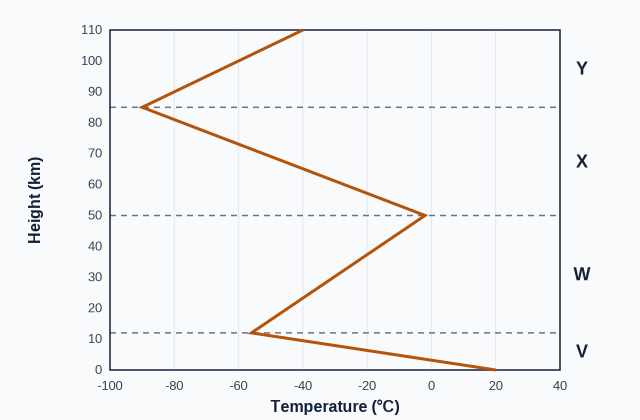
Suppose a class plots the temperatures a made-up balloon and rocket probe recorded at each height. The line is made up for practice, but its shape follows the measured pattern. The class splits the graph into four bands, V, W, X and Y, from the ground up.
Question 4 · from 4.4 · Multiple choice
Using the graph: what marks the boundary between band V and band W?
A Temperature stops falling with height and starts to rise B The air reaches a set height that is the same everywhere C The line reaches the coldest point anywhere on the graph D Temperature there first drops below the freezing point of water
Setup for question 5
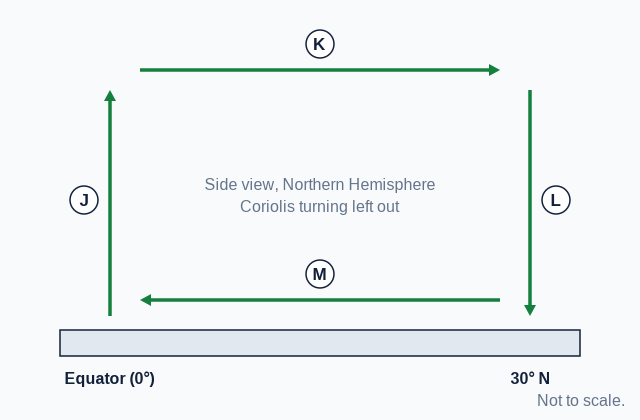
The figure is a made-up side view of the air between the equator and 30° N, as if the atmosphere were sliced from the ground up. Arrows J, K, L and M show which way the air moves in one loop. The Coriolis turning is left out, so the arrows show only up, down, north and south.
Question 5 · from 4.5 · Match
Using the figure: match each place to what is happening to the air there.
The ground at the equator, beneath J Arrow J Arrow K Arrow L Arrow M Grown denser than the air beneath it Warmed most, by the most intense sunlight Pushed along by denser air arriving behind it Less dense than the air around it, so it is pushed up Cooling as it moves away from where it was warmed
Check Start over
Question 6 · from 4.6 · Put it in order
A raindrop lands in a made-up river's watershed, just downhill of the divide. It does not soak in. Put its trip in order, first to last.
It joins a small stream near the top of the slope The river carries it out of the watershed at the outlet The stream carries it into the main river It lands on the slope on the river's side of the ridge It runs over the ground downhill as runoff Check Start over
Question 7 · from 4.7 · Sort it
Each card describes Chicago, at about 42° N, on one day of the year. Tap a card, then the season it describes.
Northern Hemisphere summer
Northern Hemisphere winter
The south end of Earth's axis leans toward the sun At noon the sun stands high, and its rays strike nearly straight on The sun is up for about 9 hours The north end of Earth's axis leans toward the sun At noon the sun sits low, and its rays come in at a slant The sun is up for about 15 hours
Question 8 · from 4.8 · Decide and justify
A student says that two places receiving the same energy from the sun through the year must have the same climate. Is the student right?
A Yes B No
Which reason supports your answer?
1 No two places ever receive the same energy from the sun, so the case cannot arise 2 The land and water around a place, such as a range or a warm sea, also shape its climate 3 Climate tends to follow the sun's energy, so places that get the same energy usually end up alike
Question 9 · from 4.9 · Select all
A made-up report describes a strong El Niño. Which two are kinds of change that El Niño and La Niña can cause? Pick two.
Select 2 answers, then check.
A Changes that usually stay out at sea, well away from any land B Shifts in the winds that blow across the Pacific and far beyond it C Changes in how ocean water moves, such as less deep water rising along a coast D Changes to the tilt of Earth's axis, which shift the seasons Check
Question 10 · from 4.1 · Select all
Which two can result at a divergent boundary? Pick two.
Select 2 answers, then check.
A A mountain range raised as two continents press against each other B A strip of stretched crust dropping down between breaks on land C A curved chain of islands where one ocean plate sinks under another D New ocean floor forming along a ridge as the two sides move away Check
0 of 10 answered.