Unit 1 · Topic 1.9 · about 30 minutes · 7 parts · 10 scored checks, 4 of them multiple choice, plus 2 from earlier lessons
AP Environmental Science 1.9: Trophic Levels
Unit 1: 6 to 8% of the multiple-choice section
What you'll be able to do
- Explain how energy flows and matter cycles through trophic levels: energy upward from the sun, matter around biogeochemical cycles, and why energy has to keep flowing in.
Key vocabulary
| Term | What it means | The exam trap |
|---|---|---|
| Trophic level | An organism's position in the order of who eats whom: producers, then primary, secondary and tertiary consumers. | An animal can feed at more than one level, so place it by what it eats in the question. |
| Consumer | An organism that gets its energy by eating other organisms. | Count the level from what the consumer eats, not from its size. |
| Biogeochemical cycle | The movement of an element such as carbon, nitrogen or phosphorus, or of water, between living things and the environment. | Name the reservoirs at both ends of each move. |
| Conservation of matter | Matter is not created or destroyed; it changes form and moves. | Apply it to atoms and grams, not to how large a living thing looks. |
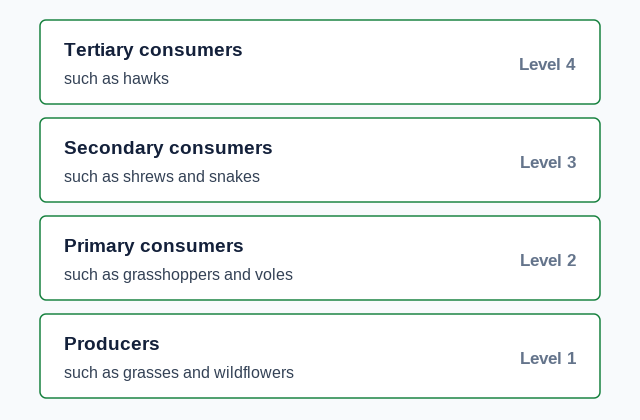 Tap to open the picture full size
Part 1 Think first The log that disappeared
Commit to a guess first. Being wrong now makes the right idea stick better.
Predict first
A large oak log lies on a forest floor. Over about twenty years, fungi, bacteria and insects break it down, until almost nothing is left where it lay. What do you predict happened to most of the log's matter?
In short. Trophic levels are the feeding positions in an ecosystem, from producers at the lowest level up through the consumers that eat them.
- In terrestrial and near-surface marine communities, energy flows from the sun to producers in the lowest trophic levels and then upward to higher trophic levels.
- All ecosystems depend on a continuous inflow of high-quality energy to maintain their structure and their function of transferring matter between the environment and organisms.
- Biogeochemical cycles are essential for life, and each cycle demonstrates the conservation of matter.
Part 2 Learn it Energy flows, matter cycles
2a. Matter cycles and is conserved
The carbon, nitrogen, phosphorus and water cycles are biogeochemical cycles: they move the atoms living things are built from between organisms and the environment. Biogeochemical cycles are essential for life, because a living thing can only grow from atoms that the cycles bring it.
Each cycle demonstrates the conservation of matter. Atoms are not created or destroyed in an ecosystem. They change form and move from one reservoir to another.
Follow a deer that eats grass. Some of the grass's carbon becomes part of the deer's body. Some leaves in the deer's breath as carbon dioxide, after cellular respiration breaks down the grass's sugars. The rest leaves in the deer's droppings, where decomposers return nitrogen and phosphorus to the soil. Every atom ends up somewhere.
So if you know how much matter went into a living thing and where some of it went, the rest must be in the places you have not counted yet.
Quick check · Multiple choice
A pumpkin seed weighing less than a gram grows into a vine and pumpkins weighing 10 kg in one summer. The soil it grew in weighs almost the same as it did in spring. Where did most of the matter in the vine and pumpkins come from?
2b. Energy flows upward from the sun
A trophic level is an organism's position in the order of who eats whom.
- Producers, such as plants, algae and phytoplankton, make their own food by photosynthesis. They are the lowest trophic level.
- Primary consumers eat producers.
- Secondary consumers eat primary consumers.
- Tertiary consumers eat secondary consumers.
In terrestrial and near-surface marine communities, energy flows from the sun to producers in the lowest trophic levels and then upward to higher trophic levels. Sunlight is captured by producers and stored in their organic compounds. A grasshopper gets that energy by eating the grass, and a shrew gets it by eating the grasshopper.
Energy does not flow back down. Nutrients in an animal's droppings or dead body do return to the soil and to producers, but that is matter cycling, not energy.
Quick check · Multiple choice
In a near-surface ocean community, which describes the path energy takes?
2c. A continuous inflow of energy
Matter can be used again and again: the same nitrogen atom may pass from soil to grass to deer to soil many times. Energy cannot. Each time an organism uses energy, to move, grow or keep its cells working, that energy leaves it, mostly as heat that no living thing can use to make food. The next topic follows where it goes.
So all ecosystems depend on a continuous inflow of high-quality energy to keep going. For most ecosystems that energy is sunlight. It maintains the ecosystem's structure, the living things in it, and its function of transferring matter between the environment and organisms through the biogeochemical cycles.
Cut off the energy and the cycles stall. Producers stop making organic compounds, consumers run out of food, and the matter they are made of piles up as dead material for decomposers, which also run down once that stored energy is used.
Quick check · Select all
Plants, insects and soil microbes live in a sealed greenhouse lit only by lamps. The lamps fail for a month. Which two processes that were going on before will stop, or soon stop? Pick two.
Select 2 answers, then check.
Part 3 Watch it done Where did the leaves go?
Open each step in turn, answer the why, then finish the calculation yourself.
Suppose a caterpillar eats 12 g of leaves. Over the same days its body gains 2 g, and its droppings hold 5 g. The rest of the leaves' matter leaves its body as carbon dioxide and water vapor from cellular respiration. The numbers are made up for practice. How many grams of the leaves' matter leave the caterpillar that way?
Step 1 · Every gram goes somewhere
Matter is conserved, so the 12 g of leaves must all be accounted for: in the caterpillar's body, in its droppings, or in the air as carbon dioxide and water vapor.
Step 2 · Add up what you know
Body and droppings together: g.
Step 3 · Set up the rest
Whatever is not in the body or the droppings went into the air: g.
Why this step?
Why can't the missing grams have been used up as energy?
Respiration releases energy from the sugars in the leaves, but the atoms in those sugars are not destroyed. They leave the body in carbon dioxide and water vapor, together with oxygen the caterpillar took in from the air; the 5 g counts only the part that came from the leaves.
Your step · Calculate
Finish it. In a made-up example, a caterpillar eats 12 g of leaves, its body gains 2 g, and its droppings hold 5 g. The rest leaves its body as carbon dioxide and water vapor from cellular respiration. How many grams of the leaves' matter leave that way?
g
Part 4 Try it Matter or energy?
These situations are new. For each one, decide first what is moving and whether it can come back around.
Try it · Sort it
Each card is something that leaves an organism. Tap a card, then whether producers can ever use it again.
Can cycle back to producers
Cannot cycle back to producers
Try it · Multiple choice
In a pond, herons eat sunfish, sunfish eat snails, and snails eat algae. Where did the energy in a heron's muscles first enter this food chain?
Part 5 Explain it Read a year in a coastal sea
Write your answer first. Nothing you type here leaves this page. Then compare it with the model and each scoring point.
Free response is 40% of the exam score. This one is shaped like Question 2, Analyze and interpret quantitative data.
Free-response practice · Question 2 style
Suppose researchers in a coastal sea measure, every two months, the hours of daylight and the amounts of phytoplankton and zooplankton near the surface. The numbers below are made up for practice.
- Months: January, March, May, July, September, November
- Daylight, hours per day: 8, 11, 14, 15, 12, 9
- Phytoplankton, micrograms of chlorophyll per liter: 1, 3, 7, 9, 5, 2
- Zooplankton, animals per liter: 10, 15, 40, 70, 80, 30
(a) Identify the month with the most phytoplankton.
(b) Describe the relationship between daylight and phytoplankton in the data.
(c) The zooplankton eat the phytoplankton. Explain why the zooplankton peak comes after the phytoplankton peak, using the way energy flows through trophic levels.
(d) Suppose a month of thick clouds cuts the daylight reaching this sea. Explain which group would decline first, the phytoplankton or the zooplankton, and why.
Model answer
(a) July, with 9 micrograms of chlorophyll per liter.
(b) The two rise and fall together. As daylight rises from 8 hours in January to 15 in July, phytoplankton rise from 1 to 9 micrograms per liter, and as daylight falls to 9 hours in November, phytoplankton fall to 2.
(c) Energy flows from the sun to the phytoplankton, the producers in the lowest trophic level, and then upward to the zooplankton that eat them. The zooplankton can grow in number only after the phytoplankton have captured that energy and built up, so their peak, 80 animals per liter in September, follows the phytoplankton peak in July.
(d) The phytoplankton would decline first. They are the producers in the lowest trophic level and capture the sun's energy directly, so less light means less photosynthesis at once. The zooplankton get their energy by eating phytoplankton, so they would decline only after their food did, because energy reaches them from the level below.
Score your own answer. This is a self-check, not a grade. Tick each point your answer makes.
Part 6 Check yourself Two sealed jars
The first two questions use the table.
Suppose students seal two identical glass jars, each holding pond water, algae, six snails and bacteria. They set Jar A in a sunny window and Jar B in a dark closet, and weigh each jar and count its living snails every two weeks. The numbers below are made up for practice.
| Week | Jar A, sunny: mass (g) | Jar A: snails alive | Jar B, dark: mass (g) | Jar B: snails alive |
|---|---|---|---|---|
| 0 | 1,250 | 6 | 1,250 | 6 |
| 2 | 1,250 | 6 | 1,250 | 5 |
| 4 | 1,250 | 6 | 1,250 | 2 |
| 6 | 1,250 | 6 | 1,250 | 0 |
Case question 1 · Multiple choice
Using the table of the two jars: every snail in Jar B died, yet the jar's mass stayed at 1,250 g. Which best explains the steady mass?
Case question 2 · Decide and justify
Using the table of the two jars, a student concludes that Jar B's community collapsed because it ran out of matter. Is the student right?
Which reason supports your answer?
The rest stand on their own and do not use the case.
Check yourself · Spot the error
A student describes how energy moves through a tundra food chain. Tap the first line that goes wrong.
Check yourself · Put it in order
Suppose a chemical spilled on a field kills its decomposers, and the field is farmed for several years afterward. Put the effects in the order they happen.
Part 7 Keep it Bring back earlier ideas
Two questions from earlier topics: gross primary productivity worked backward, and which nutrient limits algae.
The same relationship works in either direction. If you know what producers store and what they use, you can find the total they captured.
From 1.8 Primary Productivity · Calculate
Suppose a rain forest's producers have a net primary productivity of 6,000 kcal/m²/yr and use 9,000 kcal/m²/yr in their own respiration. The numbers are made up for practice. What is the forest's gross primary productivity? Give your answer in kcal/m²/yr.
From 1.6 The Phosphorus Cycle · Rank it
The algae in a lake are limited by phosphorus, and tests show the water already holds far more nitrate than the algae can use. A student fills three jars with the lake's water and algae, adds phosphate to one, nitrate to another and nothing to the third, and sets them all in the same light. Rank the jars by how much the algae will grow in two weeks.
Most algae growth first
Give each one a place, 1 for first. Give two the same place if they are equal.
Your ranking: none yet
In three lines
- In terrestrial and near-surface marine communities, energy flows from the sun to producers in the lowest trophic level and then upward to higher levels.
- All ecosystems depend on a continuous inflow of high-quality energy to maintain their structure and keep matter moving through the biogeochemical cycles.
- Biogeochemical cycles are essential for life, and each demonstrates the conservation of matter: atoms change form and move, but are not created or destroyed.
Exam strategy for this topic
- Section I, Multiple Choice: 80 questions in 90 minutes.
- Section II, Free Response: 3 questions in 70 minutes.
- This lesson's Explain it is shaped like free-response question 2, Analyze and interpret quantitative data.
- A four-function, scientific, or graphing calculator is allowed on both sections of the exam.
When a question asks about an ecosystem, decide first whether it is about energy, which flows one way from the sun and must keep coming in, or matter, which cycles and is conserved. Then account for every gram of matter.
Questions students ask
What is a trophic level?
An organism's position in the order of who eats whom. Producers are the lowest trophic level, then primary, secondary and tertiary consumers.
Which way does energy flow through trophic levels?
In terrestrial and near-surface marine communities, energy flows from the sun to producers in the lowest trophic levels and then upward to higher trophic levels.
Why do ecosystems need a constant supply of energy?
All ecosystems depend on a continuous inflow of high-quality energy to maintain their structure and keep matter cycling, because energy is not reused the way matter is.
What does conservation of matter mean in an ecosystem?
Atoms are not created or destroyed. They change form and move between living things and the environment through the biogeochemical cycles.
Does energy cycle like matter?
No. Matter cycles back to producers through decomposers, but energy flows one way, from the sun upward through the trophic levels.
Course alignment, for teachers
AP Environmental Science topic 1.9, Unit 1: The Living World: Ecosystems.
- Skill 1.B: Explain environmental concepts and processes.
This lesson maps all 3 essential knowledge statements of the topic to the part that teaches each one: 3 are checked by a scored question. The map is in the lesson file.