Unit 6 · Topic 6.3 · about 30 minutes · 7 parts · 11 scored checks, 2 of them multiple choice, plus 2 from earlier lessons
AP Environmental Science 6.3: Fuel Types and Uses
Unit 6: 10 to 15% of the multiple-choice section
What you'll be able to do
- Identify types of fuels and their uses.
Key vocabulary
| Term | What it means | The exam trap |
|---|---|---|
| Bitumen | A thick, sticky, tar-like form of petroleum. | Bitumen is a form of petroleum, not a kind of coal. |
| Methane | A gas whose molecule is one carbon atom bonded to four hydrogen atoms (CH4). | Methane is a gas at everyday temperatures, not a liquid fuel like gasoline. |
| Organic material | Matter that comes from living things, such as stems, leaves and roots. | Organic here means made by living things, not grown without pesticides. |
 Tap to open the picture full size
Part 1 Think first A hot engine
Commit to a guess first. Being wrong now makes the right idea stick better.
Predict first
A made-up factory runs a gas engine that spins a generator to make the factory's electricity, and the engine gives off a great deal of heat. The factory also runs a separate gas boiler to warm its buildings. Engineers want to burn less fuel in all. Which plan do you predict saves the most fuel?
In short. People burn many fuels, from wood and peat to coal, natural gas and oil, and each comes in its own forms and has its own uses.
- The lesson starts with the forms wood is burned in, where it is most used, and peat.
- It names the types of coal and the conditions that shape them.
- It then turns to natural gas, oil from tar sands and the fuels made from crude oil, and ends with how a plant can put its fuel to work.
Part 2 Learn it Fuels and what they are
2a. Wood and peat
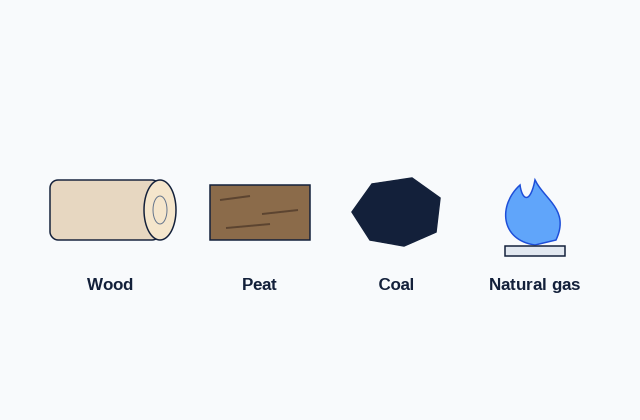
Wood is commonly used as fuel in the forms of firewood and charcoal. It is often used in developing countries because it is easily accessible. Peat is partially decomposed organic material that can be burned for fuel.
- Firewood is wood cut and burned as it is. Charcoal is a light, black fuel made from wood. Background: charcoal is made by heating wood with little air, which drives off water and gases.
- Easily accessible: where there are few power lines, gas pipes or fuel deliveries, wood is the fuel a family can gather or buy nearby.
- Peat forms in wet places such as bogs, where dead plants pile up faster than they fully decay. It is cut, dried and burned. Background: the water in a bog slows decay, so the plant matter is only partly broken down.
Quick check · Multiple choice
In a made-up rural district of a developing country, most families cook with charcoal. Which statement best describes the fuel and why the families use it?
2b. Three types of coal
Three types of coal used for fuel are lignite, bituminous and anthracite. Heat, pressure and depth of burial contribute to the development of various coal types and their qualities.
Coal forms from plant remains that were buried and changed over long spans of time. How deeply they were buried, and how much heat and pressure they met, helps decide which type of coal forms and what it is like to burn: how much carbon it holds, how much energy it releases per kilogram, and how much water and other matter it carries.
So two seams of coal can differ a great deal. Knowing a seam's burial history tells a geologist a good deal about the coal inside it.
Quick check · Decide and justify
A made-up geologist studies two coal seams. Seam P lay close to the surface and was never deeply buried. Seam Q was buried far deeper for millions of years. She says the two coals probably differ in type and quality. Is she right?
Which reason supports your answer?
2c. Gas, oil and tar sands
Natural gas, the cleanest of the fossil fuels, is mostly methane. Crude oil can be recovered from tar sands, which are a combination of clay, sand, water and bitumen. Fossil fuels can be made into specific fuel types for specialized uses (e.g., in motor vehicles).
- Natural gas is piped to furnaces, stoves and power plants. Of coal, oil and natural gas, it is the cleanest to burn.
- Tar sands hold bitumen, a thick, tar-like petroleum, mixed with clay, sand and water. Separating and processing the bitumen recovers crude oil.
- Crude oil is not burned as it comes from the ground. It is made into specific fuels for specific jobs, such as gasoline and diesel for motor vehicles and jet fuel for aircraft. Background: the plant that does this is a refinery.
Quick check · Select all
A made-up energy company sells natural gas and runs a tar sands mine. Which two statements about its fuels are accurate? Pick two.
Select 2 answers, then check.
2d. Heat and electricity from one fuel
Cogeneration occurs when a fuel source is used to generate both useful heat and electricity.
A plant that makes only electricity turns part of its fuel's energy into electricity and loses much of the rest as heat, released into the air or a river. A cogeneration plant captures that heat and puts it to work: warming buildings, heating water, or supplying a factory's processes.
The key word is useful. Heat that leaves a stack or warms a river does no job; heat piped to a hospital's radiators does. One fuel then does two jobs, so less fuel is burned in all than a power plant and a separate boiler would need.
Quick check · Sort it
Is each made-up plant an example of cogeneration? Tap a card, then its group.
Cogeneration
Not cogeneration
Part 3 Watch it done How much of the fuel is put to use?
Open each step in turn, answer the why, then finish the calculation yourself.
A made-up plant burns fuel holding 900 gigajoules (GJ) of energy a day and makes 315 GJ of electricity. It used to release the rest of the energy as heat. Now it captures 378 GJ of that heat and pipes it to nearby buildings. What percent of the fuel's energy is now put to use?
Step 1 · Add the useful outputs
Electricity and captured heat are both put to use: GJ a day.
Why this step?
Why does the captured heat count as a useful output now?
It warms buildings, a job that would otherwise need its own fuel. A plant that uses one fuel to make both useful heat and electricity is cogeneration.
Step 2 · Compare with the fuel burned
Divide the useful energy by the 900 GJ in the fuel, then multiply by 100.
Your step · Calculate
Finish it. The plant puts 693 GJ a day to use from fuel holding 900 GJ. What percent of the fuel's energy is used?
%
Making electricity alone, the plant used 35% of its fuel's energy. Capturing the heat raises that to 77%. That is the case for cogeneration: the same fuel does two jobs.
Part 4 Try it Match the fuels, then check an account
First match made-up descriptions to the fuel each one names. Then find where a student's account of a power company goes wrong.
Try it · Match
Match each made-up description to the fuel or material it describes.
Try it · Spot the error
A student describes a made-up power company's two plants. Tap the first line that goes wrong.
Part 5 Explain it Charcoal for a village
Write your answer first. Nothing you type here leaves this page. Then compare it with the model and each scoring point.
Free response is 40% of the exam score. This one is shaped like Question 3, Analyze an environmental problem doing calculations.
Free-response practice · Question 3 style
A made-up village in a developing country has 400 households. Each household burns 3.5 kilograms of charcoal a day for cooking, and making 1 kilogram of charcoal takes 6 kilograms of wood. A bog near the village also holds peat. The numbers are made up for practice.
(a) Calculate the kilograms of charcoal the village burns in a 365-day year. Show your work.
(b) Calculate the metric tons of wood needed to make that charcoal (1 metric ton = 1,000 kilograms). Show your work.
(c) Explain why villages in developing countries often use wood and charcoal as fuel.
(d) A pipeline company offers to bring natural gas. Identify the gas that makes up most of natural gas.
(e) Describe what peat is.
Model answer
(a) kilograms of charcoal a year.
(b) kilograms of wood, which is metric tons.
(c) Wood is easily accessible: families can gather or buy it nearby, where there may be no gas lines or fuel deliveries.
(d) Methane.
(e) Peat is partially decomposed organic material, plant matter from a wet bog, that can be dried and burned for fuel.
Score your own answer. This is a self-check, not a grade. Tick each point your answer makes.
Part 6 Check yourself Four coal seams
The first two questions use the table.
A made-up survey samples coal from four seams and records how deeply each seam was buried, how much carbon its coal holds, and how much energy a kilogram of its coal releases when burned. The numbers are made up for practice.
| Seam | Greatest depth of burial (meters) | Carbon in the coal (percent) | Energy per kilogram (megajoules) |
|---|---|---|---|
| R | 2,400 | 86 | 31 |
| S | 300 | 62 | 19 |
| T | 1,100 | 74 | 26 |
| U | 700 | 68 | 22 |
Case question 1 · Multiple choice
Which conclusion do the data best support?
Case question 2 · Calculate
Using the table: by what percent is the energy per kilogram of the deepest seam's coal greater than that of the shallowest seam's coal?
The rest stand on their own and do not use the case.
Check yourself · Fill the statement
Complete the account of a made-up country's fuels.
A refinery on the coast turns crude oil into for the country's cars and trucks, while in mountain villages with no fuel deliveries, families burn cut from the trees nearby. Mines in the north dig all three types of coal used for fuel: lignite, bituminous and .
Check yourself · Put it in order
Put the steps from a made-up tar sands mine to a car's fuel tank in order, first to last.
Part 7 Keep it Bring back earlier ideas
Two questions from earlier topics: matching observations to trends in energy use, and a student's account of a forest.
First match made-up observations to the trend each one shows. Then find where a student's account of a country's development goes wrong.
From 6.2 Global Energy Consumption · Match
Match each made-up observation to the trend in energy consumption it shows.
First sort forest practices by what they do. Then find where a student's account of a timber company goes wrong.
From 5.17 Sustainable Forestry · Spot the error
A student explains how a made-up timber company manages its land. Tap the first line that goes wrong.
In three lines
- Wood is burned as firewood and charcoal, often in developing countries because it is easily accessible, and peat is partially decomposed organic material burned for fuel.
- Lignite, bituminous and anthracite are three types of coal; heat, pressure and depth of burial shape their development and qualities.
- Natural gas is mostly methane, crude oil can be recovered from tar sands, fossil fuels are made into specific fuels, and cogeneration makes useful heat and electricity from one fuel.
Exam strategy for this topic
- Section I, Multiple Choice: 80 questions in 90 minutes.
- Section II, Free Response: 3 questions in 70 minutes.
- This lesson's Explain it is shaped like free-response question 3, Analyze an environmental problem doing calculations.
- A four-function, scientific, or graphing calculator is allowed on both sections of the exam.
Know what each fuel is made of or from: charcoal from wood, peat from partly decomposed plant matter, natural gas mostly methane, tar sands of clay, sand, water and bitumen. Cogeneration means one fuel gives useful heat and electricity.
Questions students ask
What are the three types of coal?
Lignite, bituminous and anthracite. Heat, pressure and depth of burial contribute to their development and qualities.
Why is wood used so much in developing countries?
Wood, as firewood or charcoal, is easily accessible there.
What is cogeneration?
Using one fuel source to generate both useful heat and electricity.
Course alignment, for teachers
AP Environmental Science topic 6.3, Unit 6: Energy Resources and Consumption.
- Skill 1.A: Describe environmental concepts and processes.
This lesson maps all 7 essential knowledge statements of the topic to the part that teaches each one: 7 are checked by a scored question. The map is in the lesson file.