Unit 2 · Topic 2.1 · about 30 minutes · 7 parts · 11 scored checks, 2 of them multiple choice, plus 2 from earlier lessons
AP Environmental Science 2.1: Introduction to Biodiversity
Unit 2: 6 to 8% of the multiple-choice section
What you'll be able to do
- Explain levels of biodiversity and their importance to ecosystems: genetic, species and habitat diversity, species richness, population bottlenecks, recovery from disruptions, and which species habitat loss removes first.
Key vocabulary
| Term | What it means | The exam trap |
|---|---|---|
| Genetic diversity | The variety of genes, and versions of genes, among the members of one species or population. | A question may give you both a population's size and its genetic variety; decide which one it is asking about. |
| Species richness | The number of different species found in an ecosystem. | A survey table often lists more than one count; check which column counts kinds of species. |
| Habitat diversity | The variety of habitats, the different kinds of places to live, in an area. | Habitat diversity is one of three levels of biodiversity; do not mix it up with the other two. |
| Population bottleneck | A sharp drop in the size of a population, after which only the survivors pass on their genes. | Look at what happens to the gene versions, not only to the number of individuals, after the drop. |
| Specialist and generalist species | A specialist species needs particular foods or conditions; a generalist species can use many foods and live in many conditions. | Unit 3 compares the two in more detail; here the question is how habitat loss affects each. |
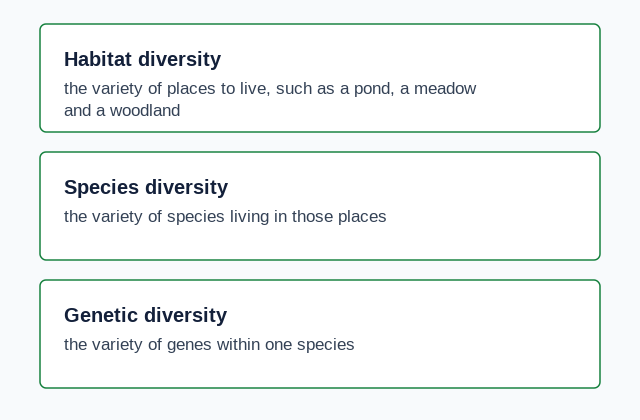 Tap to open the picture full size
Part 1 Think first Two orchards and a fungus
Commit to a guess first. Being wrong now makes the right idea stick better.
Predict first
Two orchards in the same valley each have 500 apple trees. In the first, every tree was grafted from one prize tree, so all 500 are genetically the same. In the second, the trees were grown from the seeds of many different trees. A new leaf fungus reaches the valley. Which orchard is more likely to still have many healthy trees after a few years?
In short. Biodiversity in an ecosystem includes three levels: genetic diversity, species diversity and habitat diversity.
- Species richness is the number of different species found in an ecosystem.
- Ecosystems that have a larger number of species are more likely to recover from disruptions.
- Loss of habitat removes specialist species first, then generalist species, and reduces the number of species that need large territories.
Part 2 Learn it Biodiversity
2a. Three levels, and counting species
Biodiversity in an ecosystem includes three levels.
- Genetic diversity is the variety of genes within a species. Two deer of the same species can carry different versions of a gene, and so differ in coat color or in how well they fight off a disease.
- Species diversity is the variety of species in an ecosystem.
- Habitat diversity is the variety of habitats, the different kinds of places to live, in an area: a river valley with a stream, a marsh and an oak woodland has more of it than a valley that is all marsh.
The simplest way to describe species diversity is species richness: the number of different species found in an ecosystem. It counts kinds, not individuals. A pond with 400 frogs of 2 species has a richness of 2; a pond with 30 frogs of 6 species has a richness of 6.
Quick check · Match
Each observation describes one level of biodiversity. Match each observation to the level it describes.
2b. Genetic diversity and bottlenecks
The more genetically diverse a population is, the better it can respond to environmental stressors, such as a new disease, a drought or a hotter summer. When the members of a population differ in their genes, some of them are more likely to carry traits that let them survive the stressor and reproduce. A population whose members are nearly identical has fewer ways to respond: what harms one can harm them all.
Size is not the same as diversity. A population of 5,000 nearly identical plants can be less able to respond than a population of 500 varied ones.
A population bottleneck is a sharp drop in a population's size, for example after a flood, a fire or heavy hunting. A bottleneck can lead to a loss of genetic diversity. Only the survivors pass on their genes, so any gene version that none of them carried is gone. If the population grows large again with no newcomers joining it from elsewhere, every new member descends from that small group, so its numbers can recover while its genetic diversity can stay low.
Quick check · Decide and justify
A wild grass grows in two prairies. In one, 300 plants carry many different versions of their genes. In the other, 3,000 plants are nearly identical genetically. A student says the 300 varied plants are better placed to survive a long drought as a population. Is the student right?
Which reason supports your answer?
2c. More species, better recovery
Diversity matters at the species level too. Ecosystems that have a larger number of species are more likely to recover from disruptions such as a fire, a flood, a storm or a disease outbreak.
Compare two grasslands that a drought hits equally hard. In one, almost all the plants belong to three species. In the other, the same area holds forty species. If the drought kills most of one or two species in the forty-species grassland, many other species are left to keep growing, hold the soil and feed the animals while the community recovers. In the three-species grassland, losing one or two species is losing most of the community.
So when you compare ecosystems for how likely they are to recover, compare the number of species, not the number of individual organisms.
Quick check · Multiple choice
Suppose four wetlands of the same size are hit by the same hurricane. Wetland A has 5 plant species and 60,000 plants; B has 9 species and 30,000 plants; C has 3 species and 90,000 plants; D has 21 species and 20,000 plants. The numbers are made up for practice. Which wetland is most likely to recover from the hurricane?
2d. What habitat loss takes first
A specialist species needs particular foods or conditions, such as a moth whose caterpillars eat the leaves of only one kind of tree. A generalist species can live on many foods in many conditions, such as a raccoon. (Unit 3 compares the two in detail.)
When habitat is lost, for example when a forest is cleared, drained or broken into small patches, the losses come in an order. Loss of habitat leads to a loss of specialist species, followed by a loss of generalist species. The specialist has nowhere else to go once its one food or condition is gone; the generalist can shift to other foods for a while, until too little habitat is left for it as well.
Habitat loss also reduces the numbers of species that have large territorial requirements, the animals that need a large area to hunt, graze or nest in. A cougar that ranges over hundreds of square kilometers cannot live in a patch of forest a few kilometers across, even if every tree in that patch still stands.
Quick check · Put it in order
Over 30 years, roads and farms cut a large forest into smaller and smaller patches. Put these events in the order they usually happen, first to last.
Part 3 Watch it done What a bottleneck takes
Open each step in turn, answer the why, then finish the calculation yourself.
Suppose a population of beach mice numbers 1,500, and among them they carry 12 different versions of a gene for fur color. A hurricane kills all but 20 mice, and those 20 carry only 4 of the 12 versions. No mice join from anywhere else, and ten years later there are 1,500 mice again. The numbers are made up for practice. What percent of the gene's versions did the population lose?
Step 1 · Name each number
12 is the number of versions of the gene before the hurricane, and 4 is the number the 20 survivors carry. The mouse counts, 1,500 and 20, describe the population's size, not its genetic diversity.
Step 2 · Find how many versions were lost
Versions lost = versions before minus versions kept: .
Step 3 · Set up the percent
Percent lost = (versions lost ÷ versions before) × 100%: . The whole is the number of versions before the hurricane.
Why this step?
Why does the population growing back to 1,500 mice not bring the lost versions back?
No mice joined from anywhere else, so every mouse born after the hurricane inherits its genes from the 20 survivors and can only carry versions they carried. The number of mice recovers; the versions none of the survivors carried are gone.
Your step · Calculate
Finish it. In a made-up population of 1,500 beach mice, the mice carry 12 versions of a fur-color gene. A hurricane leaves 20 mice, which carry only 4 of the 12 versions, no mice join from anywhere else, and ten years later there are 1,500 mice again. What percent of the gene's versions did the population lose? Give your answer as a percent.
%
Two-thirds of the versions are gone, even though the number of mice is back where it started. The population's size recovered; its genetic diversity did not.
Part 4 Try it Big territories, and what richness counts
Habitat loss does not only remove specialists. Here it is the size of the patches that matters.
Try it · Select all
Suppose a prairie is plowed for farms until only scattered patches of grass remain, each about 1 square kilometer in area, with plowed fields between them. The territory sizes below are made up for practice. Which two of these prairie animals are least likely to keep living in the patches? Pick two.
Select 2 answers, then check.
Try it · Sort it
Each card is something a biologist might report from a full survey of a lake and its shores. Tap a card, then whether it gives the lake's species richness.
Gives the species richness
Does not give the species richness
Part 5 Explain it Calculate what a forest lost
Write your answer first. Nothing you type here leaves this page. Then compare it with the model and each scoring point.
Free response is 40% of the exam score. This one is shaped like Question 3, Analyze an environmental problem doing calculations.
Free-response practice · Question 3 style
Suppose ecologists survey the bird species of a tropical forest before and after most of it is cleared for farms. The numbers are made up for practice.
- Before clearing: 40 specialist species and 80 generalist species.
- After clearing: 16 specialist species and 72 generalist species.
(a) Calculate the percent decrease in the forest's bird species richness. Show your work.
(b) Calculate the percent of specialist species lost and the percent of generalist species lost. Show your work.
(c) Describe the pattern your answers to (b) show, and how it fits the order in which habitat loss removes species.
(d) Identify one trait of a bird species, other than being a specialist or a generalist, that makes habitat loss likely to reduce its numbers.
Model answer
(a) Richness before: species. After: species. Percent decrease: .
(b) Specialists: lost. Generalists: lost.
(c) The forest lost a much larger share of its specialist species (60%) than of its generalist species (10%). That fits the order of losses: habitat loss removes specialist species first, followed by generalist species.
(d) Needing a large territory. Habitat loss reduces the numbers of species with large territorial requirements, such as large birds of prey that hunt over a wide area.
Score your own answer. This is a self-check, not a grade. Tick each point your answer makes.
Part 6 Check yourself Three wetlands surveyed
The first two questions use the table.
Suppose ecologists survey three wetlands of the same size. They count the kinds of habitat in each (open water, marsh, wet meadow, swamp forest), the plant species, and the individual plants. The numbers below are made up for practice.
| Wetland | Kinds of habitat | Plant species | Individual plants |
|---|---|---|---|
| Wetland A | 2 | 31 | 9,000 |
| Wetland B | 1 | 12 | 26,000 |
| Wetland C | 4 | 19 | 14,000 |
Case question 1 · Multiple choice
Using the table of the three wetlands: which wetland has the greatest plant species richness?
Case question 2 · Decide and justify
Using the table of the three wetlands, a student says Wetland B has the greatest habitat diversity, because it has the most individual plants. Is the student right?
Which reason supports your answer?
The rest stand on their own and do not use the case.
Check yourself · Fill the statement
Suppose a flood leaves only 15 of a river's 2,000 wild turtles alive. No turtles join from other rivers, and twenty years later there are 1,800 turtles again. Tap a blank, then an answer.
Compared with before the flood, the population now has genetic diversity, because every turtle alive today descends from .
Check yourself · Rank it
Suppose three coral reefs of the same size are hit by the same marine heat wave. The numbers are made up for practice. Rank the reefs by how likely each is to recover from it.
Most likely to recover first
Give each one a place, 1 for first. Give two the same place if they are equal.
Your ranking: none yet
Part 7 Keep it Bring back earlier ideas
Two questions from earlier topics: telling a food chain from a food web, and whether algae can photosynthesize in deep water.
From 1.11 Food Chains and Food Webs · Sort it
Each card describes a model of feeding links. Tap a card, then whether it is a food chain or a food web.
A food chain
A food web
From 1.8 Primary Productivity · Decide and justify
Algae live 40 meters deep in very clear ocean water, where almost no red light reaches. A student says they can still photosynthesize at that depth. Is the student right?
Which reason supports your answer?
In three lines
- Biodiversity includes genetic, species and habitat diversity, and species richness is the number of different species in an ecosystem.
- The more genetically diverse a population is, the better it can respond to stressors, and a bottleneck can lead to a loss of genetic diversity; ecosystems with more species are more likely to recover from disruptions.
- Loss of habitat removes specialist species first, then generalist species, and reduces the numbers of species that need large territories.
Exam strategy for this topic
- Section I, Multiple Choice: 80 questions in 90 minutes.
- Section II, Free Response: 3 questions in 70 minutes.
- This lesson's Explain it is shaped like free-response question 3, Analyze an environmental problem doing calculations.
- A four-function, scientific, or graphing calculator is allowed on both sections of the exam.
When a question compares populations or ecosystems, first name the level it is about: genes within a species, the number of species, or the kinds of habitat. Then use the matching column of the data, not the one with the biggest numbers.
Questions students ask
What are the three levels of biodiversity?
Genetic diversity, species diversity and habitat diversity.
What is species richness?
The number of different species found in an ecosystem.
Why does genetic diversity matter to a population?
The more genetically diverse a population is, the better it can respond to environmental stressors such as disease or drought.
What is a population bottleneck?
A sharp drop in a population's size. A bottleneck can lead to a loss of genetic diversity, because only the survivors' gene versions are passed on.
Which species are lost first when habitat is lost?
Specialist species are lost first, followed by generalist species. Habitat loss also reduces the numbers of species that need large territories.
Course alignment, for teachers
AP Environmental Science topic 2.1, Unit 2: The Living World: Biodiversity.
- Skill 1.A: Describe environmental concepts and processes.
This lesson maps all 5 essential knowledge statements of the topic to the part that teaches each one: 5 are checked by a scored question. The map is in the lesson file.