Unit 5 · Topic 5.16 · about 30 minutes · 7 parts · 10 scored checks, 2 of them multiple choice, plus 2 from earlier lessons
AP Environmental Science 5.16: Aquaculture
Unit 5: 10 to 15% of the multiple-choice section
What you'll be able to do
- Describe the benefits and drawbacks of aquaculture.
Key vocabulary
| Term | What it means | The exam trap |
|---|---|---|
| Net pen | An enclosure of netting that holds fish in open water, such as a bay or a lake. | A net pen floats in natural water; a pond or tank is built on land. |
| Population density | The number of individuals of a species in a given area or volume. | Density compares a count with a space, so a bigger pen can hold more fish at the same density. |
| Disease incidence | The number of new cases of a disease in a population over a set time. | Incidence counts new cases, not everyone who happens to be sick. |
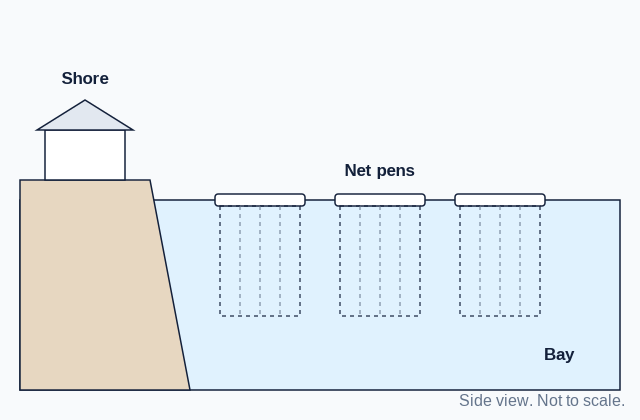 Tap to open the picture full size
Part 1 Think first A torn net
Commit to a guess first. Being wrong now makes the right idea stick better.
Predict first
A storm tears a made-up salmon farm's net pen, and thousands of farm salmon escape up a river that holds a small run of wild salmon. Biologists check the river again ten years later. Which change do you predict worries them most?
In short. Aquaculture, raising fish and other water organisms for food, has expanded because it is highly efficient, requires only small areas of water and requires little fuel.
- Aquaculture can contaminate wastewater, and fish that escape can affect the wild fish around a farm.
- Crowding fish raises their density, which can increase disease incidence, and the disease can be transmitted to wild fish.
- Weigh both sides: a benefit such as little fuel against a drawback such as disease reaching wild fish.
Part 2 Learn it Farming fish: gains and costs
2a. Why aquaculture has expanded
Aquaculture has expanded because it is highly efficient, requires only small areas of water, and requires little fuel.
Aquaculture means raising fish, shellfish or other water organisms for food in ponds, tanks or net pens, instead of catching them in the wild. It is fish farming in the broad sense.
- Highly efficient: a farm turns its feed, water and work into a large amount of food to sell. Background: farmed fish are fed where they live, so they spend little energy hunting, and the farmer harvests them in one place instead of searching for them.
- Small areas of water: a few ponds, or a row of pens in one corner of a bay, can hold a large harvest.
- Little fuel: the fish stay in one place, so the farm burns little fuel reaching them. Background: a fishing boat may burn fuel for days at sea searching for fish.
Quick check · Multiple choice
A made-up coastal town weighs raising fish in ponds onshore against catching them with boats that travel far out to sea. Which advantage of the ponds helps explain why aquaculture has expanded?
2b. Wastewater and escaped fish
Aquaculture can contaminate wastewater, and fish that escape may compete or breed with wild fish.
- Wastewater: the water that leaves a fish farm can carry fish waste, uneaten feed and medicines. Background: a pond or tank farm drains or pumps this water out into a stream or the sea; a net pen in open water has no wall at all, so its waste mixes straight into the water around it.
- Escapes: storms, torn nets and handling let farm fish get out. An escaped fish may compete with wild fish for food and space, and it may breed with wild fish of its kind. Background: farm fish are bred to grow fast in pens, so young fish with one farm parent may be less fit for life in the wild.
Quick check · Select all
A made-up company opens a trout farm in ponds beside a creek where wild trout live. Which two are drawbacks of aquaculture that could follow? Pick two.
Select 2 answers, then check.
2c. Crowding and disease
The density of fish in aquaculture can lead to increases in disease incidences, which can be transmitted to wild fish.
Density is how many fish share a given volume of water, and farms keep it high to raise many fish in a small space. Disease incidence is how many new cases of a disease appear over a set time. Background: crowded fish touch and share water constantly, so a disease that reaches one fish can pass quickly to many.
The disease does not have to stay on the farm. It can be transmitted to wild fish that swim near the pens or live where the farm's water flows. Background: parasites behave the same way; sea lice, for example, can spread from crowded salmon pens to young wild salmon swimming past.
Quick check · Decide and justify
A made-up farm manager plans to double the number of salmon in each net pen. A biologist warns that wild salmon swimming past the pens could fall sick as a result. Is the biologist right?
Which reason supports your answer?
Part 3 Watch it done How much fuel does a fish farm save?
Open each step in turn, answer the why, then finish the calculation yourself.
A made-up town buys 250 metric tons of fish a year. In this made-up example, a fishing fleet burns 400 liters of fuel for each metric ton it catches; a pond farm burns 60 liters for each metric ton it raises. How many liters less fuel does the pond farm use for the town's 250 metric tons?
Step 1 · Fuel for the fleet
liters.
Why this step?
Why does the pond farm need so little fuel?
Its fish stay in one place, so no boats travel out to search for them. Aquaculture requires little fuel.
Step 2 · Fuel for the farm, then the difference
Multiply the 250 metric tons by the farm's 60 liters per metric ton the same way, then subtract that from 100,000.
Your step · Calculate
Finish it. The fleet burns 100,000 liters for the 250 metric tons. How many liters less does the pond farm burn at 60 liters per metric ton?
liters
For the same 250 metric tons of fish, the farm burns 85,000 liters less fuel than the fleet. That is one reason aquaculture has expanded. The rest of the lesson weighs what a farm can cost the water and the wild fish around it.
Part 4 Try it Sort the results, then check an account
First sort results of fish farming into benefits and drawbacks. Then find where a student's account of a salmon farm goes wrong.
Try it · Sort it
Is each made-up result of a fish farm a benefit or a drawback of aquaculture? Tap a card, then its group.
Benefit
Drawback
Try it · Spot the error
A student explains how a made-up salmon farm in a bay works. Tap the first line that goes wrong.
Part 5 Explain it A salmon farm in a bay
Write your answer first. Nothing you type here leaves this page. Then compare it with the model and each scoring point.
Free response is 40% of the exam score. This one is shaped like Question 3, Analyze an environmental problem doing calculations.
Free-response practice · Question 3 style
A made-up company raises 54,000 salmon in 9 net pens in a bay. Each pen holds 1,500 cubic meters of water. The farm's wastewater carries about 2.5 kilograms of nitrogen into the bay each day. The numbers are made up for practice.
(a) Calculate the density of salmon in the pens, in salmon per cubic meter. Show your work.
(b) Calculate the kilograms of nitrogen the farm adds to the bay in a 365-day year. Show your work.
(c) Describe one way the farm's wastewater can harm the bay.
(d) Explain how the density of salmon in the pens could put the bay's wild fish at risk.
(e) Explain one reason aquaculture has expanded despite drawbacks like these.
Model answer
(a) Total volume: cubic meters. Density: salmon per cubic meter.
(b) kilograms of nitrogen a year.
(c) The wastewater carries fish waste, uneaten feed and nitrogen out of the pens, contaminating the bay's water.
(d) Crowding the salmon at a high density can lead to an increase in disease incidence in the pens, and the disease can be transmitted to wild fish that swim near the pens.
(e) Aquaculture is highly efficient: the farm raises a large amount of fish in only a small area of water and burns little fuel, since no boats have to search for the fish.
Score your own answer. This is a self-check, not a grade. Tick each point your answer makes.
Part 6 Check yourself Five years after a farm opens
The first two questions use the table.
A made-up salmon farm opens in a bay at the mouth of a river where wild salmon spawn. Biologists compare the bay and the river before the farm opened with five years after. The numbers are made up for practice.
| Measure | Before the farm | Five years after |
|---|---|---|
| Wild salmon tested that carried the disease (percent) | 4 | 18 |
| Nitrogen in bay water beside the pens (milligrams per liter) | 0.2 | 0.9 |
| Farm salmon caught in the river's wild-salmon count trap (per year) | 0 | 140 |
| Wild salmon returning up the river to spawn | 6,400 | 4,672 |
Case question 1 · Multiple choice
Which description of the changes after the farm opened do the data best support?
Case question 2 · Calculate
Using the table: by what percent did the number of wild salmon returning up the river to spawn fall over the five years?
The rest stand on their own and do not use the case.
Check yourself · Fill the statement
Complete the account of a made-up cod farm.
Packing more cod into the same pens raises their , which can increase disease incidence; a disease that breaks out in the pens can then be to wild fish swimming past.
Check yourself · Match
Match each made-up scene at a fish farm to the benefit or drawback of aquaculture it shows.
Part 7 Keep it Bring back earlier ideas
Two questions from earlier topics: matching ways to conserve soil to farm scenes, and a student's plan to house a town's new residents with less runoff.
First match each made-up farm scene to the soil conservation method it shows. Then find where a student's account of strip cropping goes wrong.
From 5.15 Sustainable Agriculture · Match
Match each made-up farm scene to the soil conservation method it shows.
First sort city projects by the method each uses. Then find where a student's account of building up goes wrong.
From 5.13 Methods to Reduce Urban Runoff · Spot the error
A student explains how a made-up town could house new residents with less runoff. Tap the first line that goes wrong.
In three lines
- Aquaculture has expanded because it is highly efficient, requires only small areas of water and requires little fuel.
- Aquaculture can contaminate wastewater, and fish that escape may compete or breed with wild fish.
- The density of fish on a farm can raise disease incidence, and the disease can be transmitted to wild fish.
Exam strategy for this topic
- Section I, Multiple Choice: 80 questions in 90 minutes.
- Section II, Free Response: 3 questions in 70 minutes.
- This lesson's Explain it is shaped like free-response question 3, Analyze an environmental problem doing calculations.
- A four-function, scientific, or graphing calculator is allowed on both sections of the exam.
When a question asks for a benefit and a drawback of aquaculture, name one of each: it is highly efficient, needs only small areas of water and needs little fuel, but it can contaminate wastewater, its escaped fish may compete or breed with wild fish, and its crowded fish can spread disease to wild fish.
Questions students ask
Why has aquaculture expanded?
Because it is highly efficient, requires only small areas of water, and requires little fuel.
What are the drawbacks of aquaculture?
It can contaminate wastewater, fish that escape may compete or breed with wild fish, and the density of fish can raise disease incidence, with disease that can be transmitted to wild fish.
Why does crowding fish matter?
The density of fish in aquaculture can lead to increases in disease incidence, and the disease can be transmitted to wild fish.
Course alignment, for teachers
AP Environmental Science topic 5.16, Unit 5: Land and Water Use.
- Skill 7.C: Describe disadvantages, advantages, or unintended consequences for potential solutions.
This lesson maps all 2 essential knowledge statements of the topic to the part that teaches each one: 2 are checked by a scored question. The map is in the lesson file.