Unit 1 · Topic 1.3 · about 30 minutes · 7 parts · 12 scored checks, 3 of them multiple choice, plus 2 from earlier lessons
AP Environmental Science 1.3: Aquatic Biomes
Unit 1: 6 to 8% of the multiple-choice section
What you'll be able to do
- Describe the freshwater and marine biomes, where they are found and their principal environmental features, and explain what decides where their resources occur.
Key vocabulary
| Term | What it means | The exam trap |
|---|---|---|
| Freshwater biome | An aquatic biome with very little dissolved salt: streams, rivers, ponds and lakes. | Whether water flows or stands does not decide fresh or marine; salt does. |
| Marine biome | An aquatic biome of salt water or mixed water: oceans, coral reefs, marshland and estuaries. | Coastal places that seawater reaches count as marine, even where rivers flow in. |
| Estuary | The place where a river meets the sea, so that fresh water and salt water mix. | Read what a question says about salt in the water before you classify a coastal place. |
| Salinity | The amount of salt dissolved in water. | Fresh water has very little salt and seawater has much more, and an estuary falls between them. |
| Turbidity | How cloudy water is with suspended particles such as mud. | Water can turn cloudy from mud washed in from land or stirred up from the bottom. |
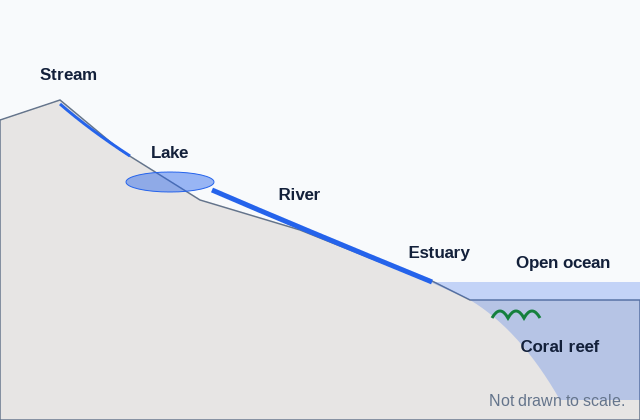 Tap to open the picture full size
Part 1 Think first A reef fish heads north
Commit to a guess first. Being wrong now makes the right idea stick better.
Predict first
A diver sees a brightly colored fish that is common on a coral reef near the equator. Later she dives along a coast far to the north, in water just as deep and just as salty but about ten degrees colder. What do you predict she finds there?
In short. Aquatic biomes are freshwater (streams, rivers, ponds and lakes) or marine (oceans, coral reefs, marshland and estuaries).
- Freshwater biomes are a vital resource for drinking water.
- Marine biomes are salt or mixed water, and their producers matter to the whole atmosphere, not only to the sea.
- Where marine resources such as fish are found depends on a combination of conditions in the water, and usually more than one is at work.
Part 2 Learn it Fresh water, salt water, and what lives where
2a. Freshwater biomes
Freshwater biomes include streams, rivers, ponds and lakes. Their water has very little dissolved salt.
- Streams and rivers flow. A stream is small and often fast, high in hills or mountains; streams join into rivers, which carry water toward a lake or the sea.
- Ponds and lakes hold standing water. A pond is small and shallow; a lake is larger and can be deep.
Freshwater biomes are a vital resource for drinking water. People cannot drink seawater, so towns and cities take their water from rivers and lakes, or from water underground, and clean it. A river that is polluted upstream affects every town that drinks from it downstream.
These biomes are also home to their own communities: fish, insects, frogs and plants adapted to low salinity, and, in streams, to moving water.
Quick check · Fill the statement
Complete the description of freshwater biomes. Tap a blank, then an answer.
Streams and rivers hold fresh water, while ponds and lakes hold fresh water. Freshwater biomes are a vital resource for .
2b. Marine biomes and their algae
Marine biomes include oceans, coral reefs, marshland and estuaries.
- Oceans are salty and cover most of Earth's surface.
- Coral reefs are built by coral animals in warm, shallow, clear ocean water.
- Salt marshes are coastal marshland, flooded by the tide, with grasses that tolerate salt.
- Estuaries are where a river meets the sea, so fresh water and salt water mix. Their salinity is between the two.
Where they are found: the open ocean covers most of Earth's surface. Coral reefs grow in the tropics, near the equator, for example in the Caribbean Sea and along the northeast coast of Australia. Estuaries form wherever rivers reach the sea, and salt marshes line many temperate and cold coasts. Freshwater biomes lie on land around the world, wherever rain and melting snow collect in streams, rivers, ponds and lakes.
Algae in marine biomes supply a large portion of the Earth's oxygen, and they also take in carbon dioxide from the atmosphere. Most marine algae are tiny and float near the surface, where sunlight reaches them. Like plants, they photosynthesize: they take in carbon dioxide and release oxygen.
So marine biomes matter far from the coast. The oxygen in the air you breathe, and part of the carbon dioxide that leaves the air, depend on algae in the oceans.
Quick check · Decide and justify
A student says the algae floating in the oceans matter to people living far inland, not only to the animals that live in the sea. Is the student right?
Which reason supports your answer?
2c. What decides where marine resources are
The global distribution of nonmineral marine natural resources, such as different types of fish, varies because of some combination of five conditions:
- Salinity, the amount of salt dissolved in the water. Each species is adapted to a range: some to full seawater, some to the mixed water of estuaries.
- Depth. Sunlight fades with depth, so algae grow only in the upper, lit water, and the animals that eat them gather there.
- Turbidity, how cloudy the water is with mud or other particles. Cloudy water blocks light, so algae grow less, and there is less food at the base of the food chain.
- Nutrient availability. Algae need nutrients. Where rivers or currents bring nutrients, algae grow fast and support many fish.
- Temperature. Each species lives within its own range: coral reef fish in warm water, others in cold water.
As with land biomes, more than one condition is usually at work, so name each one that applies.
Quick check · Match
Match each condition to the observation it best explains.
Part 3 Watch it done The shrimp of one estuary
Open each step in turn, answer the why, then finish the explanation yourself.
A species of shrimp is caught in large numbers in an estuary where a river meets the sea. Upstream, in the river's fresh water, none are caught. Far offshore, in deep ocean water, very few are caught. Explain why the shrimp are found mainly in the estuary.
Step 1 · List what differs between the three places
Upstream is fresh water. The estuary is a mix of fresh and salt water. Far offshore the water is full seawater and much deeper. So salinity and depth both differ.
Step 2 · Use salinity
The shrimp are found in the mixed water but not in fresh water, which fits a species adapted to the salinity of an estuary, between fresh water and seawater.
Step 3 · Use depth and nutrients
The river carries nutrients into the shallow estuary, and light reaches the bottom there, so algae grow well and there is food for the shrimp. In the deep water offshore, light does not reach the bottom and the river's nutrients are spread thin.
Why this step?
Why is one condition not enough to explain the pattern?
Salinity explains why the shrimp are missing upstream, but not why they are scarce offshore, where the water is salty too. Depth and nutrients explain the offshore part.
Your step · Fill the statement
Finish it. A shrimp species is common in an estuary, absent in the fresh water upstream, and scarce in the deep ocean offshore. Tap a blank, then an answer.
The shrimp are missing upstream because of the there. They are scarce offshore because the water is too for light to reach the bottom, and the river's are spread thin.
Part 4 Try it New waters
For each question, list the conditions that differ before you choose: salinity, depth, turbidity, nutrients, temperature.
Try it · Multiple choice
A fish feeds on algae that grow on the sea floor. It is common over a shallow underwater bank and absent where the floor drops away to great depth nearby. The water over both is equally clear, salty and warm. Which explanation fits best?
Try it · Spot the error
A student explains what marine algae do for the atmosphere. Tap the first line that goes wrong.
Try it · Select all
A fish lives only in the mixed fresh and salt water of one estuary, and eats small animals that feed on algae. Which two changes would most likely reduce the number of these fish? Pick two.
Select 2 answers, then check.
Try it · Multiple choice
A class is planning a field trip to see a coral reef. Which of these places is most likely to have one?
Part 5 Explain it Design an investigation of cloudy water
Write your answer first. Nothing you type here leaves this page. Then compare it with the model and each scoring point.
Free response is 40% of the exam score. This one is shaped like Question 1, Design an investigation.
Free-response practice · Question 1 style
A lake that a town uses for drinking water has become cloudier each summer because of soil washing in from nearby construction. A student wants to find out whether the cloudiness reduces the growth of the lake's algae.
(a) Identify a testable hypothesis for the student's question.
(b) Describe an experiment the student could do with jars of lake water to test the hypothesis.
(c) Identify the independent variable, the dependent variable, and one condition that should be kept the same in every jar.
(d) Suppose the results show that algae grow less in cloudier water. Explain how this could affect the number of fish the lake supports.
Model answer
(a) If the lake water is cloudier, then less algae will grow in it.
(b) Fill twelve clear jars with filtered lake water and the same small amount of algae. Add a different amount of washed white clay, which clouds the water but adds no nutrients, to each group of three jars: none, a little, more, and the most. Soil would not do, since it carries nutrients that could make algae grow faster and hide the effect of the cloudiness. Set all the jars in the same sunny place for two weeks, then measure the algae in each jar, for example by how green the water is with a color chart or by counting algae cells under a microscope.
(c) The independent variable is the amount of clay, or how cloudy the water is. The dependent variable is the amount of algae that grew. Kept the same: the amount of light, the temperature, the starting algae, or the volume of water.
(d) Algae are at the base of the lake's food chain. If cloudiness cuts algae growth, there is less food for the small animals that eat algae and then for the fish that eat them, so the lake could support fewer fish.
Score your own answer. This is a self-check, not a grade. Tick each point your answer makes.
Part 6 Check yourself A fish survey along one coast
The first two questions use the table.
Suppose researchers set the same nets at five sites along one coast and count one species of fish. The numbers below are made up for practice.
| Site | Site depth (m) | Salinity (parts per thousand) | Water temperature (°C) | Depth light reaches (m) | Fish caught per net |
|---|---|---|---|---|---|
| A | 60 | 34 | 18 | 20 | 42 |
| B | 55 | 35 | 17 | 19 | 39 |
| C | 58 | 34 | 18 | 3 | 6 |
| D | 62 | 35 | 26 | 20 | 4 |
| E | 57 | 33 | 17 | 18 | 40 |
Case question 1 · Multiple choice
Using the table of five coastal sites: which condition best explains why so few fish were caught at Site C?
Case question 2 · Decide and justify
A student says that Site D in the table had few fish because its water is too salty. Is the student right?
Which reason supports your answer?
The rest stand on their own and do not use the case.
Check yourself · Sort it
Tap each aquatic biome, then the group it belongs to.
Freshwater biome
Marine biome
Check yourself · Rank it
One river runs from a mountain stream to an estuary and then into the open ocean. Rank the three waters by salinity.
Saltiest first
Give each one a place, 1 for first. Give two the same place if they are equal.
Your ranking: none yet
Part 7 Keep it Bring back earlier ideas
Two questions from the last two topics: the land biomes and the ways species compete.
Read each climate before you name a biome: temperature first, then how much precipitation and in which months.
From 1.2 Terrestrial Biomes · Sort it
Each card describes the climate and plants of a place. Tap a card, then the biome it describes.
Tropical rainforest
Savanna
Taiga
Desert
From 1.1 Introduction to Ecosystems · Sort it
Each card describes competition for a limited resource. Tap a card, then the kind of competition it shows.
Competition within a species
Competition between species
In three lines
- Freshwater biomes are streams, rivers, ponds and lakes, and they are a vital source of drinking water.
- Marine biomes are oceans, coral reefs, marshland and estuaries, and their algae supply a large portion of Earth's oxygen while taking in carbon dioxide.
- Where fish and other marine resources are found depends on some combination of salinity, depth, turbidity, nutrients and temperature.
Exam strategy for this topic
- Section I, Multiple Choice: 80 questions in 90 minutes.
- Section II, Free Response: 3 questions in 70 minutes.
- This lesson's Explain it is shaped like free-response question 1, Design an investigation.
- A four-function, scientific, or graphing calculator is allowed on both sections of the exam.
When a question asks why a fish or other resource is found in one place and not another, compare the places condition by condition (salinity, depth, turbidity, nutrients, temperature) and name the one that actually differs.
Questions students ask
What are the freshwater biomes?
Streams, rivers, ponds and lakes. They are a vital resource for drinking water.
What are the marine biomes?
Oceans, coral reefs, marshland and estuaries. An estuary is where a river meets the sea.
Why do ocean algae matter to people on land?
Algae in marine biomes supply a large portion of the Earth's oxygen and take in carbon dioxide from the atmosphere, which everyone shares.
What decides where fish are found in the ocean?
Some combination of salinity, depth, turbidity, nutrient availability and temperature. Usually more than one condition is at work.
What is turbidity?
How cloudy the water is. Cloudy water blocks sunlight, so algae grow less and there is less food for the animals that depend on them.
Course alignment, for teachers
AP Environmental Science topic 1.3, Unit 1: The Living World: Ecosystems.
- Skill 1.B: Explain environmental concepts and processes.
This lesson maps all 3 essential knowledge statements of the topic to the part that teaches each one: 3 are checked by a scored question. The map is in the lesson file.