Unit 5 · Topic 5.17 · about 30 minutes · 7 parts · 10 scored checks, 2 of them multiple choice, plus 2 from earlier lessons
AP Environmental Science 5.17: Sustainable Forestry
Unit 5: 10 to 15% of the multiple-choice section
What you'll be able to do
- Describe methods for mitigating human impact on forests.
Key vocabulary
| Term | What it means | The exam trap |
|---|---|---|
| Deforestation | The clearing or cutting of a forest without replacing it, so the land holds fewer trees. | A forest can be lost slowly, a few hectares at a time, as well as all at once. |
| Pathogen | An organism that causes disease, such as a fungus, a bacterium or a virus. | Trees get diseases too; pathogens are not only a problem for animals. |
| Fire line | A strip cleared down to bare soil so that a fire cannot cross it easily. | Crews dig fire lines before a planned fire, not only while fighting one. |
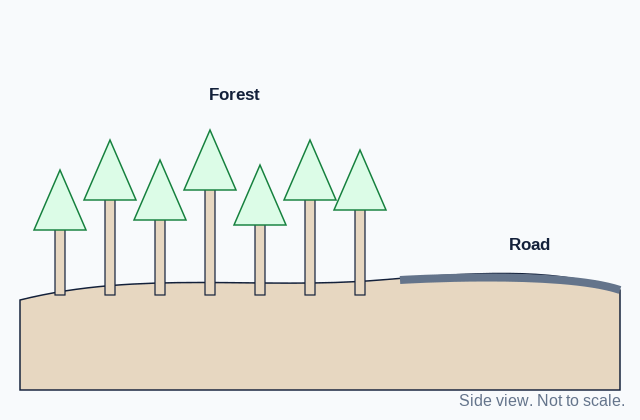 Tap to open the picture full size
Part 1 Think first Cutting trees to save a forest
Commit to a guess first. Being wrong now makes the right idea stick better.
Predict first
A fungus is killing a few oak trees in one corner of a made-up forest. Foresters cut down the sick oaks and also a ring of healthy-looking oaks around them. Which reason do you predict explains the ring?
In short. Some methods for mitigating deforestation are reforestation, using and buying wood harvested by ecologically sustainable forestry techniques, and reusing wood.
- Integrated pest management (IPM) and the removal of affected trees protect forests from pathogens and insects.
- A prescribed burn sets a forest on fire under controlled conditions to reduce the occurrence of natural fires.
- Each method lessens a different human impact on forests: cutting, pests and disease, or fire.
Part 2 Learn it Lessening human impact on forests
2a. Slowing deforestation
Some of the methods for mitigating deforestation include reforestation, using and buying wood harvested by ecologically sustainable forestry techniques, and reusing wood.
To mitigate is to lessen. Each method below lessens the loss of forest in its own way.
- Reforestation: planting trees on land where a forest was cut or cleared, so that a forest grows back.
- Wood from ecologically sustainable forestry: wood cut in ways that let the forest regrow and keep working as an ecosystem. Background: such techniques include cutting only some of the trees in a stand, leaving strips of forest along streams, and replanting after a harvest. Using and buying this wood rewards forests managed that way.
- Reusing wood: building with wood that has already been cut, such as beams from a torn-down house framed into a new one, so fewer trees are cut for new lumber.
Quick check · Multiple choice
A made-up town council wants its new park to add less to deforestation. Which plan does that?
2b. Protecting forests from pathogens and insects
Methods to protect forests from pathogens and insects include integrated pest management (IPM) and the removal of affected trees.
A pathogen is an organism that causes disease, such as a fungus, a bacterium or a virus.
- IPM in a forest: the same combination of biological, physical and limited chemical methods used on farms, aimed at the insects and pathogens that attack trees.
- Removal of affected trees: cutting down and taking away trees that carry the pathogen or the insects. Background: a sick or infested tree is a source; taking it out leaves less to spread to the healthy trees around it.
Quick check · Select all
Bark beetles are killing pine trees in one corner of a made-up forest. Which two methods protect the rest of the forest? Pick two.
Select 2 answers, then check.
2c. Prescribed burns
Prescribed burn is a method by which forests are set on fire under controlled conditions in order to reduce the occurrence of natural fires.
Controlled conditions means the people setting the fire choose when and where it burns: a day with the right weather, wind and moisture, an area marked off with lines of bare soil, and crews standing by to keep it inside them.
Background: dead branches, needles and brush build up on a forest floor over the years. A small, controlled fire burns some of that fuel away, leaving less to feed a natural fire later.
Quick check · Decide and justify
A made-up ranger plans to set part of a dry pine forest on fire on a calm, damp spring day, with crews and fire lines ready. She says that over the next ten years the forest should have fewer fires that start on their own. Is she right?
Which reason supports your answer?
Part 3 Watch it done How many seedlings survive?
Open each step in turn, answer the why, then finish the calculation yourself.
A made-up timber company logged 85 hectares and replants them at 1,200 seedlings per hectare. About 15% of the seedlings die in their first year. How many seedlings are alive after the first year?
Step 1 · Seedlings planted
seedlings.
Why this step?
Why replant land that was logged?
Planting trees where a forest was cut is reforestation, one of the methods for mitigating deforestation.
Step 2 · Seedlings alive
If 15% die, the rest live: . Multiply 102,000 by that share written as a decimal.
Your step · Calculate
Finish it. The company plants 102,000 seedlings, and 15% die in their first year. How many are alive after the first year?
seedlings
About 86,700 young trees start the new forest. Reforestation takes years to grow back what logging took in weeks, which is why it is paired with careful harvesting and reused wood.
Part 4 Try it Sort the methods, then check an account
First sort forest practices by what they do. Then find where a student's account of a timber company goes wrong.
Try it · Sort it
What does each made-up practice do? Tap a card, then its group.
Mitigates deforestation
Protects trees from pathogens and insects
Try it · Spot the error
A student explains how a made-up timber company manages its land. Tap the first line that goes wrong.
Part 5 Explain it A county's forest over twenty years
Write your answer first. Nothing you type here leaves this page. Then compare it with the model and each scoring point.
Free response is 40% of the exam score. This one is shaped like Question 2, Analyze and interpret quantitative data.
Free-response practice · Question 2 style
A made-up county tracks the area of its forest. Replanted land counts as forest in these figures. The numbers are made up for practice.
- Forest area in 2000: 52,000 hectares
- Forest area in 2010: 46,800 hectares
- Forest area in 2020: 48,100 hectares
- From 2010 to 2020, the county replanted 260 hectares of logged land each year
(a) Describe the trend in the county's forest area from 2000 to 2020.
(b) Calculate the percent change in forest area from 2000 to 2010. Show your work.
(c) Calculate the hectares of forest cut or cleared from 2010 to 2020, if replanting and cutting were the only changes. Show your work.
(d) Identify one method other than reforestation that the county's residents could use to mitigate deforestation.
(e) Explain one advantage of a prescribed burn for the county's forest.
Model answer
(a) Forest area fell from 52,000 hectares in 2000 to 46,800 in 2010, then rose to 48,100 by 2020, after replanting began.
(b) hectares. , a 10% decrease.
(c) Replanted: hectares. Cut or cleared: hectares.
(d) Use and buy wood harvested by ecologically sustainable forestry techniques, or reuse wood instead of buying new lumber.
(e) A prescribed burn sets part of the forest on fire under controlled conditions, which reduces the occurrence of natural fires there.
Score your own answer. This is a self-check, not a grade. Tick each point your answer makes.
Part 6 Check yourself Two zones, one with burns
The first two questions use the table.
A made-up national forest has two zones, North and South, of about the same size and tree cover. From 2016 on, crews set prescribed burns in North every few years; South gets none. Rangers count the natural fires in each zone. The numbers are made up for practice.
| Five-year period | Natural fires in North | Natural fires in South |
|---|---|---|
| 2011 to 2015 | 24 | 22 |
| 2016 to 2020 | 15 | 23 |
| 2021 to 2025 | 9 | 25 |
Case question 1 · Multiple choice
The forest service proposes prescribed burns for South as well. Which use of the data best justifies the proposal?
Case question 2 · Calculate
Using the table: by what percent did North's natural fires fall from the 2011 to 2015 period to the 2021 to 2025 period?
The rest stand on their own and do not use the case.
Check yourself · Fill the statement
Complete the account of two made-up projects.
Planting seedlings on a slope a logging crew cleared last year is ; building a deck from boards pulled off an old barn is wood.
Check yourself · Match
Match each made-up scene to the forest method it shows.
Part 7 Keep it Bring back earlier ideas
Two questions from earlier topics: sorting the benefits and drawbacks of fish farming, and a student's account of an orchard that switches to integrated pest management.
First sort results of fish farming into benefits and drawbacks. Then find where a student's account of a salmon farm goes wrong.
From 5.16 Aquaculture · Sort it
Is each made-up result of a fish farm a benefit or a drawback of aquaculture? Tap a card, then its group.
Benefit
Drawback
First sort farm practices into those that fit integrated pest management and those that do not. Then find where a student's account of an orchard goes wrong.
From 5.14 Integrated Pest Management · Spot the error
A student explains how a made-up apple grower's switch to integrated pest management works out. Tap the first line that goes wrong.
In three lines
- Methods for mitigating deforestation include reforestation, using and buying wood harvested by ecologically sustainable forestry techniques, and reusing wood.
- Integrated pest management and the removal of affected trees protect forests from pathogens and insects.
- A prescribed burn sets a forest on fire under controlled conditions to reduce the occurrence of natural fires.
Exam strategy for this topic
- Section I, Multiple Choice: 80 questions in 90 minutes.
- Section II, Free Response: 3 questions in 70 minutes.
- This lesson's Explain it is shaped like free-response question 2, Analyze and interpret quantitative data.
- A four-function, scientific, or graphing calculator is allowed on both sections of the exam.
When a question asks how to mitigate human impact on forests, name a specific method and what it does: reforestation, sustainably harvested wood or reused wood against deforestation; IPM or removing affected trees against pathogens and insects; a prescribed burn to reduce the occurrence of natural fires.
Questions students ask
How can deforestation be mitigated?
Some of the methods include reforestation, using and buying wood harvested by ecologically sustainable forestry techniques, and reusing wood.
How are forests protected from pathogens and insects?
With integrated pest management (IPM) and the removal of affected trees.
What is a prescribed burn?
A method by which forests are set on fire under controlled conditions in order to reduce the occurrence of natural fires.
Course alignment, for teachers
AP Environmental Science topic 5.17, Unit 5: Land and Water Use.
- Skill 7.F: Justify a proposed solution, by explaining potential advantages.
This lesson maps all 3 essential knowledge statements of the topic to the part that teaches each one: 3 are checked by a scored question. The map is in the lesson file.