Unit 1 · Topic 1.4 · about 30 minutes · 7 parts · 12 scored checks, 2 of them multiple choice, plus 2 from earlier lessons
AP Environmental Science 1.4: The Carbon Cycle
Unit 1: 6 to 8% of the multiple-choice section
What you'll be able to do
- Explain the steps of the carbon cycle and how its reservoirs interact: how carbon moves between sources and sinks, and how long each reservoir holds it.
Key vocabulary
| Term | What it means | The exam trap |
|---|---|---|
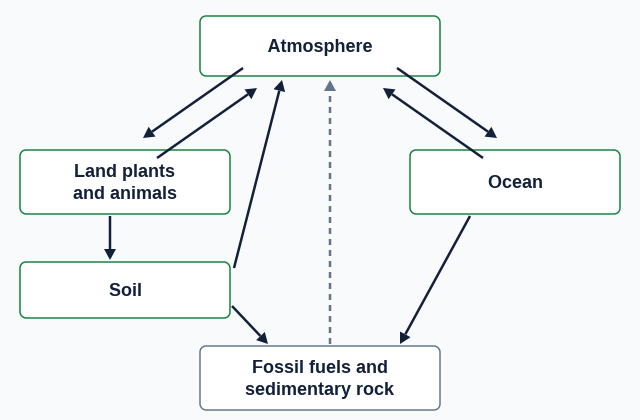
| Carbon cycle | The movement of atoms and molecules containing carbon between sources and sinks. | Name both reservoirs a flow joins, the one carbon leaves and the one it enters. |
| Reservoir | A place where carbon, or another element, is held for a time, such as the atmosphere, living things, the oceans or rock. | Reservoirs differ in how long they hold an element, so read the time scale a question uses. |
| Source | A reservoir that releases more of an element than it takes in. | Decide whether a reservoir is a source from all of its flows over the same time, not from one. |
| Sink | A reservoir that takes in more of an element than it releases. | A reservoir can switch between sink and source when its flows change. |
| Fossil fuel | A fuel such as coal, oil or natural gas, formed over millions of years from buried remains of plants and animals. | The carbon in a fossil fuel was once in living things and the air; burning returns it. |
 Tap to open the picture full size
Part 1 Think first The forest's breathing air
Commit to a guess first. Being wrong now makes the right idea stick better.
Predict first
Scientists measure the carbon dioxide in the air above a large northern forest all year. It rises through the winter and drops through the summer, every year. What do you predict causes the summer drop?
In short. The carbon cycle is the movement of atoms and molecules containing carbon between sources and sinks: the air, living things, soil, the oceans, and rock and fossil fuels.
- A source releases more carbon than it takes in, and a sink takes in more carbon than it releases.
- Some reservoirs hold carbon for long periods of time, while others hold it for relatively short periods.
- Carbon stored over millions of years in fossil fuels returns to the atmosphere quickly, as carbon dioxide, when those fuels are burned.
Part 2 Learn it Following carbon
2a. Reservoirs, sources and sinks
The carbon cycle is the movement of atoms and molecules containing the element carbon between sources and sinks.
Carbon is held in reservoirs: the atmosphere (as carbon dioxide), living things (in sugars, wood and other tissue), soil (in dead and decaying matter), the oceans (dissolved in the water and in sea life), and rock, including sedimentary rock and fossil fuels such as coal, oil and natural gas.
Carbon moves between reservoirs in flows. A reservoir is a source when it releases more carbon than it takes in, and a sink when it takes in more carbon than it releases.
The ocean and the air trade carbon all the time: carbon dioxide dissolves into seawater from the air, and comes back out of it. Whether the ocean is a sink depends on which of those two flows is larger.
The same reservoir can be either one. A young forest that is growing takes in more carbon than it releases, so it is a sink. If that forest burns, it becomes a source. To tell which, compare everything flowing in with everything flowing out over the same time.
Quick check · Select all
Which two of these are acting as sinks for carbon? Pick two.
Select 2 answers, then check.
2b. Photosynthesis and cellular respiration
Carbon cycles between photosynthesis and cellular respiration in living things.
- Photosynthesis: producers such as plants and algae use energy from sunlight to combine carbon dioxide and water into sugars, releasing oxygen. Carbon moves from the atmosphere (or the water, for algae) into living things.
- Cellular respiration: living things break sugars down with oxygen to release the energy stored in them, giving off carbon dioxide and water. Carbon moves back to the atmosphere.
Producers do both. A plant photosynthesizes in light and respires all the time, day and night, to power its own cells. Consumers and decomposers only respire: a rabbit that eats clover respires some of the clover's carbon back to the air, and the fungi that break down a dead rabbit respire more.
The two processes are close to mirror images, which is why carbon can go round and round between the air and the living world for as long as the sun keeps shining.
Quick check · Fill the statement
Complete the description of carbon moving between the air and living things. Tap a blank, then an answer.
moves carbon from the air into living things, and returns it to the air. Of these two processes, carry out both.
2c. Short stays and long stays
Some of the reservoirs in which carbon compounds occur hold those compounds for long periods of time, while some hold them for relatively short periods of time.
The atmosphere and living things are short-term reservoirs. A carbon atom in a leaf may be respired back to the air within days, or held in wood for decades, but it does not stay in the living world for millions of years: the plant, or whatever eats it, eventually respires or decomposes, and the carbon returns to the air.
Rock and fossil fuels are long-term reservoirs. Carbon locked in sedimentary rock or in a coal seam can stay there for millions of years. The deep ocean is in between: carbon that sinks there can stay out of the air for centuries.
This is why time matters in the carbon cycle. A flow into a short-term reservoir can come back out quickly. A flow into a long-term reservoir takes carbon out of circulation for a very long time.
Quick check · Decide and justify
A carbon atom from the air is built into a maple leaf this spring. A student says the atom will most likely stay in the living world for millions of years. Is the student right?
Which reason supports your answer?
2d. Fossil fuels: slow in, fast out
Plant and animal decomposition have led to the storage of carbon over millions of years. In swamps and seas long ago, dead plants and animals were buried under mud and sediment faster than they could fully break down. Over millions of years, heat and pressure turned the buried remains into fossil fuels: coal from swamp plants, and oil and natural gas from tiny sea organisms.
The burning of fossil fuels quickly moves that stored carbon into atmospheric carbon, in the form of carbon dioxide. Carbon that took millions of years to collect is released in the moment a fuel burns in an engine, a furnace or a power plant.
That difference in speed is the point. In the rest of the cycle, flows in and out of the atmosphere are close to balanced. Burning fossil fuels adds a flow from a long-term reservoir to a short-term one with no matching flow back on the same timescale, so carbon builds up in the atmosphere.
Quick check · Multiple choice
Most plants that die on a forest floor return their carbon to the air within a few years. Why did some plants in ancient swamps end up storing their carbon in coal instead?
Part 3 Watch it done Does the atmosphere gain or lose?
Open each step in turn, answer the why, then finish the calculation yourself.
Suppose a model of the carbon cycle gives these yearly flows into and out of the atmosphere, in billions of metric tons of carbon per year. The numbers are made up for practice. In: cellular respiration of living things 60, decomposition 40, burning of fossil fuels 8, release from the ocean 45. Out: photosynthesis 100, uptake by the ocean 49. Does the atmosphere gain or lose carbon each year, and how much?
Step 1 · Add the flows in
Respiration, decomposition, burning and the ocean's release all add carbon to the atmosphere: billion metric tons per year.
Step 2 · Add the flows out
Photosynthesis and the ocean's uptake remove carbon from the atmosphere: billion metric tons per year.
Step 3 · Set up the net change
Net change = flows in minus flows out, with the same units on both. A positive answer means the atmosphere gains carbon; a negative one means it loses carbon.
Why this step?
Why subtract the flows out from the flows in, rather than add every flow together?
Flows in raise the amount of carbon in the atmosphere and flows out lower it, so they work against each other. Adding every flow together would count carbon leaving the atmosphere as if it were arriving.
Your step · Calculate
Finish it. In a made-up model, carbon flows into the atmosphere each year from cellular respiration (60), decomposition (40), burning of fossil fuels (8) and the ocean (45), and out of it through photosynthesis (100) and uptake by the ocean (49), all in billions of metric tons of carbon per year. What is the atmosphere's net change in carbon each year? Give your answer in billions of metric tons per year, positive for a gain.
billion metric tons/yr
Notice that without the 8 from fossil fuels, the flows in would total 145, less than the 149 flowing out. In this model, burning fossil fuels is what tips the atmosphere from losing carbon to gaining it.
Part 4 Try it Other reservoirs, other flows
The same bookkeeping works for any reservoir. Decide what flows in and what flows out of the reservoir in the question, not of the atmosphere.
Try it · Calculate
Suppose a young forest takes in 12 metric tons of carbon per hectare per year by photosynthesis. The trees respire 5, decomposers in the forest's soil and litter respire 4, and small fires release 1, all in metric tons of carbon per hectare per year. The numbers are made up for practice. What is the forest's net change in carbon each year? Give your answer in metric tons per hectare per year, positive for a gain.
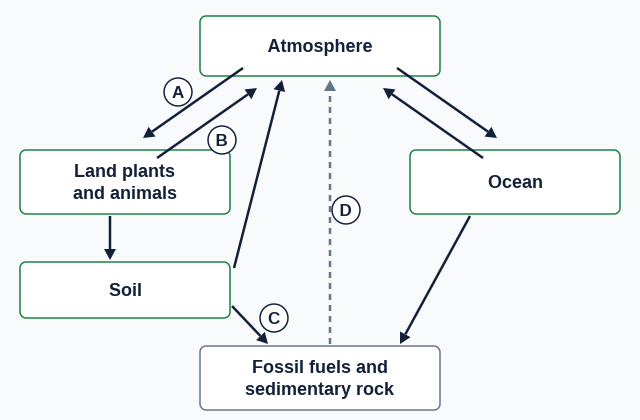
Try it · Match
Use the drawing of the carbon cycle with lettered arrows. Match each lettered arrow to the process that moves carbon that way.
Try it · Sort it
Each card is a flow of carbon. Tap a card, then what it does to the carbon in the atmosphere.
Adds carbon to the atmosphere
Removes carbon from the atmosphere
Part 5 Explain it Read a year of carbon dioxide
Write your answer first. Nothing you type here leaves this page. Then compare it with the model and each scoring point.
Free response is 40% of the exam score. This one is shaped like Question 2, Analyze and interpret quantitative data.
Free-response practice · Question 2 style
Suppose a station in a northern forest region records the carbon dioxide in the air each month, in parts per million (ppm). The numbers below are made up for practice.
- January to June: 412, 413, 414, 415, 416, 414
- July to December: 411, 408, 406, 407, 409, 411
(a) Identify the month with the highest carbon dioxide level.
(b) Calculate the difference between the highest and lowest monthly levels. Show your work and include units.
(c) Explain the drop from May to September, using a process in the carbon cycle.
(d) Explain why the level rises again from September to May.
Model answer
(a) May, at 416 ppm.
(b) The lowest level is 406 ppm, in September. ppm.
(c) From late spring through summer the region's plants are in leaf and photosynthesize strongly, taking carbon dioxide out of the air and building it into sugars and new tissue. Photosynthesis removes more carbon dioxide than living things release, so the level falls.
(d) From fall to spring, photosynthesis slows as leaves fall and plants go dormant, but cellular respiration by plants, animals and decomposers continues, releasing carbon dioxide. More carbon now flows into the atmosphere than out of it, so the level rises.
Score your own answer. This is a self-check, not a grade. Tick each point your answer makes.
Part 6 Check yourself How long carbon stays
The first two questions use the table.
A class builds a simple model of the carbon cycle and gives each reservoir a rough time that a carbon atom stays there before moving on. The times are rounded for practice, not taken from a study.
| Reservoir | Rough time a carbon atom stays |
|---|---|
| Atmosphere | A few years |
| Living plants and animals | Days to decades |
| Soil | Years to centuries |
| Deep ocean | Centuries |
| Fossil fuels and sedimentary rock | Millions of years |
Case question 1 · Multiple choice
Using the class model's table: which flow moves carbon from the reservoir that holds it longest into the atmosphere, within moments?
Case question 2 · Decide and justify
A student says that planting a forest stores carbon away from the atmosphere for a far shorter time than the coal in the ground does. Using the class model's table, is the student right?
Which reason supports your answer?
The rest stand on their own and do not use the case.
Check yourself · Put it in order
Put the journey of one carbon atom in order, from the ancient air to the air today.
Check yourself · Spot the error
A student explains how burning coal affects the atmosphere. Tap the first line that goes wrong.
Part 7 Keep it Bring back earlier ideas
Two questions from earlier topics: what decides where marine life is found, and when species compete.
For each question, list the conditions that differ before you choose: salinity, depth, turbidity, nutrients, temperature.
From 1.3 Aquatic Biomes · Multiple choice
A fish feeds on algae that grow on the sea floor. It is common over a shallow underwater bank and absent where the floor drops away to great depth nearby. The water over both is equally clear, salty and warm. Which explanation fits best?
From 1.1 Introduction to Ecosystems · Decide and justify
A new stone jetty in a bay has far more bare rock than the bay's barnacles can cover, even though hundreds of barnacles have settled on it. A student says the barnacles on the jetty must be competing hard for space, because so many of them live there. Is the student right?
Which reason supports your answer?
In three lines
- The carbon cycle moves carbon between sources and sinks; compare all the flows in and out to tell which a reservoir is.
- Photosynthesis moves carbon from the air into producers, and cellular respiration returns it; some reservoirs hold carbon briefly, others for millions of years.
- Decomposition and burial stored carbon in fossil fuels over millions of years, and burning them moves it quickly into the atmosphere as carbon dioxide.
Exam strategy for this topic
- Section I, Multiple Choice: 80 questions in 90 minutes.
- Section II, Free Response: 3 questions in 70 minutes.
- This lesson's Explain it is shaped like free-response question 2, Analyze and interpret quantitative data.
- A four-function, scientific, or graphing calculator is allowed on both sections of the exam.
For a cycle diagram or a table of flows, name the reservoir the question asks about, total what flows into it and out of it with units, and say whether it gains or loses before you explain why.
Questions students ask
What is the carbon cycle?
The movement of atoms and molecules containing carbon between sources and sinks: the atmosphere, living things, soil, the oceans, and rock and fossil fuels.
What is the difference between a carbon source and a carbon sink?
A source releases carbon to another reservoir. A sink takes in more carbon than it releases. Compare all the flows in and out to tell which.
How do photosynthesis and respiration move carbon?
Photosynthesis moves carbon from the atmosphere into producers. Cellular respiration, in producers, consumers and decomposers, returns it to the atmosphere as carbon dioxide.
Which carbon reservoirs hold carbon the longest?
Rock and fossil fuels, for millions of years. The atmosphere and living things hold carbon for relatively short periods.
Why does burning fossil fuels raise carbon dioxide in the air?
It moves carbon stored over millions of years into the atmosphere quickly, as carbon dioxide, with no flow back into fossil fuels on the same timescale.
Course alignment, for teachers
AP Environmental Science topic 1.4, Unit 1: The Living World: Ecosystems.
- Skill 2.B: Explain relationships between different characteristics of environmental concepts, processes, or models represented visually:
This lesson maps all 4 essential knowledge statements of the topic to the part that teaches each one: 4 are checked by a scored question. The map is in the lesson file.