Unit 6 · Topic 6.7 · about 30 minutes · 7 parts · 10 scored checks, 2 of them multiple choice, plus 2 from earlier lessons
AP Environmental Science 6.7: Energy from Biomass
Unit 6: 10 to 15% of the multiple-choice section
What you'll be able to do
- Describe the effects of the use of biomass in power generation on the environment.
Key vocabulary
| Term | What it means | The exam trap |
|---|---|---|
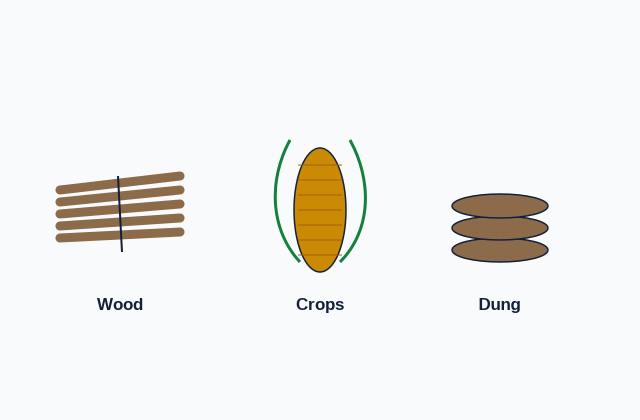
| Biomass | Organic matter from living or recently living things, used as fuel. | Biomass is fuel from living or recently living things, so wood, crops and dung count and coal does not. |
| Particulates | Tiny solid particles and liquid droplets carried in the air, such as soot and ash. | Particulates are not gases, though they travel with the gases in smoke. |
| Fermentation | A process in which yeast or bacteria turn sugar into other substances, such as alcohol. | Fermenting a crop makes a fuel from it; it does not burn the crop. |
 Tap to open the picture full size
Part 1 Think first What does it cost to make the fuel?
Commit to a guess first. Being wrong now makes the right idea stick better.
Predict first
Making ethanol from corn takes tractors, fertilizer, trucks, and heat to ferment and distill it, and all of that uses energy. How do you predict the energy in the finished ethanol compares with the energy used to make it?
In short. Biomass is fuel from living or recently living things, and ethanol is one fuel made from it.
- The lesson weighs what burning biomass gives and what its smoke carries.
- It follows what happens to a forest that is cut for fuel.
- It ends with ethanol as a fuel for cars: what happens to its carbon, and its energy return.
Part 2 Learn it Fuel that grew recently
2a. Cheap heat, dirty smoke
Burning of biomass produces heat for energy at a relatively low cost, but it also produces carbon dioxide, carbon monoxide, nitrogen oxides, particulates, and volatile organic compounds.
Biomass is organic matter from living or recently living things: wood, charcoal, crop waste, dried dung, and fuels made from plants. Burning it gives heat for cooking, for warming homes, and in some places for making steam in a power plant.
The heat comes at a relatively low cost: wood and waste can often be gathered nearby or bought cheaply. The smoke is the drawback. It carries:
- carbon dioxide, and carbon monoxide, a poisonous gas from burning with too little oxygen;
- nitrogen oxides, gases formed in the heat of the fire;
- particulates, tiny solid particles and droplets of soot and ash;
- volatile organic compounds, carbon-based chemicals that evaporate easily.
Indoors, over an open fire, these build up where people breathe.
Quick check · Multiple choice
Families in a made-up valley stop heating with bottled gas bought in a distant town and start burning wood they gather on the hills. Which change are they most likely to notice?
2b. Cutting faster than trees grow
The overharvesting of trees for fuel also causes deforestation.
To overharvest is to cut trees faster than the forest grows new wood to replace them. Deforestation is the loss of a forest, or a large part of one, as the land is cleared and the trees are not replaced.
A forest can supply firewood for a long time if people take no more than it regrows. When a town grows and burns more wood each year, or when charcoal is made for sale in a distant city, the harvest can outpace the regrowth. Each year the forest is a little thinner, and in time the land is bare.
That is why the same fuel can be a renewable use in one place and not in another: the rate of cutting against the rate of growth decides it. Background: bare slopes lose their soil to rain, and the animals that lived in the forest lose their habitat.
Quick check · Decide and justify
In a made-up district, people cut more firewood every year as their town grows. A student says that since trees grow back, cutting a forest for fuel cannot cause deforestation. Is the student right?
Which reason supports your answer?
2c. Ethanol
Ethanol can be used as a substitute for gasoline. Burning ethanol does not introduce additional carbon into the atmosphere via combustion, but the energy return on energy investment for ethanol is low.
Ethanol is an alcohol made by fermenting the sugar in crops such as corn or sugarcane. It burns in car engines, alone or blended with gasoline.
Why, as this page explains it: the crop took in carbon dioxide from the air as it grew, and burning the ethanol returns that carbon. So combustion adds no carbon beyond what the crop recently removed, unlike a fossil fuel, whose carbon was locked underground for millions of years.
The catch is its energy return on energy investment (EROEI): the energy a fuel delivers divided by the energy used to produce it.
Farming, fertilizer, trucking and distilling use a great deal of energy, so ethanol's EROEI is low: each unit invested returns not much more than one unit.
Quick check · Select all
A made-up city switches its buses from gasoline to corn ethanol. Which two statements about the switch are accurate? Pick two.
Select 2 answers, then check.
Part 3 Watch it done Ethanol's energy return
Open each step in turn, answer the why, then finish the calculation yourself.
Ethanol made from one made-up field of corn delivers 75 gigajoules (GJ) of energy when burned. Growing, harvesting, trucking and distilling it used 60 GJ. What is the ethanol's energy return on energy investment?
Step 1 · Name the two amounts
Energy delivered: 75 GJ. Energy used to produce it: 60 GJ.
Why this step?
Why does making ethanol use so much energy?
The corn has to be grown with machines and fertilizer, carried to a plant, fermented and distilled, and every step uses energy before any ethanol is burned.
Step 2 · Set up the fraction
EROEI puts the energy delivered on top: .
Your step · Calculate
Finish it. The ethanol delivers 75 GJ and took 60 GJ to produce. What is its energy return on energy investment?
GJ delivered per GJ invested
An EROEI of 1.25 means each gigajoule invested returns 1.25: a gain of only one quarter. That is what a low energy return on energy investment looks like.
Part 4 Try it Sort the fuels, then check an account
First sort made-up fuels into biomass and fossil fuels. Then find where a student's account of a village's wood use goes wrong.
Try it · Sort it
Is each made-up fuel a biomass fuel or a fossil fuel? Tap a card, then its group.
Biomass fuel
Fossil fuel
Try it · Spot the error
A student describes a made-up mountain village's fuel. Tap the first line that goes wrong.
Part 5 Explain it A bus fleet on ethanol
Write your answer first. Nothing you type here leaves this page. Then compare it with the model and each scoring point.
Free response is 40% of the exam score. This one is shaped like Question 3, Analyze an environmental problem doing calculations.
Free-response practice · Question 3 style
A made-up city plans to run its buses on ethanol made from corn. The figures are made up for practice:
- Buses in the fleet: 200
- Gasoline each bus burns in a year: 30,000 liters
- Ethanol needed to replace each liter of gasoline: 1.5 liters
- Energy one liter of the ethanol delivers: 21 megajoules (MJ)
- Energy used to produce one liter of the ethanol: 17.5 MJ
(a) Calculate the liters of ethanol the whole fleet would burn in a year. Show your work.
(b) Calculate the ethanol's energy return on energy investment. Show your work.
(c) Explain why burning the ethanol does not introduce additional carbon into the atmosphere via combustion.
(d) Explain what your answer to (b) shows is a drawback of the plan.
(e) Describe one air pollutant, other than carbon dioxide, that burning a biomass fuel produces.
Model answer
(a) liters of ethanol a year.
(b) MJ delivered for each MJ used to produce it.
(c) The carbon in the ethanol came from carbon dioxide the corn took from the air as it grew, so burning it returns that carbon rather than adding carbon that was stored underground.
(d) An EROEI of 1.2 is low: almost as much energy goes into growing, trucking and distilling the ethanol as it gives back, so the fleet gains little energy for all that work.
(e) Carbon monoxide, a poisonous gas; nitrogen oxides, particulates and volatile organic compounds also fit.
Score your own answer. This is a self-check, not a grade. Tick each point your answer makes.
Part 6 Check yourself Thirty years of firewood
The first two questions use the table.
A made-up district's forest office records how much wood its people burn each year and how much forest is left. The numbers are made up for practice.
| Measure | 1990 | 2000 | 2010 | 2020 |
|---|---|---|---|---|
| Forest area (square kilometers) | 840 | 760 | 610 | 483 |
| Families in the district | 4,100 | 5,200 | 6,600 | 8,300 |
| Wood burned (thousand metric tons a year) | 120 | 150 | 190 | 240 |
Case question 1 · Multiple choice
Which statement do the data best support?
Case question 2 · Calculate
Using the table: what percent of the district's 1990 forest area was lost by 2020?
The rest stand on their own and do not use the case.
Check yourself · Fill the statement
Complete the account of a made-up farm cooperative.
The cooperative ferments its corn into to sell in place of gasoline, though the fuel's energy return on energy investment is .
Check yourself · Match
Match each made-up observation to what it shows about biomass and ethanol.
Part 7 Keep it Bring back earlier ideas
Two questions from earlier topics: matching nuclear scenes to their ideas, and a student's account of a region's coal, oil and gas.
First match made-up scenes to the idea each one shows. Then find where a student's account of a nuclear plant goes wrong.
From 6.6 Nuclear Power · Match
Match each made-up scene to the idea it shows.
First sort made-up explanations of where resources lie. Then find where a student's account of a country's resources goes wrong.
From 6.4 Distribution of Natural Energy Resources · Spot the error
A student describes where a made-up country's resources lie. Tap the first line that goes wrong.
In three lines
- Burning biomass gives heat at a relatively low cost but produces carbon dioxide, carbon monoxide, nitrogen oxides, particulates and VOCs.
- Overharvesting trees for fuel causes deforestation.
- Ethanol can substitute for gasoline and adds no additional carbon via combustion, but its energy return on energy investment is low.
Exam strategy for this topic
- Section I, Multiple Choice: 80 questions in 90 minutes.
- Section II, Free Response: 3 questions in 70 minutes.
- This lesson's Explain it is shaped like free-response question 3, Analyze an environmental problem doing calculations.
- A four-function, scientific, or graphing calculator is allowed on both sections of the exam.
For biomass, pair the advantage with the costs: cheap heat, but air pollutants and deforestation from overharvesting. For ethanol, say it substitutes for gasoline and adds no additional carbon via combustion, but its energy return on energy investment is low.
Questions students ask
What does burning biomass release?
Heat at a relatively low cost, along with carbon dioxide, carbon monoxide, nitrogen oxides, particulates and volatile organic compounds.
How can using wood for fuel cause deforestation?
Overharvesting trees for fuel, cutting them faster than the forest regrows, causes deforestation.
What are the pros and cons of ethanol?
It can substitute for gasoline and does not introduce additional carbon via combustion, but its energy return on energy investment is low.
Course alignment, for teachers
AP Environmental Science topic 6.7, Unit 6: Energy Resources and Consumption.
- Skill 7.B: Describe potential responses or approaches to environmental problems.
This lesson maps all 2 essential knowledge statements of the topic to the part that teaches each one: 2 are checked by a scored question. The map is in the lesson file.