Unit 9 · Topic 9.4 · about 30 minutes · 7 parts · 10 scored checks, 2 of them multiple choice, plus 2 from earlier lessons
AP Environmental Science 9.4: Increases in the Greenhouse Gases
Unit 9: 15 to 20% of the multiple-choice section
What you'll be able to do
- Identify the threats to human health and the environment posed by an increase in greenhouse gases.
Key vocabulary
| Term | What it means | The exam trap |
|---|---|---|
| Greenhouse gas | A gas, such as carbon dioxide or methane, that traps heat in the atmosphere. | A greenhouse gas warms the climate by trapping heat, not by harming lungs or blocking sunlight. |
| Vector | An organism, such as a mosquito or a tick, that carries a pathogen to people. | The vector carries the disease's cause; it is not the cause itself. |
| Population dynamics | How a population's size and makeup change over time, through births, deaths and moves. | It describes change over time, not one count on one day. |
 Tap to open the picture full size
Part 1 Think first A sea that rises far from any ice
Commit to a guess first. Being wrong now makes the right idea stick better.
Predict first
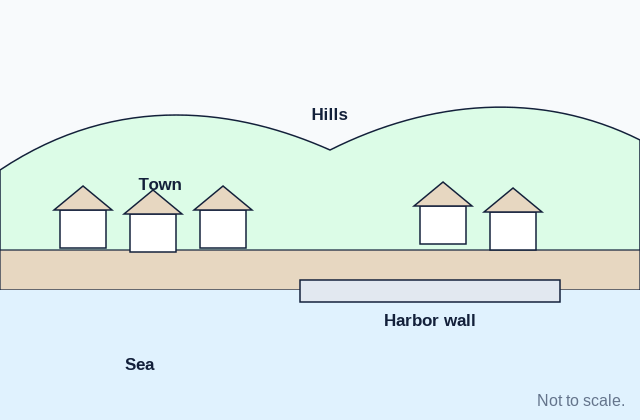
A made-up harbor town lies on a warm coast, thousands of kilometers from any ice. Over fifty years, its high-tide line has crept up the harbor wall. Which do you predict could explain the rise?
In short. An increase in greenhouse gases threatens human health and the environment because the global climate change it causes brings problems that reach people and wildlife.
- Global climate change is caused by excess greenhouse gases in the atmosphere.
- The problems it brings include rising sea levels and diseases reaching new places.
- Those problems can change how populations grow and where people and other species live.
Part 2 Learn it Three threats from extra greenhouse gases
2a. Excess greenhouse gases and rising seas
A greenhouse gas is a gas that traps heat in the atmosphere, such as carbon dioxide or methane. These gases occur naturally, but people add more of them, for example by burning fossil fuels, so the atmosphere now holds more than it did.
Global climate change is caused by excess greenhouse gases in the atmosphere. The extra trapped heat warms the air, the land and the oceans, and the warming leads to a variety of environmental problems that threaten people and wildlife.
One of them is rising sea levels, which come from two causes:
- Melting ice sheets. An ice sheet is a thick layer of ice covering a large area of land. When it melts, water that sat on land runs into the ocean, so the ocean holds more water.
- Ocean water expansion. Water takes up more room as it warms, so a warmer ocean fills more space even with no water added.
For example, over a made-up century a coast's sea level rises by 30 cm: part of the rise is meltwater from an ice sheet on a faraway continent, and part is the warming of water that was already in the sea.
Quick check · Multiple choice
In one made-up decade, almost no ice on land melted, yet the sea at a harbor still rose a little as the ocean grew warmer. Which best explains the rise in that decade?
2b. Disease vectors move toward the poles
Some diseases reach people through a vector, an organism such as a mosquito or a tick that carries a pathogen, the living thing or virus that causes the disease, to people. Where a vector can survive and breed depends on the climate.
As the climate warms, disease vectors spread from the tropics toward the poles. Places nearer the poles that were too cold for a vector become warm enough for it, so the vector, and the disease it carries, can reach people who have not faced that disease before. That is one of the threats to human health that an increase in greenhouse gases poses.
For example, a made-up valley's winters grow milder over forty years, and a tick that once lived only in lowlands nearer the equator is now found in the valley's woods.
Quick check · Decide and justify
Winters in a made-up northern country have grown milder for decades. A student says a mosquito that carries a disease will stay in the tropics where it lives now, so the country's towns face no new disease risk from it. Is the student right?
Which reason supports your answer?
2c. Populations respond
The problems that excess greenhouse gases bring can lead to changes in population dynamics, how a population's size and makeup change over time through births, deaths and moves, and to population movements, as people and other species move to new places in response.
Problems such as rising seas and spreading diseases can change population dynamics and set populations moving. A coast that floods more often can lose farmland and clean wells, so fewer people can live there. A disease that reaches a town for the first time can raise its deaths. People may move to higher or safer ground, and plants and animals may shift to places that still suit them.
For example, a mosquito-borne disease reaches a made-up hill town for the first time, more people die there that summer than in any summer before, and some families leave for a city where the disease is not found.
Quick check · Select all
Rising seas flood a made-up low island's fields and wells with salt water. Which two are changes in population dynamics or population movements that could follow? Pick two.
Select 2 answers, then check.
Part 3 Watch it done An island loses people
Open each step in turn, answer the why, then finish the calculation yourself.
A made-up island had 12,000 people in 2000. As rising seas turned its wells salty, families left, and by 2020 it had 9,000 people. By what percent did the population fall? The numbers are made up for practice.
Step 1 · Find the change
fewer people.
Why this step?
Why divide by the 2000 population and not the 2020 one?
A percent change compares the change with where it started, so the starting population is the base.
Step 2 · Set up the percent
Divide the change by the starting population, then multiply by 100%.
Your step · Calculate
Finish it. The island lost 3,000 of its 12,000 people. By what percent did its population fall? Round to the nearest whole percent.
%
25%. A percent lets a planner compare a small island's loss with a large city's on the same footing.
Part 4 Try it Fill in a rising sea, then check an account
First complete an account of a made-up coast. Then find where a student's account of an island's shorebirds goes wrong.
Try it · Fill the statement
Complete the account of a made-up coast.
Two changes raise the sea along a made-up coast: water from melting runs off the land into the ocean, and the ocean's own water takes up more room through as it warms.
Try it · Spot the error
A student describes a made-up island's shorebirds. Tap the first line that goes wrong.
Part 5 Explain it A model of a warming sea
Write your answer first. Nothing you type here leaves this page. Then compare it with the model and each scoring point.
Free response is 40% of the exam score. This one is shaped like Question 1, Design an investigation.
Free-response practice · Question 1 style
Water takes up more room as it warms. A student plans a classroom model of one cause of rising seas: a flask filled to the top with water and sealed with a stopper that has a thin, clear straw through it, so any change in the water's volume shows as a change in the height of the water in the straw. The flask can be set in water baths kept at different temperatures.
(a) Identify a testable hypothesis for the investigation.
(b) Identify the independent variable and the dependent variable.
(c) Identify one variable that should be kept the same in every trial.
(d) Describe a result that would support your hypothesis.
(e) Explain how the result relates to sea level along a coast as the climate warms.
Model answer
(a) If the water in the flask is warmer, then it will stand higher in the straw, because water expands as it warms.
(b) Independent variable: the temperature of the water bath (for example 10, 20, 30 and 40 °C). Dependent variable: the height of the water in the straw once the flask has reached the bath's temperature.
(c) The volume of water in the flask at the start. (The same flask and straw, the same starting temperature, or the same time in each bath also fit.)
(d) The water stands higher in the straw at each warmer bath temperature.
(e) As excess greenhouse gases warm the ocean, its water expands and takes up more room, so sea level rises along the coast even with no water added.
Score your own answer. This is a self-check, not a grade. Tick each point your answer makes.
Part 6 Check yourself A harbor's tide gauge
The first two questions use the graph.
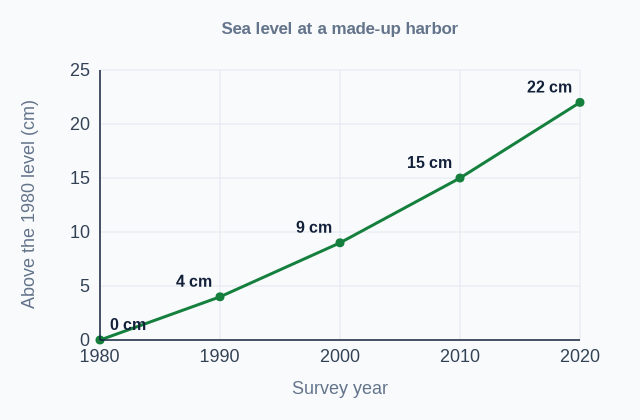
A made-up harbor's tide gauge has measured sea level since 1980. The graph shows how far above its 1980 level the sea stood in each survey year. Many of the harbor town's streets lie on low ground. The numbers are made up for practice.
 Tap to open the picture full size
Case question 1 · Multiple choice
In the graph, what does the record imply for the harbor town's low-lying streets?
Case question 2 · Calculate
Using the graph: by what percent was the sea's rise from 2010 to 2020 larger than its rise from 1980 to 1990? Round to the nearest whole percent.
The rest stand on their own and do not use the case.
Check yourself · Put it in order
Put the steps from a made-up country's power plants to a coastal town's move in order, first to last.
Check yourself · Match
Match each made-up observation to the threat it shows.
Part 7 Keep it Bring back earlier ideas
Two questions from earlier topics, to bring them back before they fade.
First complete a sentence about where two greenhouse gases come from. Then find where a student's account of a made-up town's report goes wrong.
From 9.3 The Greenhouse Effect · Fill the statement
Complete the sentence about where two greenhouse gases come from.
A cattle feedlot and a leaking natural gas pipe both release , and a coal power plant's smokestack releases . Both are principal greenhouse gases.
First complete two sentences about causes of ozone loss. Then find where a student's account of a made-up town goes wrong.
From 9.1 Stratospheric Ozone Depletion · Spot the error
A student describes a made-up town. Tap the first line that goes wrong.
In three lines
- Global climate change is caused by excess greenhouse gases in the atmosphere.
- Melting ice sheets and the expansion of warming ocean water raise sea levels, and disease vectors spread from the tropics toward the poles.
- These problems can change population dynamics and set people and other species moving in response.
Exam strategy for this topic
- Section I, Multiple Choice: 80 questions in 90 minutes.
- Section II, Free Response: 3 questions in 70 minutes.
- This lesson's Explain it is shaped like free-response question 1, Design an investigation.
- A four-function, scientific, or graphing calculator is allowed on both sections of the exam.
When a question shows a rising sea or a spreading disease, trace it back to excess greenhouse gases and forward to what it does to people and other species: their numbers and where they live.
Questions students ask
What causes global climate change?
Excess greenhouse gases in the atmosphere, which trap more heat.
Why do sea levels rise as the climate warms?
Ice sheets on land melt and add water to the ocean, and ocean water expands as it warms.
Why are diseases reaching places nearer the poles?
As the climate warms, disease vectors such as mosquitoes and ticks spread from the tropics toward the poles.
How do rising seas affect people?
They can change population dynamics and cause population movements, as people leave flooded coasts for higher ground.
Course alignment, for teachers
AP Environmental Science topic 9.4, Unit 9: Global Change.
- Skill 2.C: Explain how environmental concepts and processes represented visually relate to broader environmental issues.
This lesson maps the one essential knowledge statement of the topic to the part that teaches each one: 1 is checked by a scored question. The map is in the lesson file.