Unit 2 · Topic 2.4 · about 30 minutes · 7 parts · 10 scored checks, 3 of them multiple choice, plus 2 from earlier lessons
AP Environmental Science 2.4: Ecological Tolerance
Unit 2: 6 to 8% of the multiple-choice section
What you'll be able to do
- Describe ecological tolerance: the range of conditions an organism can endure before injury or death results, and how it applies to individuals and to species.
Key vocabulary
| Term | What it means | The exam trap |
|---|---|---|
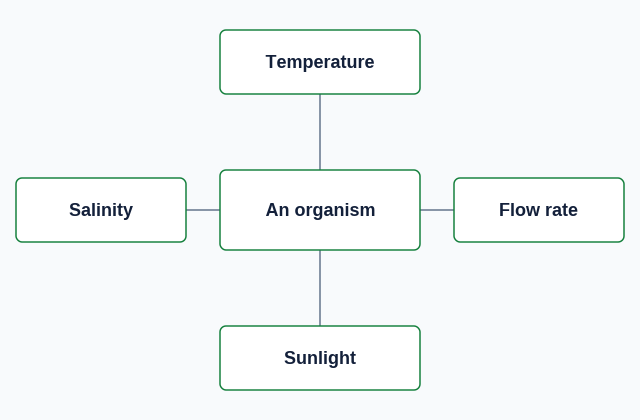
| Ecological tolerance | The range of conditions, such as temperature, salinity, flow rate and sunlight, that an organism can endure before injury or death results. | A question may give one figure for an organism; check whether it is an end of the range or a point inside it. |
| Salinity | How salty water is, often measured in parts per thousand (ppt). | Salinity matters in fresh water too, for example where salt washes into a pond. |
| Flow rate | How fast water moves past a point, as in a stream or river. | Flow rate is about how fast water moves, not how much water there is. |
 Tap to open the picture full size
Part 1 Think first Two fish and a heat wave
Commit to a guess first. Being wrong now makes the right idea stick better.
Predict first
Two kinds of fish live in the same stretch of river. During a heat wave, the water stays near 29°C for a week. Afterward, one kind has nearly vanished from that stretch, while the other kind seems unharmed. The story is made up for practice. What do you predict best explains the difference?
In short. Ecological tolerance is the range of conditions an organism can endure before injury or death results.
- The conditions include temperature, salinity, flow rate and sunlight, and the organism has a range for each one.
- A range has a lowest and a highest value; beyond either end, injury or death results.
- Ecological tolerance can apply to individuals and to species.
Part 2 Learn it Ecological tolerance
2a. A range with two ends
Every organism can live only within certain conditions. Ecological tolerance refers to the range of conditions, such as temperature, salinity, flow rate and sunlight, that an organism can endure before injury or death results.
The key word is range. A range has a lowest value and a highest value. Suppose a kind of crayfish can endure water from 3°C to 27°C (made up for practice). Inside that range, it survives. Colder than 3°C or warmer than 27°C, it is injured or it dies.
So a single number, such as the temperature where the crayfish does best, does not describe its tolerance. Its tolerance is the whole span it can endure, from one end to the other, and a question about harm is a question about whether a condition has gone past either end.
Quick check · Multiple choice
Suppose a minnow can endure water temperatures from 2°C to 28°C. The numbers are made up for practice. Which statement describes the minnow's ecological tolerance for temperature?
2b. More than one condition
Temperature is only one of the conditions tolerance covers. Others are:
- Salinity: how salty the water is, often measured in parts per thousand (ppt).
- Flow rate: how fast the water moves, as in a stream or river.
- Sunlight: how much light reaches the organism.
An organism has a range for each condition, and it has to stay inside all of them at once. A mussel can be fine in the water's temperature and still die if the water turns too salty. An insect larva that clings to rocks in a fast stream can be harmed when a drought leaves the water barely moving, even though the water is no warmer.
When a question describes harm to an organism, ask which condition moved, and whether it moved past one end of that organism's range.
Quick check · Match
In each case, one condition has moved outside the organism's range. Match each case to that condition.
2c. Individuals and species
Ecological tolerance can apply to individuals and to species.
- For an individual, it is the range one organism can endure: this frog, this seedling, this crab in this tank.
- For a species, it is the range that the species as a whole can endure.
Individuals of one species are not identical, so one individual may endure a little more heat or salt than another. Suppose a class keeps ten snails of one species in a tank that is made saltier, a little at a time (made up for practice). They do not all die at the same point. Some last longer than others. Each snail had its own tolerance.
So when you read a tolerance figure, ask whose it is: one organism's, or a whole species'.
Quick check · Decide and justify
A student says ecological tolerance describes only whole species, so it cannot be used to describe one crab living in one tide pool. Is the student right?
Which reason supports your answer?
Part 3 Watch it done Reading a survival table
Open each step in turn, answer the why, then finish the reading yourself.
Suppose a class raises groups of 20 tadpoles of one frog species for a week at six water temperatures, and counts the survivors. The numbers are made up for practice.
Temperature (°C): 10, 15, 20, 25, 30, 35
Survivors out of 20: 3, 18, 20, 19, 17, 1
What range of temperature did most of these tadpoles tolerate?
Step 1 · Say what was measured
The condition the class changed is water temperature. The result is how many of the 20 tadpoles in each group were still alive after a week.
Step 2 · Find where most died
At 10°C only 3 of 20 lived, and at 35°C only 1 of 20. Most tadpoles died at those two temperatures.
Why this step?
Why not say the tadpoles' tolerance is 20°C, where all 20 lived?
Tolerance is the whole range the tadpoles can endure, not the one temperature where they did best. 20°C is inside the range, but so are other temperatures where nearly all of them lived.
Your step · Multiple choice
Finish it. In the made-up test, the survivors out of 20 tadpoles were 3, 18, 20, 19, 17 and 1 at 10, 15, 20, 25, 30 and 35°C. Which best describes the temperature range most of the tadpoles tolerated?
The test only shows the tolerance at the temperatures tried. The true ends of the range lie somewhere between 10°C and 15°C, and between 30°C and 35°C.
Part 4 Try it Conditions that change
In each question, a condition changes. Compare its new value with both ends of the organism's range.
Try it · Select all
Suppose a trout species can endure water from 0°C to 24°C, and still water injures it. The numbers are made up for practice. Which two changes to its stream could injure or kill the trout? Pick two.
Select 2 answers, then check.
Try it · Spot the error
A student predicts what a heat wave will do to sea anemones in a tide pool. Tap the first line that goes wrong.
Part 5 Explain it Design a salinity test
Write your answer first. Nothing you type here leaves this page. Then compare it with the model and each scoring point.
Free response is 40% of the exam score. This one is shaped like Question 1, Design an investigation.
Free-response practice · Question 1 style
Suppose a student wants to find the range of salinity that duckweed, a small floating plant of freshwater ponds, can endure. The student has tanks, pond water, salt, a scale and many duckweed plants from one pond. The situation is made up for practice.
(a) Identify a testable scientific question for the investigation.
(b) Identify the independent variable and the dependent variable.
(c) Describe the control for the investigation, and identify one variable that should be held constant.
(d) Explain why the student should use several tanks at each salinity.
(e) The investigation finds that duckweed is injured above a certain salinity. Propose one way to protect the duckweed in a pond beside a road that is salted in winter.
Model answer
(a) What range of salinity can duckweed endure before it is injured or dies?
(b) The independent variable is the salinity of the water: for example 0, 2, 4, 6 and 8 parts per thousand of added salt, made by dissolving weighed amounts of salt in pond water. The dependent variable is the number of duckweed plants still green and alive after 14 days.
(c) The control is tanks of pond water with no salt added, set up and treated exactly like the others. One variable held constant: every tank gets the same light.
(d) One tank can give an odd result for a reason that has nothing to do with salt, such as a batch of plants that was already weak. Three tanks at each salinity show whether a result repeats, and the student can average them.
(e) Spread sand instead of salt on the stretch of road beside the pond, so less salt washes into the water.
Score your own answer. This is a self-check, not a grade. Tick each point your answer makes.
Part 6 Check yourself A letter about trout
The first two questions use the letter and its table.
Suppose a fishing club's newsletter prints this letter from a member, with a table from the club's own survey. Both are made up for practice.
"Brook trout have disappeared from the lower river, and I believe the reason is that the water there now gets too warm for them. Lab tests show this trout can endure water up to about 24°C. Our club's thermometers found the lower river reaching 27°C last July, while the upper river stayed below 20°C. Our survey found no trout at all in the lower river. If we plant trees along the lower banks to shade the water, I expect trout to return within a few years."
| Site | Highest water temperature (°C) | Trout counted |
|---|---|---|
| Upper river | 19 | 48 |
| Middle river | 23 | 31 |
| Lower river | 27 | 0 |
Case question 1 · Multiple choice
Using the letter: which statement is the author's claim about why trout are gone from the lower river?
Case question 2 · Decide and justify
Using the letter and its table, a reader says the club's data are consistent with the author's claim about the lower river. Is the reader right?
Which reason supports your answer?
The rest stand on their own and do not use the case.
Check yourself · Calculate
Suppose road salt washing into a pond raises its salinity by 0.4 ppt each week, starting from 1.0 ppt. A kind of dragonfly larva in the pond can endure salinity up to 3.0 ppt. The numbers are made up for practice. After how many weeks will the pond reach the top of the larvae's range? Give your answer in weeks.
Check yourself · Sort it
Each card describes a finding about tolerance. Tap a card, then whether it is about an individual's tolerance or a species' tolerance.
An individual's tolerance
A species' tolerance
Part 7 Keep it Bring back earlier ideas
Two questions from earlier topics in this unit: which stowaway could become invasive on an island, and which animals lose out when a prairie is cut into patches.
From 2.3 Island Biogeography · Multiple choice
Inspectors at an island's port find four kinds of stowaway animal in cargo from the mainland. Which one is most likely to become an invasive species that outcompetes the island's specialists?
Habitat loss does not only remove specialists. Here it is the size of the patches that matters.
From 2.1 Introduction to Biodiversity · Select all
Suppose a prairie is plowed for farms until only scattered patches of grass remain, each about 1 square kilometer in area, with plowed fields between them. The territory sizes below are made up for practice. Which two of these prairie animals are least likely to keep living in the patches? Pick two.
Select 2 answers, then check.
In three lines
- Ecological tolerance is the range of conditions, such as temperature, salinity, flow rate and sunlight, that an organism can endure before injury or death results.
- A range has two ends, and an organism has one for each condition; a change is harmful when it goes past an end.
- Ecological tolerance can apply to individuals and to species.
Exam strategy for this topic
- Section I, Multiple Choice: 80 questions in 90 minutes.
- Section II, Free Response: 3 questions in 70 minutes.
- This lesson's Explain it is shaped like free-response question 1, Design an investigation.
- A four-function, scientific, or graphing calculator is allowed on both sections of the exam.
When a question shows harm to an organism, name the condition that changed, then compare its new value with both ends of the organism's range.
Questions students ask
What is ecological tolerance?
The range of conditions, such as temperature, salinity, flow rate and sunlight, that an organism can endure before injury or death results.
What happens outside an organism's range of tolerance?
Injury or death results.
Does ecological tolerance apply to individuals or to species?
Both. It can apply to a single individual and to a whole species.
Which conditions does tolerance cover?
Conditions such as temperature, salinity, flow rate and sunlight. An organism has a range for each one.
Course alignment, for teachers
AP Environmental Science topic 2.4, Unit 2: The Living World: Biodiversity.
- Skill 3.A: Identify the author’s claim.
This lesson maps all 2 essential knowledge statements of the topic to the part that teaches each one: 2 are checked by a scored question. The map is in the lesson file.