Unit 1 · Topic 1.1 · about 30 minutes · 7 parts · 9 scored checks, 2 of them multiple choice
AP World History: Modern 1.1: Developments in East Asia from c. 1200 to c. 1450
Unit 1: 8 to 10% of the multiple-choice section
What you'll be able to do
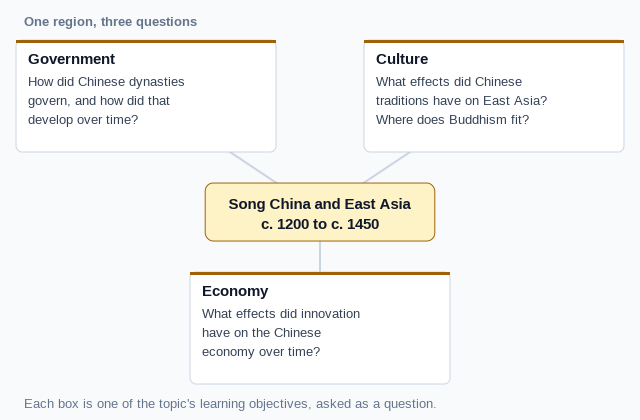
- Explain the system of government the Song Dynasty used to keep and justify its rule, and how Chinese government developed over time.
- Explain how Chinese cultural traditions, and Buddhism in its many branches, affected East Asia over time.
- Explain how innovation and expanding trade changed the economy of Song China over time.
Key vocabulary
| Term | What it means | The exam trap |
|---|---|---|
| Song Dynasty | The family of rulers that governed China in the 13th century, the part of this period the framework names it for. | A question about the Song can be about its government, its culture or its economy. Decide which before reading the choices. |
| Confucianism | A Chinese tradition of thought about conduct, duty and order. | The same tradition turns up under government and under culture. Read which one a stem is asking about. |
| Imperial bureaucracy | The officials who carry out the work of an empire's government. | Read a choice about government for who holds power and how, not just for a familiar word. |
| Buddhism | A religion with its own core beliefs and practices, followed in many societies in Asia. | When a question names a belief system, check whether it asks about the belief itself or the society it shaped. |
| Commercialized | Organized more and more around making goods to buy and sell in markets. | An economy can change in what it makes, how it trades or who does the work. A question may ask about only one. |
| Productive capacity | How much a society is able to make. | Producing more and trading more are related but separate. Keep them apart in a list of causes. |
| Trade network | The routes and connections along which goods are exchanged. | Ideas also travel along routes, so read whether a question is about goods or about culture. |
| Peasant and artisan | A peasant is a farmer who works the land; an artisan is a skilled craftsperson. | Who works, and on what terms, is its own question. Read the labor words in a choice one at a time. |
 Tap to open the picture full size
Part 1 Think first Who did the work?
Commit to a guess before you read. A wrong guess now still helps the right idea stick.
Predict first
In Song China, more and more goods were made to be sold, and trade spread farther. Someone had to grow the food and make the goods. Which group do you expect did most of that work?
In short. In the 13th century, the Song Dynasty kept its rule in China through long-standing methods, Chinese traditions and Buddhism shaped East Asia, and the Song economy flourished and grew more commercial.
- The Song Dynasty used traditional methods of Confucianism and an imperial bureaucracy to maintain and justify its rule.
- Chinese cultural traditions continued and influenced neighboring regions, and Buddhism, with many branches, schools and practices, kept shaping societies in Asia.
- More productive capacity, expanding trade networks and new methods in farming and manufacturing made the Song economy flourish; it grew more commercialized while still depending on free peasant and artisanal labor.
Part 2 Learn it Government, culture and economy in Song China
2a. How the Song held power
The Song Dynasty ruled China in the 13th century, early in this unit's period. It used traditional methods of Confucianism and an imperial bureaucracy, a body of officials who carried out the government's work, to maintain and justify its rule.
That sentence has two means and two ends. To maintain rule is to keep it going. To justify rule is to give people a reason to accept it. The statement pairs them: the Song used both means toward both ends.
The word traditional matters too. It marks Song government as continuity, an older way of ruling carried forward.
Step back and the Song is one case of something wider. In the 13th century, empires and states across Afro-Eurasia and the Americas showed continuity, innovation and diversity. Those three words come back in every lesson of this unit, so learn them now: what carried on, what was new, and how states differed from one another.
Quick check · Multiple choice
Which statement best describes how the Song Dynasty maintained and justified its rule?
2b. Traditions that crossed borders
Chinese cultural traditions continued, and they influenced neighboring regions. College Board's framework offers examples:
- filial piety, the duty children owe their parents and elders, in East Asia;
- the influence of Neo-Confucianism and Buddhism in East Asia;
- Confucian traditions of both respect for women and expected deference from them;
- Chinese literary and scholarly traditions, and their spread to Heian Japan and Korea.
Read the third one slowly. It holds two things at once, and a choice that keeps only one of them has misread it.
Buddhism and its core beliefs also continued to shape societies in Asia. It was many traditions rather than one: it included a variety of branches, schools and practices. Three branches are named: Theravada, Mahayana and Tibetan.
Notice that Buddhism appears twice, once in its own right and once beside Neo-Confucianism as an influence in East Asia. Both continued in this period.
Quick check · Select all
Chinese cultural traditions continued and influenced neighboring regions. Which two of these are examples of that? Pick two.
Select 2 answers, then check.
2c. Why the economy flourished
The economy of Song China flourished for three reasons, given together:
- increased productive capacity, meaning the economy could make more;
- expanding trade networks;
- innovations in agriculture and manufacturing.
The framework's examples of technological innovations are Champa rice, transportation innovations like the Grand Canal expansion, steel and iron production, and textiles and porcelains for export. Champa rice is the farming example; steel and iron are made goods.
As it grew, the economy became increasingly commercialized: more of what people made was made to sell. Textiles and porcelains made for export are goods made to sell abroad.
Now the sentence from Think first. All that growth rested on free peasant and artisanal labor, as it had before. So the market side changed while the labor side carried on. When a choice links growing trade to a new kind of worker, check it against that sentence.
Quick check · Select all
Which three were causes of the flourishing Song economy? Pick three.
Select 3 answers, then check.
Part 3 Watch it done Describe a historical context
Watch the first steps, then take the last one yourself.
Identify and describe a historical context for this development: the Song Dynasty used traditional methods of Confucianism and an imperial bureaucracy to maintain and justify its rule.
Predict first
Before the steps: where would you look for the context of Song rule?
Step 1 · Name the development exactly
The development is Song rule: traditional Confucian methods and an imperial bureaucracy, used to maintain and justify the state's power. Write it in one line before you look for anything around it.
Step 2 · Widen the frame
Context is the bigger picture a development sits inside. Ask what was going on across more of the world in the same period. For the 13th century, the framework gives the answer: empires and states in Afro-Eurasia and the Americas showed continuity, innovation and diversity. The Song state is one of those states.
Why this step?
Why not use the growth of the Song economy as the context?
Economic growth is a separate development inside the same state, with its own causes. Context has to be wider than the thing it explains, so that the development reads as one case of a larger pattern.
Your step · Decide and justify
Finish it. Which sentence describes a historical context for Song rule?
Why does that sentence work as context?
Part 4 Try it Test a student's claim
A student wrote the claim below for practice. It was written for this page, not taken from a source. Test it against what the lesson taught.
"Because the Song economy became more commercial in the 13th century, Song government must have dropped its traditional methods."
Try it · Decide and justify
Does the framework support the student's claim?
Which point from the framework decides it?
Part 5 Explain it Change and continuity, in writing
This is a self-check. Nothing you type leaves this page. Compare your answer with the model and each scoring point.
Free-response practice · Question 2 style
A short practice in the shape of the long essay question: a thesis, one sentence of context and one paragraph of evidence instead of a full essay. Use what this lesson taught.
In the 13th century, the economy of Song China flourished.
Explain one change and one continuity in the economy of Song China.
Model answer
Thesis: In the 13th century the Song economy changed by becoming increasingly commercialized, as productive capacity grew, trade networks expanded and new methods appeared in farming and manufacturing, but it continued to depend on free peasants and artisans to do the work.
Context: In the same centuries, Muslim rule continued to expand to many parts of Afro-Eurasia, and Islam subsequently spread through the activities of merchants, missionaries and Sufis, so merchants carried more than goods. The writer reads the Song's expanding trade networks as part of that wider world of exchange.
The change came from innovation. Champa rice in farming, the expansion of the Grand Canal in transportation, and steel and iron production in manufacturing were among the innovations behind that growth, and textiles and porcelains made for export show goods being made to sell. The continuity sat underneath: the same economy kept depending on free peasant and artisanal labor. So commercialization changed how much was made to sell more than it changed who made it.
Score your own answer. This is a self-check, not a grade. Tick each point your answer makes.
Part 6 Check yourself Change or continuity in Song China
The first two questions use the student's table. The others reach back across the lesson.
A student copied the framework's key phrases about Song China into a table to study from.
| Subject | Key phrase |
|---|---|
| Song government | used traditional methods of Confucianism and an imperial bureaucracy |
| Chinese cultural traditions | continued, and influenced neighboring regions |
| Song economy, markets | became increasingly commercialized |
| Song economy, growth | flourished as productive capacity increased, trade networks expanded and innovations spread |
| Song economy, labor | continued to depend on free peasant and artisanal labor |
Case question 1 · Sort it
Sort each row of the table by the pattern word in its key phrase.
Change
Continuity
Case question 2 · Spot the error
The student then wrote this paragraph from the table. Which line is the first to go wrong?
The rest stand on their own and do not use the case.
Check yourself · Select all
Which two statements describe Buddhism in Asia from c. 1200 to c. 1450? Pick two.
Select 2 answers, then check.
Check yourself · Multiple choice
A student writes: "As the Song economy became more commercial, it stopped relying on free workers." Which correction is accurate?
Part 7 Keep it Bring it together
This is the first lesson of the course, so there is nothing earlier to bring back yet. From the next lesson on, two questions from earlier lessons come back here.
In three lines
- The Song Dynasty used traditional Confucian methods and an imperial bureaucracy, together, to maintain and justify its rule.
- Chinese cultural traditions continued and influenced neighboring regions, and Buddhism, with many branches, kept shaping Asian societies.
- Productive capacity, trade networks and innovation made the Song economy flourish; it grew more commercial while still resting on free peasant and artisanal labor.
Exam strategy for this topic
- Section I Part A, Multiple Choice: 55 questions in 55 minutes.
- Section I Part B, Short Answer: 3 questions in 40 minutes.
- Section II, Document-Based Question and Long Essay: 2 questions in 100 minutes.
- This lesson's Explain it is shaped like free-response question 2, Long essay.
When a question names Song China, decide first whether it asks about government, culture or the economy. Then read each choice for its change or continuity word, such as traditional, continued or increasingly.
Questions students ask
Do I have to know every example in this lesson?
College Board's framework calls its examples possible ones that a teacher may choose to use, not required information. What you need are the developments they illustrate, and specific examples help you support a claim about them.
What does c. 1200 mean?
The c. stands for circa, which means about. The unit's dates mark a period of history, not a sharp line on a single day.
Why does Buddhism appear in both the culture section and the list of influences?
The framework names Buddhism twice: as a belief system with many branches, schools and practices that shaped Asian societies, and beside Neo-Confucianism as an influence in East Asia.
How is context different from a cause?
A cause helps bring a development about; context is the wider setting it happened in. The three reasons the Song economy flourished are causes. The 13th-century pattern of states across Afro-Eurasia and the Americas is context for Song rule.
Where does context come up in the free-response section?
The long essay rubric gives a point for describing a broader historical context relevant to the prompt, and it says a passing phrase or reference does not earn it.
Course alignment, for teachers
AP World History: Modern topic 1.1, Unit 1: The Global Tapestry.
- Skill 4.A: Identify and describe a historical context for a specific historical development or process.
This lesson maps all 5 essential knowledge statements of the topic, and the 3 learning objectives with none of their own, to the part that teaches each one: 8 are checked by a scored question. The map is in the lesson file.