Unit 2 · Topic 2.1 · about 30 minutes · 7 parts · 9 scored checks, 2 of them multiple choice, plus 2 from earlier lessons
AP World History: Modern 2.1: The Silk Roads
Unit 2: 8 to 10% of the multiple-choice section
What you'll be able to do
- Explain what caused networks of exchange such as the Silk Roads to grow after 1200, and what that growth led to.
Key vocabulary
| Term | What it means | The exam trap |
|---|---|---|
| Silk Roads | The trade routes this lesson is about, named in the plural in College Board's framework. | Keep the routes apart from the cities and goods along them when a question asks about one of these. |
| Commercial practices | The ways merchants do business: how they buy, sell, pay and lend. | Practices and goods both appear in this lesson. Read which one a question asks for. |
| Luxury goods | Costly goods bought for more than everyday need. | Demand for goods and the making of goods are two sides of trade. See which side a question is on. |
| Caravanserai | An inn on a trade route where traveling merchants and their animals could stop. | College Board names the caravanserai without saying who built one, where or when. Do not add details it does not give. |
| Forms of credit | Ways to buy or borrow now and pay later. | Credit lets a buyer pay later. Do not confuse it with demand, which is how much buyers want. |
| Money economy | An economy in which goods are bought and sold for money rather than swapped for other goods. | Paying with money is a way of trading, not a good that was traded. |
| Historical context | The wider setting of a development: what led up to it and what else was happening at the time. | A sentence of context and a sentence of evidence can look alike. Check what the prompt is asking you to do. |
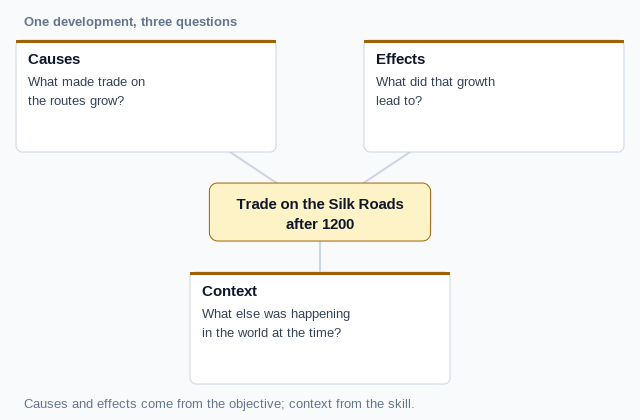 Tap to open the picture full size
Part 1 Think first More goods on the road
Commit to a guess before you read. A wrong guess now still helps the right idea stick.
Predict first
A merchant in a city on the Silk Roads around 1300 sees far more goods pass through each year than in their grandparents' time, and from farther away. What do you expect explains the change?
In short. After 1200, trade on the Silk Roads grew in volume and reached farther, as merchants improved how they did business and older technologies of trade were improved, and powerful new trading cities grew with it.
- Improved commercial practices led to an increased volume of trade and expanded the geographical range of existing trade routes, including the Silk Roads, promoting the growth of powerful new trading cities.
- Innovations in previously existing transportation and commercial technologies, including the caravanserai, forms of credit and the development of money economies, encouraged interregional trade in luxury goods.
- Demand for luxury goods increased in Afro-Eurasia: Chinese, Persian and Indian artisans and merchants expanded production of textiles and porcelains for export, and manufacture of iron and steel expanded in China.
Part 2 Learn it Why trade on the Silk Roads grew
2a. Older routes, more trade
The Silk Roads were not new after 1200. The framework calls them existing trade routes, and what changed was how much they carried and how far.
Its statement is a chain. Improved commercial practices, the ways merchants bought, sold, paid and lent, led to an increased volume of trade and expanded the geographical range of the existing routes. More goods moved, and they reached more places. That growth promoted the growth of powerful new trading cities. Kashgar and Samarkand are two possible examples the framework gives.
Read the adjectives side by side. The routes were existing; the trading cities were new. A sentence that calls the Silk Roads new routes has the first one wrong, and a sentence that keeps the volume but drops the wider range has kept only half of the effect.
Quick check · Multiple choice
Which statement best describes how trade on the Silk Roads changed after 1200?
2b. How trade was carried on, and what it carried
Trade in luxury goods, costly goods bought for more than everyday need, grew between regions. The framework says that growth was encouraged by innovations in previously existing transportation and commercial technologies, including the caravanserai, forms of credit and the development of money economies.
A caravanserai is an inn on a trade route where traveling merchants and their animals could stop. Bills of exchange, banking houses and the use of paper money are the framework's possible examples of new forms of credit and money economies. Previously existing works like existing in chunk 1: these were improvements to tools merchants already had.
The goods are a separate statement. Demand for luxury goods increased in Afro-Eurasia. Chinese, Persian and Indian artisans and merchants expanded their production of textiles and porcelains for export, that is, to sell in other regions. After a semicolon, the same statement adds that manufacture of iron and steel expanded in China, and it does not say that part was for export.
So keep two questions apart: how was trade carried on, and what was traded?
Quick check · Select all
Which two of these were innovations in transportation and commercial technologies that encouraged interregional trade in luxury goods? Pick two.
Select 2 answers, then check.
2c. Context: the set for the play
A historical context is the wider setting of a development. College Board's skill asks two questions to find one: what events led up to it, and what else was happening in the world at the time?
A sample activity in College Board's framework puts it this way: context is like the set for a play; it does not tell the story, but it does make the story easier to understand.
That makes context different from a cause. The causes the framework gives for the Silk Roads' growth are in chunks 1 and 2: improved commercial practices, and innovations in older technologies of trade. Context comes from outside that list.
Here is one sentence of context drawn from Unit 1 and written for this page. In the same period, Islam spread across Afro-Eurasia through the activities of merchants, missionaries and Sufis. It is not offered as a reason the routes carried more goods. It describes the world the trade moved through, so it can set the scene for a claim about the Silk Roads.
Quick check · Multiple choice
A student is explaining why the volume of trade on the Silk Roads increased after 1200. Which of these gives context for that development rather than one of the causes this topic names?
Part 3 Watch it done Describe a context
Watch the first steps, then take the last one yourself.
A College Board sample activity gives this claim: "Improved commercial practices and technology led to an increased volume of trade on the Silk Road." Identify and describe one historical context for it.
Step 1 · Name the development
The claim is about trade on the Silk Roads growing because of practices and technology. Context has to help a reader understand that growth without being one of the causes the claim already gives.
Step 2 · Look outside the causes
The activity lists eight items and leaves the sorting to students. One reading: the Song Dynasty, Islam and the Abbasid Caliphate come from Unit 1, not from the trade itself, so they are candidates for context. Take the Abbasid Caliphate.
Why this step?
Why is naming the Abbasid Caliphate not enough?
The task says identify and describe. A name only identifies. Describing gives the relevant characteristics: what happened to the caliphate in this period and what emerged in its place.
Your step · Decide and justify
Finish it. Which sentence identifies and describes a context for the claim?
Why does your sentence give context?
Part 4 Try it Cause or effect?
Six things that might happen along one Silk Roads route after 1200. They were written for this page, not taken from a source, and each matches something College Board's framework describes. Decide which side of the chain each one sits on.
Try it · Sort it
Each card describes something on a Silk Roads route after 1200. Sort it by whether the framework treats it as a cause of the growth of trade or as an effect of that growth.
A cause of the growth
An effect of the growth
Part 5 Explain it A cause and an effect, in writing
This is a self-check. Nothing you type leaves this page. Compare your answer with the model and each scoring point.
Free-response practice · Question 2 style
A short practice in the shape of the long essay question: a thesis, one sentence of context and one paragraph of evidence instead of a full essay.
After 1200, more goods moved along the Silk Roads, and they reached farther than before.
Explain one cause and one effect of the growth of trade on the Silk Roads in the period c. 1200 to c. 1450.
Model answer
Thesis: Improved commercial practices and innovations in older technologies of trade made trade on the Silk Roads grow, and that growth promoted the rise of powerful new trading cities.
Context: In the 13th century, the economy of Song China became increasingly commercialized, so the Silk Roads' growth belongs to a wider world in which commerce was growing in more than one region.
Improved commercial practices led to an increased volume of trade and expanded the geographical range of the existing routes. Innovations in previously existing technologies, including the caravanserai and forms of credit such as bills of exchange, encouraged interregional trade in luxury goods. The effect follows from those causes: as more goods moved over a wider area, powerful new trading cities such as Kashgar and Samarkand grew.
Score your own answer. This is a self-check, not a grade. Tick each point your answer makes.
Part 6 Check yourself A student's cause-and-effect chart
The chart drives the first two questions. The last two come from the rest of the lesson.
A student made this chart of the growth of trade on the Silk Roads. It was written for this lesson from the framework's statements, and one row is wrong.
| Row | Cause | Effect |
|---|---|---|
| 1 | Improved commercial practices | An increased volume of trade on existing routes |
| 2 | Improved commercial practices | A wider geographical range for existing routes, including the Silk Roads |
| 3 | More trade over a wider range | The growth of powerful new trading cities, such as Kashgar |
| 4 | The growth of trading cities such as Samarkand | Merchants leave the older routes and open new ones |
| 5 | Innovations in the caravanserai, credit and money economies | More interregional trade in luxury goods |
Case question 1 · Spot the error
Which row of the student's chart is the first one the framework does not support?
Case question 2 · Fill the statement
Row 4 puts Samarkand on the cause side. Use the chain in rows 1 to 3 to place it where the framework does.
Like Kashgar in row 3, Samarkand belongs in the column: trade grew on existing routes, ones before this period, and that growth promoted powerful new trading cities.
The rest stand on their own and do not use the case.
Check yourself · Select all
Which two statements about luxury goods in Afro-Eurasia in this period are accurate? Pick two.
Select 2 answers, then check.
Check yourself · Select all
Improved commercial practices changed trade on the Silk Roads. Which two were results of those improved practices? Pick two.
Select 2 answers, then check.
Part 7 Keep it Bring back earlier ideas
One question from the comparison that closed Unit 1, and one from Song China, whose economy is part of this lesson's context.
From 1.7 Comparison in the Period from c. 1200 to c. 1450 · Select all
Which two claims about differences in state formation in this period are historically defensible? Pick two.
Select 2 answers, then check.
From 1.1 Developments in East Asia from c. 1200 to c. 1450 · Select all
Which three were causes of the flourishing Song economy? Pick three.
Select 3 answers, then check.
In three lines
- Improved commercial practices increased the volume of trade on existing routes, including the Silk Roads, widened their range and promoted powerful new trading cities.
- Innovations in older technologies, including the caravanserai, forms of credit and money economies, encouraged trade in luxury goods, while demand for those goods increased.
- Context is the wider setting of a development, such as the commercializing Song economy, not one of its causes.
Exam strategy for this topic
- Section I Part A, Multiple Choice: 55 questions in 55 minutes.
- Section I Part B, Short Answer: 3 questions in 40 minutes.
- Section II, Document-Based Question and Long Essay: 2 questions in 100 minutes.
- This lesson's Explain it is shaped like free-response question 2, Long essay.
When a prompt asks for context, describe what else was happening in the world at the time, in a sentence or more. A cause the claim already rests on is evidence, and a passing phrase is not enough.
Questions students ask
Were the Silk Roads new in this period?
No. College Board's framework calls them existing trade routes. Improved commercial practices increased the volume of trade on them and expanded their geographical range.
Why does the sample activity say Silk Road when the statement says Silk Roads?
The sample activity's claim uses the singular, Silk Road, and the statement uses the plural. Both name the same routes. This lesson uses the plural except where it quotes the activity.
Do I need to know Kashgar and Samarkand?
The framework gives them as possible examples of trading cities. Its illustrative examples are possible ones, not additional or required information, so another trading city you have studied can serve as evidence too.
Is iron and steel from China part of the trade in luxury goods?
The framework says manufacture of iron and steel expanded in China, in the same statement as the textiles and porcelains made for export. It does not say the iron and steel were made for export, so do not claim that they were.
How long should a context sentence be?
Long enough to describe, not just name. The long essay rubric does not award a passing phrase or reference; it asks you to describe a broader historical context relevant to the prompt.
Course alignment, for teachers
AP World History: Modern topic 2.1, Unit 2: Networks of Exchange.
- Skill 4.A: Identify and describe a historical context for a specific historical development or process.
This lesson maps all 3 essential knowledge statements of the topic, and the one learning objective with none of its own, to the part that teaches each one: 4 are checked by a scored question. The map is in the lesson file.