Unit 7 · Topic 7.5 · about 30 minutes · 7 parts · 9 scored checks, 2 of them multiple choice, plus 2 from earlier lessons
AP World History: Modern 7.5: Unresolved Tensions After World War I
Unit 7: 8 to 10% of the multiple-choice section
What you'll be able to do
- Explain what stayed the same and what changed in territorial holdings from 1900 to the present.
Key vocabulary
| Term | What it means | The exam trap |
|---|---|---|
| Imperial state | A state that rules an empire, including lands and peoples beyond its own borders. | An imperial state is the state at the center of an empire, not a colony within it, so keep ruler and ruled apart. |
| Colonial holdings | The colonies and other territories an imperial state rules. | Holdings are territories, not trade or wealth, so a sentence about profits is not yet about holdings. |
| Predominantly | For the most part; in most cases. | It is a qualifier, so carry it into your answer rather than writing the claim without it. |
| Treaty settlement | An agreement, such as a peace treaty, that settles a conflict. | A treaty is one way territory changed hands; conquest is another, so do not merge the two. |
| Anti-imperial resistance | Opposition by people under imperial rule to that rule. | Resistance is opposition by people under imperial rule, so check who is opposing whom before you call an act resistance. |
 Tap to open the picture full size
Part 1 Think first A colonial map after the peace
Commit to a guess before you read. A wrong guess now still helps the right idea stick.
Predict first
A great war has just ended. A newspaper in a colony asks its readers whether the empires that rule them will look different in the years before the next war. What would you have predicted?
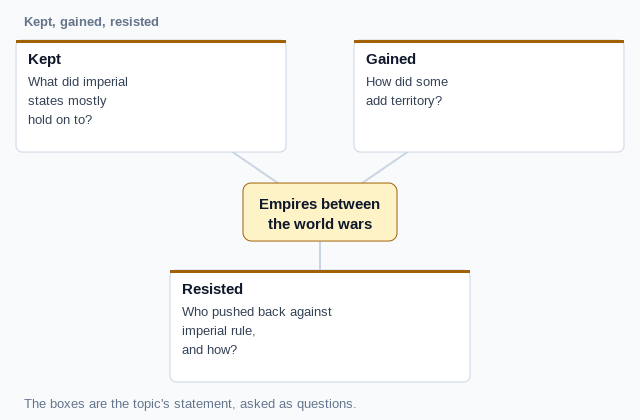
In short. Between the two world wars, Western and Japanese imperial states predominantly maintained control over colonial holdings; in some cases they gained additional territories through conquest or treaty settlement, and in other cases they faced anti-imperial resistance.
- Predominantly maintained control is the continuity, and it is a qualified claim.
- Gains through conquest or treaty settlement, and anti-imperial resistance, happened in some cases, not in all.
- Across the whole century the picture changes: by its end both land-based and maritime empires gave way to new states.
Part 2 Learn it Holdings between the wars
2a. Control, mostly kept
The statement begins with the main pattern: between the two world wars, Western and Japanese imperial states predominantly maintained control over colonial holdings.
Three parts to notice:
When: between the two world wars, after the first had ended and before the second began.
Who: Western imperial states and Japanese imperial states, both.
What: they maintained control, which means kept it. That is a continuity, something that stayed the same.
The qualifier matters most. Predominantly means for the most part. It makes the claim about the general pattern, so the sentence leaves room for the other cases the statement goes on to name.
Quick check · Multiple choice
Which imperial states does this topic's statement describe between the two world wars?
2b. In some cases, in other cases
After a semicolon, the statement names two kinds of exception.
In some cases, they gained additional territories through conquest or treaty settlement. Conquest is taking land by force; a treaty settlement is an agreement that ends a conflict. College Board's examples of territorial gains are the transfer of former German colonies to Great Britain and France under the system of League of Nations mandates, and Manchukuo and the Greater East Asia Co-Prosperity Sphere.
In other cases, they faced anti-imperial resistance. College Board's examples are the Indian National Congress and West African resistance, through strikes and congresses, to French rule.
The examples are named, not described, and the statement does not say which gain came by conquest and which by treaty. Keep in some cases and in other cases: neither exception is the general pattern.
Quick check · Select all
Besides maintaining control, which two does this topic say happened to Western and Japanese imperial states between the wars, in some cases or in other cases? Pick two.
Select 2 answers, then check.
2c. Continuity and change across the century
The objective reaches from 1900 to the present, so the years between the wars are one stretch of a longer story. Other statements in this unit and the next supply the rest.
- At the start, 7.1 Shifting Power After 1900 says, the West dominated the global political order.
- Between the wars, this topic says, imperial states predominantly maintained control over colonial holdings.
- Topic 8.1 says that hopes for greater self-government were largely unfulfilled following World War I, and that in the years following World War II increasing anti-imperialist sentiment contributed to the dissolution of empires.
- By the century's end, 7.1 Shifting Power After 1900 says, both land-based and maritime empires gave way to new states.
Read together, as this page reads them, the continuity runs through the interwar years, and the large change comes after World War II. An answer about continuity and change names both, and says where the turn comes.
Quick check · Select all
The objective covers territorial holdings from 1900 to the present. Which two statements from this unit could best be used together to show continuity and change across that span? Pick two.
Select 2 answers, then check.
Part 3 Watch it done Weigh a resistance group's own words
Watch the first steps, then take the last one yourself.
A resolution written for this page (it is not a real source), passed by an imagined congress of workers' and students' groups in a colony between the wars: "This congress demands that the colonial government hear our delegates. We speak for the people of every town, and on the first of the month our members will stop work."
Explain how the resolution's point of view and purpose bear on its use as a source.
Step 1 · Name the point of view and purpose
The authors are groups resisting imperial rule. Their purpose is to press a demand on the colonial government and to show strength, both to that government and to their own supporters.
Step 2 · Say what that lets the source show
Because the resisters wrote it themselves, the resolution is good evidence of how they organized, what they demanded and how they wished to be seen. The planned stoppage of work is a strike, one of the forms College Board's examples of resistance name.
Why this step?
Why be careful with "We speak for the people of every town"?
A group trying to show strength has reason to claim the widest support it can. The line shows what the congress claimed, not how many people in each town agreed.
Your step · Decide and justify
Finish it. A student writes: "The resolution is useful evidence that resistance to imperial rule in this colony was organized." Is that a sound use of the source?
Why?
Part 4 Try it One imagined empire's holdings
An imagined empire, written for this page. It is not a real state. Six notes from its record, from the years after one great war to the century's end, are below.
Try it · Sort it
Sort each note about the imagined empire's holdings: does it show continuity or change in what the empire holds?
Continuity
Change
Part 5 Explain it Territorial holdings, from documents
This is a self-check. Nothing you type leaves this page. Compare your answer with the model, line by line, and with each scoring point.
Free-response practice · Question 1 style
A short practice in the shape of the document-based question: a thesis, one sentence of context and one paragraph that uses both documents and explains the sourcing of one, instead of a full essay. Both documents are written for this page and are not real sources.
Document 1: an imagined colonial ministry's yearly summary for its parliament, between the wars: "Our possessions remain as they were, with one addition: the former enemy's colony, placed under our care by the peace treaty."
Document 2: the congress resolution from Watch it done: "This congress demands that the colonial government hear our delegates. We speak for the people of every town, and on the first of the month our members will stop work."
Using both documents and what you know from this unit, explain the continuities and changes in territorial holdings from 1900 to the present.
Model answer
Thesis: Between the two world wars, imperial states predominantly maintained control over their colonial holdings, adding territory in some cases and facing anti-imperial resistance in others; the larger change came later, when empires gave way to new states by the century's end.
Context: Before 1900, some states with existing colonies had strengthened their control over those colonies, so some interwar empires were holding on to control they had already tightened.
Document 1 shows both the continuity and one kind of change. The ministry reports that its possessions remain as they were, control maintained, and adds a former enemy's colony gained through the peace treaty, a gain through treaty settlement. Its audience matters: a ministry reporting to its own parliament has reason to present the empire as secure, so the summary says nothing of unrest. Document 2 supplies what Document 1 leaves out, organized resistance, with delegates and a planned strike. Together they match the pattern of the interwar years: control kept, some territory gained, and resistance faced. The change came after World War II, when increasing anti-imperialist sentiment contributed to the dissolution of empires, and by the century's end both land-based and maritime empires gave way to new states.
Score your own answer. This is a self-check, not a grade. Tick each point your answer makes.
Part 6 Check yourself Four imagined colonies
Use the table for the first two questions. The last two cover the whole lesson.
Four imagined colonies between the two world wars, written for this page. None is a real place.
| Colony | What happened between the wars |
|---|---|
| North Shore | Ruled from the same capital before and after the war; its governor's reports describe quiet years. |
| Red Hills | Taken from a defeated empire and handed to a new ruler when the war's terms were signed. |
| Long Valley | Teachers and dock workers form a congress and lead strikes against the governor. |
| Stone Coast | An army crosses the border from a neighboring colony, and its commander sets up a new administration. |
Case question 1 · Match
Match each imagined colony to the part of this topic's statement it shows.
Case question 2 · Spot the error
A student wrote this paragraph about the table. Which line is the first to go wrong?
The rest stand on their own and do not use the case.
Check yourself · Multiple choice
An annual report written for this page (it is not a real source) is sent by a colonial governor between the world wars to the government at home: "The colony is calm. Trade has risen, and the people are loyal to the crown." Which choice best explains how the report's purpose limits its use as a source?
Check yourself · Select all
A pamphlet written for this page (it is not a real source) is handed out by an anti-imperial group in a colony between the wars: "Workers, put down your tools on Monday. Show the governor that this land is ours." Which two could a historian use the pamphlet to show? Pick two.
Select 2 answers, then check.
Part 7 Keep it Bring back earlier ideas
One question from the lesson on the interwar economy and one from the causes of World War I, so both come round again.
From 7.4 Economy in the Interwar Period · Select all
Which two does this topic say about the Soviet Union? Pick two.
Select 2 answers, then check.
From 7.2 Causes of World War I · Select all
Which two does this topic name as causes of World War I, apart from the factors it says combined to escalate the tensions? Pick two.
Select 2 answers, then check.
In three lines
- Between the two world wars, Western and Japanese imperial states predominantly maintained control over colonial holdings.
- In some cases they gained additional territories through conquest or treaty settlement, and in other cases they faced anti-imperial resistance.
- The large change in holdings came later: after World War II empires dissolved, and by the century's end they gave way to new states.
Exam strategy for this topic
- Section I Part A, Multiple Choice: 55 questions in 55 minutes.
- Section I Part B, Short Answer: 3 questions in 40 minutes.
- Section II, Document-Based Question and Long Essay: 2 questions in 100 minutes.
- This lesson's Explain it is shaped like free-response question 1, Document-based.
For a continuity and change question, name what stayed the same and what changed, and say when the turn came. Here the continuity is control predominantly maintained between the wars, and the larger change comes after World War II.
Questions students ask
Did empires break up after World War I?
No. The statement says Western and Japanese imperial states predominantly maintained control over colonial holdings between the two world wars. Topic 8.1 places the dissolution of empires in the years following World War II.
How did some imperial states gain territory between the wars?
Through conquest or treaty settlement. College Board's examples include the transfer of former German colonies to Great Britain and France under League of Nations mandates, and Manchukuo.
What forms did anti-imperial resistance take?
The statement says only that some imperial states faced it. College Board's examples are the Indian National Congress and West African resistance, through strikes and congresses, to French rule.
Which source does College Board suggest for this topic?
One of its sample activities for this topic assigns an excerpt from Georges Clemenceau's letter of reply to the German peace delegation and asks students to find its weaknesses from what they learned about the causes of World War I.
Where does this topic fit in the story of the whole century?
The West dominated the global political order at the start, control was predominantly kept between the wars, and by the century's end both land-based and maritime empires gave way to new states.
Course alignment, for teachers
AP World History: Modern topic 7.5, Unit 7: Global Conflict.
- Skill 2.C: Explain the significance of a source’s point of view, purpose, historical situation, and/or audience, including how these might limit the use(s) of a source.
This lesson maps the one essential knowledge statement of the topic, and the one learning objective with none of its own, to the part that teaches each one: 2 are checked by a scored question. The map is in the lesson file.