Unit 7 · Topic 7.4 · about 30 minutes · 7 parts · 9 scored checks, 2 of them multiple choice, plus 2 from earlier lessons
AP World History: Modern 7.4: Economy in the Interwar Period
Unit 7: 8 to 10% of the multiple-choice section
What you'll be able to do
- Explain how different governments responded to economic crisis after 1900.
Key vocabulary
| Term | What it means | The exam trap |
|---|---|---|
| Great Depression | A severe economic downturn whose onset came after World War I. | It is an economic crisis, not a war, so do not count it among the events of the fighting. |
| Five Year Plans | The plans through which the Soviet government controlled the national economy. | They belong to one named state, the Soviet Union, so do not use them to describe governments in general. |
| Repressive policies | Policies that hold people down by force or fear. | Notice the word that says how regularly it happened, and keep it in your answer. |
| Repercussions | Effects that follow from an action, especially harmful ones. | Repercussions are what followed from the policies, not the policies themselves, so keep cause and effect apart. |
| Corporatist economy | College Board's term for the economy under fascism, given as an example of government intervention. | College Board names it without describing how it worked, so do not supply details it does not give. |
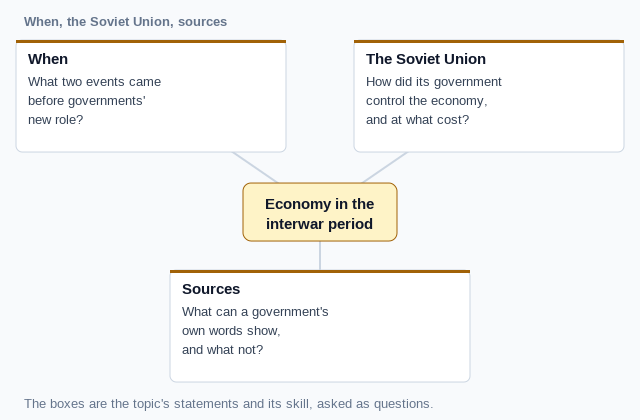 Tap to open the picture full size
Part 1 Think first The factory gates close
Commit to a guess before you read. A wrong guess now still helps the right idea stick.
Predict first
Factories across a country close, farm prices fall, and millions of people are out of work. Many people write to their government asking it to act. Which response do you think governments of the time were most likely to choose?
In short. Following World War I and the onset of the Great Depression, governments began to take a more active role in economic life.
- College Board's examples of government intervention in the economy are the New Deal, the fascist corporatist economy, and governments with strong popular support in Brazil and Mexico.
- In the Soviet Union, the government controlled the national economy through the Five Year Plans, often implementing repressive policies, with negative repercussions for the population.
- A source's purpose and audience shape what it can show, so a government's own words show its aims more surely than their results.
Part 2 Learn it Governments and economic crisis
2a. A more active role
The first statement is short: following World War I and the onset of the Great Depression, governments began to take a more active role in economic life.
Read its three parts. When: after two events, a war and the onset of an economic crisis. Who: governments, in general. What: a more active role, which compares their role with what it had been. Began marks the start of a change, not its finished form.
College Board gives three examples of government intervention in the economy:
- the New Deal
- the fascist corporatist economy
- governments with strong popular support in Brazil and Mexico
It names them and describes none, so this page gives no details of how each one worked.
Quick check · Multiple choice
According to this topic, what did governments begin to do following World War I and the onset of the Great Depression?
2b. The Five Year Plans
The second statement names one state. In the Soviet Union, the government controlled the national economy through the Five Year Plans.
It goes on: the government was often implementing repressive policies, with negative repercussions for the population. Repressive policies hold people down by force or fear. Repercussions are effects that follow from an action, here harmful ones.
Two words set the limits of the claim. Often says the repression happened regularly, not in every case, so keep it. And controlled the national economy is stronger than taking a more active role: in the Soviet case the government ran the whole economy through its plans.
The statement does not say what the plans produced or name the repressive policies, and neither does this page.
Quick check · Select all
Which two does this topic say about the Soviet Union? Pick two.
Select 2 answers, then check.
2c. Different governments, compared
The objective asks how different governments responded, and this topic's reasoning is comparison. Set the two statements side by side.
What they share: both describe a government taking a role in economic life.
Where they differ: the first speaks of governments in general and says they began to take a more active role. The second names one state, says its government controlled the national economy, and adds the repression and its negative repercussions for the population.
A comparison that says only "both governments acted" misses the difference in degree. One that says only "the Soviet Union was harsher" drops what the statements share. A strong comparison gives both, in the statements' own terms.
Quick check · Select all
Compare this topic's general statement about governments with its statement about the Soviet Union. Which two comparisons are accurate? Pick two.
Select 2 answers, then check.
Part 3 Watch it done Read a government's own words
Watch the first steps, then take the last one yourself.
A radio speech written for this page (it is not a real source), given by the leader of an imagined republic during the Great Depression: "Your government will not stand aside while the factories close. From today the state will buy the harvest at a fair price and open new public works in every province."
Explain how the speech's purpose and audience bear on its use as a source.
Step 1 · Name the point of view, purpose and audience
The speaker is the head of the government. The audience is the country's people, listening on the radio. The purpose is to win their support by promising action.
Step 2 · Say what that lets the source show
A leader announcing a program to the public is good evidence of what the government said it would do: buy the harvest and open public works, a government taking a more active role in economic life. It is good evidence of how the leader wanted the program to be seen.
Why this step?
Why can't the speech show how well the program worked?
It was given at the start, to win support, by the person whose program it is. It promises; it does not report results, and its author has every reason to present the plan well.
Your step · Decide and justify
Finish it. A student writes: "The speech is strong evidence that the republic's programs put the unemployed back to work." Is that a sound use of the source?
Why?
Part 4 Try it An imagined newspaper
A newspaper written for this page (it is not a real source). It is owned by the party that governs an imagined country during an economic crisis, and its front page praises the government's new work programs.
Try it · Sort it
Sort each use a historian might make of the imagined newspaper by what the paper's owner and purpose allow.
A use the source supports
A use its purpose limits
Part 5 Explain it Responses to economic crisis, from documents
This is a self-check. Nothing you type leaves this page. Compare your answer with the model, line by line, and with each scoring point.
Free-response practice · Question 1 style
A short practice in the shape of the document-based question: a thesis, one sentence of context and one paragraph that uses both documents and explains the sourcing of one, instead of a full essay. Both documents are written for this page and are not real sources.
Document 1: the radio speech from Watch it done: "Your government will not stand aside while the factories close. From today the state will buy the harvest at a fair price and open new public works in every province."
Document 2: a farmer's letter to a cousin, from an imagined state whose government runs the whole economy by plan: "The plan took our fields into the state farm. Those who spoke against it were sent away, and this winter there is little bread."
Using both documents and what you know from this topic, explain how different governments responded to economic crisis after 1900.
Model answer
Thesis: Following World War I and the onset of the Great Depression, governments began to take a more active role in economic life, but they did so to different degrees, from public programs to a government controlling the national economy, as the Soviet Union did through the Five Year Plans.
Context: Before 1900, some governments had promoted political, social, educational and urban reforms in response to the changes brought about by industrial capitalism, so governments answering economic change was not new; what changed after the war and the onset of the Depression was a more active role in economic life itself.
Document 1 shows the milder end of that range: a leader promises that the state will buy the harvest and open public works, a government stepping into economic life. Because he speaks to the whole country to win its support, the speech shows what his government promised, not what it achieved. Document 2 shows the other end. The farmer's fields were taken into a plan, people who objected were sent away, and bread is short. It resembles the Soviet Union, where the government controlled the national economy through the Five Year Plans, often implementing repressive policies, with negative repercussions for the population. So governments responded in different ways, from public programs to full control by plan.
Score your own answer. This is a self-check, not a grade. Tick each point your answer makes.
Part 6 Check yourself Two imagined governments
Use the table for the first two questions. The last two cover the whole lesson.
Two imagined governments facing the same economic crisis, written for this page. Neither is a real state.
| Question | Government A | Government B |
|---|---|---|
| Who decides what factories make? | Owners decide, but the government pays for new roads and dams. | A national plan sets every factory's output. |
| What happens to people who object? | Critics write against the programs in the newspapers. | Officials who question the plan's targets are arrested. |
| What source survives? | A minister's speech announcing the road and dam program. | A planning official's report to the leaders who set the targets. |
Case question 1 · Fill the statement
Complete a student's comparison of the table.
Both governments take a role in economic life, but Government resembles the Soviet statement more closely, because .
Case question 2 · Spot the error
A student wrote this paragraph about Government A's surviving source. Which line is the first to go wrong?
The rest stand on their own and do not use the case.
Check yourself · Multiple choice
A report written for this page (it is not a real source) is sent by a Soviet planning official to the party's leaders: "The steel targets of the plan have been met ahead of time. The workers of our region stand behind the plan." Which choice best explains how the report's audience limits its use as a source?
Check yourself · Select all
A letter written for this page (it is not a real source) is sent by a shopkeeper to a relative during the Great Depression: "The new government work programs have brought jobs back to our town, and my customers can pay again." Given the writer's point of view, which two are uses a historian could make of the letter? Pick two.
Select 2 answers, then check.
Part 7 Keep it Bring back earlier ideas
One question from the lesson on conducting World War I and one from the review of Unit 6, so both come round again.
From 7.3 Conducting World War I · Select all
Which two does this topic name among the strategies governments used to mobilize populations for World War I? Pick two.
Select 2 answers, then check.
From 6.8 Causation in the Imperial Age · Select all
Which two statements from this unit could best support an argument that industrialization and imperialism were connected in this period? Pick two.
Select 2 answers, then check.
In three lines
- Following World War I and the onset of the Great Depression, governments began to take a more active role in economic life.
- In the Soviet Union the government controlled the national economy through the Five Year Plans, often implementing repressive policies, with negative repercussions for the population.
- A government's own words show its aims and claims more surely than its results.
Exam strategy for this topic
- Section I Part A, Multiple Choice: 55 questions in 55 minutes.
- Section I Part B, Short Answer: 3 questions in 40 minutes.
- Section II, Document-Based Question and Long Essay: 2 questions in 100 minutes.
- This lesson's Explain it is shaped like free-response question 1, Document-based.
When a source question asks how audience or purpose limits a source, name the audience or purpose, then say what the source is weak evidence of because of it. A government's own announcement is good evidence of its aims and weak evidence of its results.
Questions students ask
Does College Board describe the New Deal or the fascist corporatist economy?
No. It lists them, with governments with strong popular support in Brazil and Mexico, as examples of government intervention in the economy, and describes none of them.
How is the Soviet case different from the general statement?
The general statement says governments began to take a more active role in economic life. The Soviet statement says the government controlled the national economy through the Five Year Plans and often implemented repressive policies.
Did the Five Year Plans harm the Soviet population?
The statement says the government was often implementing repressive policies, with negative repercussions for the population. It does not list the policies or their effects.
What two events came before governments' more active role?
World War I and the onset of the Great Depression. The statement says the change followed both.
Which sources does College Board suggest for this topic?
One of its sample activities for this topic pairs extended excerpts of a speech by Lázaro Cárdenas with a text by Joseph Stalin on the industrialization of the country and asks students about each author's purpose and audience.
Course alignment, for teachers
AP World History: Modern topic 7.4, Unit 7: Global Conflict.
- Skill 2.C: Explain the significance of a source’s point of view, purpose, historical situation, and/or audience, including how these might limit the use(s) of a source.
This lesson maps all 2 essential knowledge statements of the topic, and the one learning objective with none of its own, to the part that teaches each one: 3 are checked by a scored question. The map is in the lesson file.