Unit 3 · Topic 3.4 · about 30 minutes · 7 parts · 10 scored checks, 3 of them multiple choice, plus 2 from earlier lessons
AP World History: Modern 3.4: Comparison in Land-Based Empires
Unit 3: 12 to 15% of the multiple-choice section
What you'll be able to do
- Compare the methods by which various empires increased their influence from 1450 to 1750.
Key vocabulary
| Term | What it means | The exam trap |
|---|---|---|
| Influence | How strongly an empire shapes the peoples and places it rules or touches. | The framework's statement names scope and influence as two things, so a question may ask about one without the other. |
| Specific evidence | A named example, such as an empire, a practice or a conflict, rather than a general statement. | A specific example can still be the wrong evidence. Read the exact claim before you decide what a detail supports. |
| Transoceanic | Across an ocean. | Transoceanic voyaging and the growth of land empires happened in the same centuries but are different developments, so read which one a question is about. |
| Syncretic | Blending elements of different belief systems or practices. | The framework says syncretic belief systems developed in some cases, and a choice that leaves out the qualifier says more than it does. |
 Tap to open the picture full size
Part 1 Think first Which evidence would you pick?
Commit to a guess before you read. A wrong guess now still helps the right idea stick.
Predict first
A student wants to argue that the Ottoman Empire's influence reached far beyond one region. Which kind of evidence do you expect would help most?
In short. From 1450 to 1750, empires achieved increased scope and influence around the world, and comparing them means setting the methods they shared beside the ways they differed, with specific evidence for each.
- Imperial expansion relied on the increased use of gunpowder, cannons and armed trade, a means shared across both hemispheres.
- The land empires differed in reach, from the Safavids in the Middle East to the Ottoman across three regions.
- New connections between the hemispheres in some cases expanded the reach of existing religions and fed religious conflict.
Part 2 Learn it Comparing empires across the unit
2a. Wider scope and influence
This topic gathers the framework's key concepts for the unit. The broadest is that empires achieved increased scope and influence around the world, shaping and being shaped by the diverse populations they incorporated.
The statement runs in two directions. Empires shaped the peoples they took in, and those peoples shaped the empires. It does not give an example of either.
For scope, the list of land empires is specific evidence. Land empires included the Manchu in Central and East Asia, the Mughal in South and Central Asia, the Ottoman in Southern Europe, the Middle East and North Africa, and the Safavids in the Middle East.
Set the entries side by side and a comparison appears. Each empire ruled in more than one region except the Safavids, and the Ottoman entry is the widest, with three. That is a difference in reach you can state from the list alone.
Quick check · Select all
The course's review for this unit says empires achieved increased scope and influence around the world. Which two pieces of evidence from this unit could a student use to support the claim about scope? Pick two.
Select 2 answers, then check.
2b. Shared means, and rivals
How did empires get that reach? The framework gives one answer that applies across regions: imperial expansion relied on the increased use of gunpowder, cannons, and armed trade to establish large empires in both hemispheres.
For a comparison, the important words are both hemispheres. The same means show up in the East and the West, so this is a similarity among empires, not the story of one.
The unit's other review statement on states points the other way: political and religious disputes led to rivalries and conflict between states. The Safavid-Mughal conflict is one of the framework's examples. A rivalry shows how states clashed. It is not, on its own, evidence of how an empire grew, so match each piece of evidence to the claim it actually supports.
Quick check · Multiple choice
A student claims: "Land empires of this period grew by similar military means." Which piece of evidence from the course best supports the claim?
2c. Methods of rule, compared
The methods of rule from 3.2 Empires: Administration give more points of comparison, each tied to its own goal.
- Revenue: rulers used tribute collection, tax farming and innovative tax-collection systems to forward state power and expansion. Ottoman tax farming and Mughal zamindar tax collection are two systems with that one purpose.
- Legitimacy: rulers continued to use religious ideas, art and monumental architecture to legitimize their rule, as Mughal mausolea and mosques and the Incan sun temple of Cuzco show.
- Central control: bureaucratic elites and military professionals.
Only the revenue statement links a method of rule to expansion, so an argument that ties legitimacy to influence has to build that link from evidence.
Quick check · Multiple choice
A student uses Mughal mausolea and mosques and the Incan sun temple of Cuzco as evidence that rulers in different regions used similar methods to legitimize their rule. Which sentence best explains how the evidence supports the claim?
2d. Faiths in a connected world
Two review statements reach past the land empires.
The first: the interconnection of the Eastern and Western Hemispheres, made possible by transoceanic voyaging, transformed trade and had a significant social impact on the world. Unit 4 takes this up.
The second narrows to religion. In some cases, the increase and intensification of interactions between the newly connected hemispheres expanded the reach and furthered development of existing religions, and contributed to religious conflicts and the development of syncretic belief systems and practices. Syncretic means blending elements of different traditions.
Keep in some cases. The statement does not claim this happened everywhere. The framework numbers the three belief-system statements of 3.3 Empires: Belief Systems under it, but it does not say which of them the new connections produced, so an answer can use them as evidence of change in belief systems without claiming that cause.
Quick check · Select all
A student claims: "From 1450 to 1750, belief systems changed as well as grew." Which two pieces of evidence from this unit support the claim? Pick two.
Select 2 answers, then check.
Part 3 Watch it done Test a piece of evidence against a claim
Watch the first steps, then take the last one yourself.
A student's claim: "Empires in this period increased their scope in more than one region of the world."
Describe specific evidence for the claim, explain how it supports it, then judge one more piece of evidence the student wants to add.
Predict first
Before the steps: which kind of detail do you expect to support a claim about scope?
Step 1 · Describe specific evidence
Name the details, not a general statement. The Ottoman ruled in Southern Europe, the Middle East and North Africa. The Manchu ruled in Central and East Asia. Imperial expansion established large empires in both hemispheres.
Step 2 · Explain how it supports the claim
Each of those two entries spans more than one region, which is scope beyond a single region. "Both hemispheres" shows the pattern was not limited to one side of the world. So the evidence matches the claim's exact words.
Why this step?
Why describe the evidence before explaining it?
The skill has two parts. Describing names what the evidence is; explaining says how it backs the claim. A paragraph with only the first is a list.
Your step · Decide and justify
Finish it. The student wants to add "the Safavid-Mughal conflict" as evidence that empires increased their scope in more than one region. Does it support that claim?
Why?
Part 4 Try it Match evidence to claims
Three claims a student might make about the empires of this unit, and nine pieces of evidence, written for this page from the framework's statements and examples. Some of the evidence supports none of the three claims.
Try it · Sort it
Sort each piece of evidence by the claim it supports.
Empires shared military means of expansion
Empires differed in reach
Rulers shared a revenue purpose
Supports none of these claims
Part 5 Explain it A comparison, in writing
This is a self-check. Nothing you type leaves this page. Compare your answer with the model and each scoring point.
Free-response practice · Question 2 style
A short practice in the shape of the long essay question: a thesis, one sentence of context and one paragraph of evidence instead of a full essay.
From 1450 to 1750, empires achieved increased scope and influence around the world.
Compare the methods by which various empires increased their influence in the period from 1450 to 1750.
Model answer
Thesis: Empires in this period increased their influence by similar means, relying on gunpowder, cannons and armed trade and raising revenue to forward state power, but they differed in how far that influence reached.
Context: In the same centuries, interactions between the newly connected hemispheres in some cases expanded the reach of existing religions and contributed to religious conflicts, so empires were extending their influence while some faiths were extending theirs.
Imperial expansion relied on the increased use of gunpowder, cannons and armed trade to establish large empires in both hemispheres, a method shared across regions. Rulers also generated revenue to forward state power and expansion, and here the purpose was shared while the systems differed: the Ottoman used tax farming, the Mughal zamindar tax collection. The results differed in reach. The Ottoman ruled in Southern Europe, the Middle East and North Africa, while the Safavids ruled in the Middle East. So the methods were alike, and the difference lay in the scope each empire reached.
Score your own answer. This is a self-check, not a grade. Tick each point your answer makes.
Part 6 Check yourself A quickwrite, checked
Use the quickwrite notes for the first two questions. The last two cover the whole lesson.
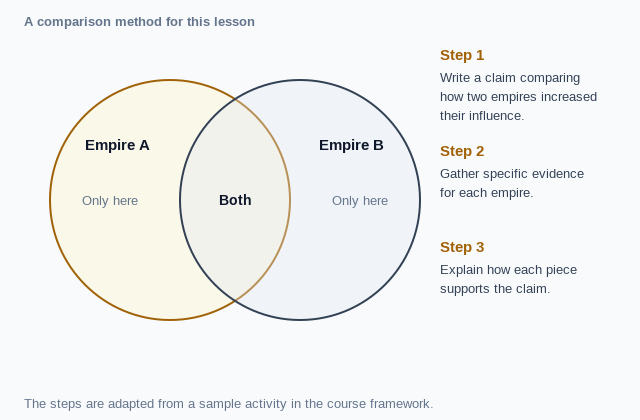
One of College Board's sample activities for this topic asks students to answer its learning objective with a claim and a paragraph explaining how specific evidence supports it. A student planned an answer in this table, written for this page from the framework's statements.
| Row | Evidence the student gathered |
|---|---|
| 1 | Imperial expansion relied on the increased use of gunpowder, cannons and armed trade. |
| 2 | That expansion established large empires in both hemispheres. |
| 3 | The Ottoman ruled in Southern Europe, the Middle East and North Africa; the Mughal in South and Central Asia. |
| 4 | Political and religious disputes led to rivalries and conflict between states, such as the Safavid-Mughal conflict. |
Case question 1 · Decide and justify
Does row 3 support the student's claim that empires increased their influence through similar means of expansion?
Why?
Case question 2 · Spot the error
The student then wrote this paragraph from the plan. Which line is the first to go wrong?
The rest stand on their own and do not use the case.
Check yourself · Select all
A student argues: "Rulers in different empires used similar methods to raise revenue." Which two pieces of specific evidence support the argument? Pick two.
Select 2 answers, then check.
Check yourself · Multiple choice
A student writes: "New connections between the hemispheres expanded the reach of existing religions everywhere." Which change makes the sentence match the course's statement on religions?
Part 7 Keep it Bring back earlier ideas
One question from the belief systems lesson and one from the lesson on expanding empires, so both come round again.
From 3.3 Empires: Belief Systems · Select all
A historian is explaining the historical situation of a source written by a Catholic reformer in this period. Which two statements from the course describe that situation? Pick two.
Select 2 answers, then check.
From 3.1 Empires Expand · Multiple choice
According to this topic's statement on rivalries, what led to rivalries and conflict between states from 1450 to 1750?
In three lines
- Empires achieved increased scope and influence, shaping and being shaped by the diverse populations they incorporated.
- They shared means of expansion and revenue for state power, and differed in how far their rule reached.
- Evidence counts only for the claim it supports: a rivalry shows conflict, and a list of regions shows scope.
Exam strategy for this topic
- Section I Part A, Multiple Choice: 55 questions in 55 minutes.
- Section I Part B, Short Answer: 3 questions in 40 minutes.
- Section II, Document-Based Question and Long Essay: 2 questions in 100 minutes.
- This lesson's Explain it is shaped like free-response question 2, Long essay.
For a comparison, write the similarity or difference first, then give specific evidence from each side and say in a clause how it shows that similarity or difference.
Questions students ask
What does the sample activity for this topic ask?
Students review their notes for the unit and answer the topic's learning objective with a claim statement, then a paragraph explaining how at least three pieces of specific evidence support the argument. Check yourself uses a plan for an answer like that.
Why is this topic a review?
The framework gives this topic the unit's key concepts, the broad statements that the earlier topics fill in, rather than new statements of its own. That makes it the place to compare across the unit.
Does the framework say that legitimizing rule increased an empire's influence?
No. It says rulers used religious ideas, art and monumental architecture to legitimize their rule, and it ties revenue, not legitimacy, to state power and expansion. An argument can make a further link, but it has to support it.
What does "in some cases" change in the statement on religions?
It limits the claim. New connections between the hemispheres expanded the reach of existing religions and fed religious conflict and syncretic beliefs in some cases, not in every case.
Can salaried samurai be evidence about one of the land empires?
The framework lists salaried samurai as an example of military professionals and does not attach them to any of the four land empires it names. The Ottoman devshirme is its example tied to a named empire.
Course alignment, for teachers
AP World History: Modern topic 3.4, Unit 3: Land-Based Empires.
- Skill 6.B: Support an argument using specific and relevant evidence. - Describe specific examples of historically relevant evidence. - Explain how specific examples of historically relevant evidence support an argument.
This lesson maps all 6 essential knowledge statements of the topic, and the one learning objective with none of its own, to the part that teaches each one: 7 are checked by a scored question. The map is in the lesson file.