Unit 1 · Topic 1.3 · about 30 minutes · 7 parts · 9 scored checks, 2 of them multiple choice, plus 2 from earlier lessons
AP World History: Modern 1.3: Developments in South and Southeast Asia from c. 1200 to c. 1450
Unit 1: 8 to 10% of the multiple-choice section
What you'll be able to do
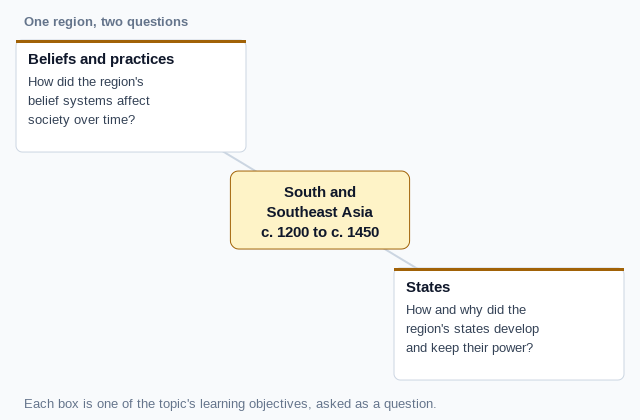
- Explain how Hinduism, Islam and Buddhism, with their beliefs and practices, affected the societies of South and Southeast Asia over time.
- Explain how and why the new Hindu and Buddhist states of South and Southeast Asia developed and kept their power.
Key vocabulary
| Term | What it means | The exam trap |
|---|---|---|
| Hinduism | One of the major religions of South Asia, with many traditions and practices. | A practice's name may not tell you which faith it belongs to. Check the faith before using it as evidence. |
| Core beliefs and practices | What a religion's followers hold to be true, and what they do because of it. | A practice belongs to a faith without being the whole faith. Read whether a choice names a practice or a religion. |
| State formation | How states come into being and take shape. | A state and a religion can share a name or a label. Read whether a choice is about a government or a belief. |
| Continuity | What carries on from earlier times. | Continuity and change can sit inside one development. A question may ask about only one of them. |
| Innovation | Something new, done or made for the first time. | New does not mean better. The word says only that something had not been done before. |
| Diversity | Variety; differences among things of one kind. | The word on its own does not say what differed. Read on to find whether it is rulers, beliefs or forms of government. |
 Tap to open the picture full size
Part 1 Think first Three faiths in one region
Commit to a guess before you read. A wrong guess now still helps the right idea stick.
Predict first
In South and Southeast Asia from c. 1200 to c. 1450, Hindus, Muslims and Buddhists all lived in the region. Over those years, what do you expect happened to the influence of the three faiths?
In short. From c. 1200 to c. 1450, Hinduism, Islam and Buddhism all continued to shape the societies of South and Southeast Asia, and new Hindu and Buddhist states emerged there, showing continuity, innovation and diversity.
- Hinduism, Islam and Buddhism, with their core beliefs and practices, continued to shape societies in South and Southeast Asia.
- Beliefs and practices in the region included the Bhakti movement, Sufism and Buddhist monasticism.
- New Hindu and Buddhist states emerged, such as the Vijayanagara Empire, the Srivijaya Empire, the Khmer Empire and Majapahit, and state formation there showed continuity, innovation and diversity.
Part 2 Learn it Faiths and states in South and Southeast Asia
2a. Three faiths, many practices
Hinduism, Islam and Buddhism, and their core beliefs and practices, continued to shape societies in South and Southeast Asia. Continued is the key word: all three were there before this period, and all three stayed.
A religion is more than its name. It also lives in what its followers do. The framework's examples of beliefs and practices in the region are:
- the Bhakti movement;
- Sufism, a practice within Islam, which you met in the Dar al-Islam lesson as one way the faith spread;
- Buddhist monasticism, the life of Buddhist monks and nuns.
Each example is a practice, a narrower thing than a whole faith. Naming a practice is a more specific answer than naming a faith, and the long essay rubric asks for specific evidence.
Quick check · Multiple choice
Which statement best describes religion in South and Southeast Asia from c. 1200 to c. 1450?
2b. New Hindu and Buddhist states
State formation and development in the region showed continuity, innovation and diversity, including the new Hindu and Buddhist states that emerged in South and Southeast Asia.
The framework's examples are the Vijayanagara Empire, the Srivijaya Empire, the Rajput kingdoms, the Khmer Empire, Majapahit, the Sukhothai kingdom and the Sinhala dynasties. Notice the variety of words: empires, kingdoms, dynasties. That variety is the diversity the statement describes.
The statement uses the same three words as the Song lesson and the Dar al-Islam lesson. Here is how the regions line up so far:
- Song China: traditional methods of government, kept going.
- Dar al-Islam: a caliphate fragmenting into new Islamic states, most dominated by Turkic peoples.
- South and Southeast Asia: new states, including Hindu and Buddhist ones.
One pattern, three forms. Comparisons on this unit start from exactly that kind of list.
Quick check · Select all
Which two of these are examples of the new Hindu and Buddhist states that emerged in South and Southeast Asia? Pick two.
Select 2 answers, then check.
2c. Finding the claim in a source
This topic's skill is to identify and describe a claim or argument in a source.
A claim is the point an author wants you to accept. Evidence is what the author offers to make you accept it. In a short passage the claim is often the most general sentence, and the evidence is the specific names, numbers or examples that follow.
Try it on two sentences about the last lesson's region, written for this page: "Muslim states valued learning from other peoples and times. They preserved Greek moral and natural philosophy and wrote commentaries on it." The first sentence is general and could be argued with. The second gives a specific case that backs it up. So the first is the claim and the second is evidence.
To describe a claim, put it in your own words. A teacher's tip from College Board's sample activities: start with "According to the author...".
Quick check · Multiple choice
A practice passage reads: "State formation in South and Southeast Asia shows great diversity. New Hindu and Buddhist states, from the Khmer Empire to the Sukhothai kingdom, emerged in this period." Which describes the author's argument?
Part 3 Watch it done Identify and describe a claim
Watch the first steps, then take the last one yourself.
A practice passage, written for this lesson from the framework's statements:
"Religion in South and Southeast Asia in this period was not one tradition but several. Hinduism, Islam and Buddhism all continued to shape the region's societies, and practices such as the Bhakti movement, Sufism and Buddhist monasticism show how varied that influence was."
Identify and describe the author's claim.
Step 1 · Sort the sentences
The first sentence is general: religion was several traditions, not one. The second sentence names faiths and practices. Names are the usual sign of evidence.
Step 2 · Test the general sentence
Could someone argue with it? Yes; a person might say one faith dominated. Does the second sentence back it up? Yes; it names three faiths and three practices. So the first sentence is the claim.
Why this step?
Why restate the claim instead of copying it?
Copying shows you found the sentence. Restating it in your own words shows you understood what it argues, and that is what describing asks for.
Your step · Decide and justify
Finish it. Which sentence describes the author's claim?
Which part of the passage supports your choice?
Part 4 Try it Find the claim in a new passage
A second practice passage, written for this page from the framework's statements:
"State formation in South and Southeast Asia brought something new in this period. New Hindu and Buddhist states emerged, among them the Srivijaya Empire and the Sinhala dynasties."
Try it · Decide and justify
Which sentence is the author's claim?
Why?
Part 5 Explain it Compare two regions in writing
This is a self-check. Nothing you type leaves this page. Compare your answer with the model and each scoring point.
Free-response practice · Question 2 style
A short practice in the shape of the long essay question: a thesis, one sentence of context and one paragraph of evidence instead of a full essay. Use what this lesson and the Dar al-Islam lesson taught.
In the period c. 1200 to c. 1450, new states emerged in several regions of Afro-Eurasia.
Compare state formation in South and Southeast Asia with state formation in Dar al-Islam in the period c. 1200 to c. 1450.
Model answer
Thesis: In both South and Southeast Asia and Dar al-Islam new states emerged and showed continuity, innovation and diversity, but they differed in faith: the new states of South and Southeast Asia included Hindu and Buddhist states, while Dar al-Islam's new states were Islamic and mostly dominated by Turkic peoples.
Context: Faiths crossed borders in this period. Hinduism, Islam and Buddhism all continued to shape South and Southeast Asia, and Islam spread across Afro-Eurasia through merchants, missionaries and Sufis, so both regions' new states formed among living, spreading religions.
In Dar al-Islam, new Islamic political entities such as the Seljuk Empire and the Mamluk sultanate of Egypt emerged as the Abbasid Caliphate fragmented. In South and Southeast Asia, new Hindu and Buddhist states emerged, such as the Vijayanagara Empire, the Khmer Empire and Majapahit. The similarity is the process, new states forming; the difference is the faith of the new states the framework names for each region.
Score your own answer. This is a self-check, not a grade. Tick each point your answer makes.
Part 6 Check yourself A student's organizer
The organizer is for the first two questions. The last two draw on the whole lesson.
A student read a practice passage about states in the region, written for this lesson from the framework's statements, and laid out its argument in a graphic organizer, as one of College Board's sample activities suggests. One evidence row has gone wrong.
| Part | What the passage says |
|---|---|
| Claim | The region's state formation took many different forms, with new Hindu and Buddhist states among them. |
| Evidence 1 | New Hindu and Buddhist states emerged, such as the Vijayanagara Empire. |
| Evidence 2 | The Khmer Empire and Majapahit were among them. |
| Evidence 3 | Buddhist monasticism shaped societies in the region. |
| Evidence 4 | The Sukhothai kingdom and the Sinhala dynasties were others. |
Case question 1 · Fill the statement
Describe the passage's claim in your own words, using the organizer.
According to the author, state formation in South and Southeast Asia showed , and the new states the author names include the Empire.
Case question 2 · Spot the error
Which evidence row of the organizer does not support the claim it sits under?
The rest stand on their own and do not use the case.
Check yourself · Select all
Which two of these are beliefs or practices that shaped societies in South and Southeast Asia in this period? Pick two.
Select 2 answers, then check.
Check yourself · Select all
Which two statements accurately compare state formation in South and Southeast Asia with state formation in Dar al-Islam in this period? Pick two.
Select 2 answers, then check.
Part 7 Keep it Bring back earlier ideas
One question from the Dar al-Islam lesson and one from the Song China lesson, so both come round again.
From 1.2 Developments in Dar al-Islam from c. 1200 to c. 1450 · Select all
Which two statements correctly describe how Muslim rule and Islam spread in this period? Pick two.
Select 2 answers, then check.
From 1.1 Developments in East Asia from c. 1200 to c. 1450 · Multiple choice
Which statement best describes how the Song Dynasty maintained and justified its rule?
In three lines
- Hinduism, Islam and Buddhism all continued to shape South and Southeast Asia, through practices such as the Bhakti movement, Sufism and Buddhist monasticism.
- New Hindu and Buddhist states emerged, such as the Vijayanagara Empire, the Khmer Empire and Majapahit, showing continuity, innovation and diversity.
- In a source, the claim is the general point and the evidence is the specific detail that backs it up.
Exam strategy for this topic
- Section I Part A, Multiple Choice: 55 questions in 55 minutes.
- Section I Part B, Short Answer: 3 questions in 40 minutes.
- Section II, Document-Based Question and Long Essay: 2 questions in 100 minutes.
- This lesson's Explain it is shaped like free-response question 2, Long essay.
When a question names a state from South or Southeast Asia, ask whether it belongs with the Hindu and Buddhist states or with Dar al-Islam's Islamic ones before you compare it with anything.
Questions students ask
Where are these states on a map?
College Board's framework names them without locating them, and this lesson stays with what it says. The course framework's world regions map shows where South Asia and Southeast Asia lie.
Is Sufism part of this topic or the Dar al-Islam topic?
Both. The framework lists Sufism among this region's beliefs and practices, and names Sufis among the people who spread Islam in its Dar al-Islam topic.
Is the Bhakti movement part of Hinduism?
The framework lists the Bhakti movement among the region's beliefs and practices without tying it to one faith in its text, so this lesson does not either. Your class may study it further.
Where did the passages in this lesson come from?
They were written for this lesson from the framework's own statements, so the practice is about finding a claim, not about any outside facts. The sources in the free-response section are real primary and secondary sources.
What skill does this topic practice?
Identifying and describing a claim or argument in a text-based or non-text-based source. Chunk 3 and Watch it done show how.
Course alignment, for teachers
AP World History: Modern topic 1.3, Unit 1: The Global Tapestry.
- Skill 3.A: Identify and describe a claim and/or argument in a text-based or non-text-based source.
This lesson maps all 2 essential knowledge statements of the topic, and the 2 learning objectives with none of their own, to the part that teaches each one: 4 are checked by a scored question. The map is in the lesson file.