Unit 7 · Topic 7.6 · about 30 minutes · 7 parts · 9 scored checks, 2 of them multiple choice, plus 2 from earlier lessons
AP World History: Modern 7.6: Causes of World War II
Unit 7: 8 to 10% of the multiple-choice section
What you'll be able to do
- Explain what caused World War II and what followed from it.
Key vocabulary
| Term | What it means | The exam trap |
|---|---|---|
| Peace settlement | The terms that end a war, usually set out in treaties. | Here it is the settlement after World War I, named as a cause of the next war, so do not read it as the peace that ended World War II. |
| Engendered | Brought about; caused to exist. | It ties the crisis to the Great Depression as its source, so do not read the two as separate causes. |
| Imperialist aspirations | The aims of states to build or enlarge empires. | Aspirations are imperialist only when they aim at empire, so ask what the aim is before you name it. |
| Totalitarian regime | A government that seeks to control nearly every part of public and private life. | Fascist and totalitarian are named together, but they are two words, so do not treat them as one term. |
| Militarism | Putting armed force at the center of a state's aims. | Militarism is a state's outlook and policy, not a single battle, so read it as a pattern rather than an event. |
 Tap to open the picture full size
Part 1 Think first A peace that might not hold
Commit to a guess before you read. A wrong guess now still helps the right idea stick.
Predict first
Not long after one world war, another begins. A student is asked to name its single biggest cause. What kind of cause would you reach for first?
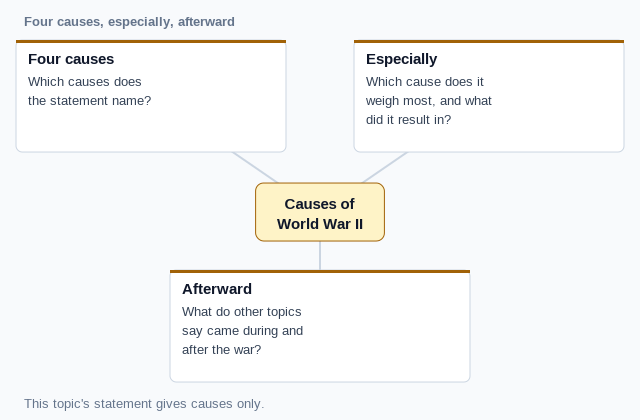
In short. The causes of World War II included the unsustainable peace settlement after World War I, the global economic crisis engendered by the Great Depression, continued imperialist aspirations, and especially the rise to power of fascist and totalitarian regimes that resulted in the aggressive militarism of Nazi Germany under Adolf Hitler.
- Four causes are named, and one is marked with especially.
- The rise to power of fascist and totalitarian regimes resulted in the aggressive militarism of Nazi Germany under Adolf Hitler.
- This topic's statement gives causes only. What happened during and after the war comes from other topics.
Part 2 Learn it Why a second world war
2a. Causes from the years between the wars
The statement lists the causes of World War II in one sentence. It opens with three.
- The unsustainable peace settlement after World War I. Unsustainable means it could not be kept up. The settlement that ended one war is named as a cause of the next.
- The global economic crisis engendered by the Great Depression. Engendered means brought about. The Depression produced a crisis that was global, not confined to one country.
- Continued imperialist aspirations. Aspirations are aims, and continued says they carried on from earlier.
The verb is included, so these are causes among others. The first two reach back to the years after World War I, which 7.4 Economy in the Interwar Period also covers; continued says the third carried on from earlier.
Quick check · Select all
Which two of these does this topic name among the causes of World War II? Pick two.
Select 2 answers, then check.
2b. The cause marked especially
The fourth cause comes last and carries a weight the others do not: and especially the rise to power of fascist and totalitarian regimes that resulted in the aggressive militarism of Nazi Germany under Adolf Hitler.
Two parts of that clause do the work.
Especially is the statement's own ranking. It names this cause above the others without taking them off the list.
That resulted in names a result: the rise of those regimes led to the aggressive militarism of Nazi Germany under Adolf Hitler. Militarism is putting armed force at the center of a state's aims, and aggressive says that force was turned outward.
So the statement does more than list. It weighs one cause most and says what that cause led to.
Quick check · Multiple choice
The statement names four causes of World War II. Which one does it mark with the word especially?
2c. During and after the war, from other topics
The objective asks for consequences as well, but this topic's statement gives causes only. Other topics say what came during and after the war.
During: 7.7 Conducting World War II says new military technology and new tactics, including the atomic bomb and fire-bombing, led to increased levels of wartime casualties. 7.8 Mass Atrocities After 1900 says the rise of extremist groups in power led to the attempted destruction of specific populations, notably the Nazi killing of the Jews in the Holocaust during World War II.
After: Topic 8.1 says that in the years following World War II, increasing anti-imperialist sentiment contributed to the dissolution of empires and the restructuring of states, and that technological and economic gains experienced during the war by the victorious nations shifted the global balance of power.
None of these calls itself a consequence of the war's causes. Linking them is your claim.
Quick check · Select all
Which two statements from other topics in this unit describe what happened during World War II, rather than before it? Pick two.
Select 2 answers, then check.
Part 3 Watch it done One diary, and what it can carry
Watch the first steps, then take the last one yourself.
A diary entry written for this page (it is not a real source), by a shopkeeper in an imagined country in the years before World War II: "Since the banks failed, my shop has few customers. The new party promises bread and pride, and many on my street now wear its badge."
Explain how the diary's point of view and historical situation bear on its use as a source.
Step 1 · Name the point of view and situation
The writer is one shopkeeper, writing privately, during an economic crisis: banks have failed and customers are few. A new party is gaining support on the writer's street.
Step 2 · Say what that lets the source show
Written for no audience but the writer, the entry is good evidence of how one person experienced the crisis and saw a party's promises. It fits two of the causes the statement names: the global economic crisis engendered by the Great Depression, and the rise of a regime.
Why this step?
Why not use the entry to explain how the party came to power?
The writer sees one street. The entry shows support growing there, not how the party took power or how widely it was backed. A single point of view limits how far the source can be stretched.
Your step · Decide and justify
Finish it. A student writes: "The diary shows that the party rose to power because voters across the country wanted bread." Is that a sound use of the source?
Why?
Part 4 Try it Four imagined sources
Four sources from an imagined country in the years before a second world war, written for this page. None is real.
Try it · Match
Match each imagined source to what its point of view or purpose lets it show best.
Part 5 Explain it Causes of World War II, from documents
This is a self-check. Nothing you type leaves this page. Compare your answer with the model, line by line, and with each scoring point.
Free-response practice · Question 1 style
A short practice in the shape of the document-based question: a thesis, one sentence of context and one paragraph that uses both documents and explains the sourcing of one, instead of a full essay. Both documents are written for this page and are not real sources.
Document 1: the veteran's letter from Try it: "The treaty took our provinces and left our army a shadow. My sons will not accept it."
Document 2: the shopkeeper's diary from Watch it done: "Since the banks failed, my shop has few customers. The new party promises bread and pride, and many on my street now wear its badge."
Using both documents and what you know from this topic, explain the causes of World War II.
Model answer
Thesis: World War II had several causes, including the unsustainable peace settlement after World War I and the global economic crisis engendered by the Great Depression, but above all the rise to power of fascist and totalitarian regimes, which resulted in the aggressive militarism of Nazi Germany under Adolf Hitler.
Context: Before 1900, states including the United States, Russia and Japan had expanded their land holdings by conquering and settling neighboring territories, so the imperialist aspirations among the war's causes continued an older pattern of expansion.
Document 1 shows why the peace settlement could not last: a veteran whose country lost provinces and most of its army says his sons will not accept the treaty. As a soldier of a defeated country he speaks for those who felt the loss most, so the letter shows resentment of the settlement, not how every state saw it. Document 2 joins two causes. The banks have failed, part of the economic crisis, and a new party gains support by promising bread and pride. Neither document shows a regime in power, but the rise to power of fascist and totalitarian regimes, the cause that weighed most, resulted in the aggressive militarism of Nazi Germany. The documents show the conditions those regimes rose in.
Score your own answer. This is a self-check, not a grade. Tick each point your answer makes.
Part 6 Check yourself An imagined country between the wars
Use the table for the first two questions. The last two cover the whole lesson.
An imagined country between two world wars, written for this page. It is not a real state, and its record comes from its own government's yearbook.
| Stage | What the yearbook records |
|---|---|
| After the first war | The peace terms take two provinces and cut the army; crowds protest the treaty. |
| The crisis | Banks close here and abroad; factory work falls by half. |
| The new regime | One party takes power, bans the others and puts its leader above the law. |
| The last years | The army is rebuilt and sent across the border into a neighboring state. |
Case question 1 · Rank it
Rows 1 to 3 of the record each resemble a cause of World War II. Rank them by how this topic's statement weighs the cause each one resembles.
Weighted most by the statement first; tie the ones it does not set apart
Give each one a place, 1 for first. Give two the same place if they are equal.
Your ranking: none yet
Case question 2 · Spot the error
A student wrote this paragraph about the table. Which line is the first to go wrong?
The rest stand on their own and do not use the case.
Check yourself · Multiple choice
An editorial written for this page (it is not a real source) appears in a newspaper in a country defeated in World War I: "The peace treaty is a humiliation, and no proud people will live under it for long." Which choice best explains how the editorial's point of view affects its use as a source?
Check yourself · Select all
A speech written for this page (it is not a real source) is given by the leader of a regime to a rally of supporters in the years before World War II: "Our nation needs room to grow, and our army will win it." Given the speech's purpose and audience, which two could a historian use it to show? Pick two.
Select 2 answers, then check.
Part 7 Keep it Bring back earlier ideas
One question from the lesson on empires between the wars and one from conducting World War I, so both come round again.
From 7.5 Unresolved Tensions After World War I · Select all
Besides maintaining control, which two does this topic say happened to Western and Japanese imperial states between the wars, in some cases or in other cases? Pick two.
Select 2 answers, then check.
From 7.3 Conducting World War I · Select all
Which two of these does this topic state about World War I? Pick two.
Select 2 answers, then check.
In three lines
- The causes of World War II included the unsustainable peace settlement, the global economic crisis engendered by the Great Depression, and continued imperialist aspirations.
- The statement especially names the rise to power of fascist and totalitarian regimes, which resulted in the aggressive militarism of Nazi Germany under Adolf Hitler.
- What happened during and after the war comes from other topics, and linking it to these causes is the writer's claim.
Exam strategy for this topic
- Section I Part A, Multiple Choice: 55 questions in 55 minutes.
- Section I Part B, Short Answer: 3 questions in 40 minutes.
- Section II, Document-Based Question and Long Essay: 2 questions in 100 minutes.
- This lesson's Explain it is shaped like free-response question 1, Document-based.
When a prompt asks for causes, name several and weigh them. For World War II the statement weighs one itself, with especially, which gives a thesis something to argue from. Carry that cause through to what it resulted in.
Questions students ask
Which cause of World War II does College Board weigh most?
Its statement marks the rise to power of fascist and totalitarian regimes with especially, and says that rise resulted in the aggressive militarism of Nazi Germany under Adolf Hitler.
How did World War I help cause World War II?
The statement names the unsustainable peace settlement after World War I as a cause. It does not describe the settlement's terms.
Was the Great Depression itself a cause?
The statement names the global economic crisis engendered by the Great Depression, the crisis the Depression brought about, as a cause.
Does this topic give the consequences of World War II?
No. Its statement gives causes only. 7.7 Conducting World War II and 7.8 Mass Atrocities After 1900 describe what happened during the war, and Topic 8.1 describes changes after it.
Is the list of causes complete?
The statement says the causes included those four, so the list is not closed. It weighs one of them most with especially.
Course alignment, for teachers
AP World History: Modern topic 7.6, Unit 7: Global Conflict.
- Skill 2.C: Explain the significance of a source’s point of view, purpose, historical situation, and/or audience, including how these might limit the use(s) of a source.
This lesson maps the one essential knowledge statement of the topic, and the one learning objective with none of its own, to the part that teaches each one: 2 are checked by a scored question. The map is in the lesson file.