Unit 9 · Topic 9.9 · about 30 minutes · 7 parts · 9 scored checks, 2 of them multiple choice, plus 2 from earlier lessons
AP World History: Modern 9.9: Continuity and Change in a Globalized World
Unit 9: 8 to 10% of the multiple-choice section
What you'll be able to do
- Explain the extent to which science and technology brought change in the period from 1900 to the present.
Key vocabulary
| Term | What it means | The exam trap |
|---|---|---|
| Extent | How far, or how much. | An extent answer is not a yes or a no. A thesis that says only that technology changed the world has not said how far. |
| Continuity | Something that carries on, or stays the same, over a period. | A continuity needs evidence that something carried on. A topic saying nothing about a change does not show that things stayed the same. |
| Corroborate | To back up a claim with further evidence; this lesson's working meaning. | Evidence that backs a different claim does not corroborate this one, however true it is. |
| Qualify | To keep a claim and limit how far it holds; this lesson's working meaning. | A qualification comes from evidence, not from adding words like maybe. Doubt alone qualifies nothing. |
| Modify | To change part of a claim to fit the evidence; this lesson's working meaning. | Modifying is not throwing the claim out. Be ready to say which part of it changed. |
 Tap to open the picture full size
Part 1 Think first Everything changed?
Make a guess before you read. A wrong guess still helps the right idea stick.
Predict first
A woman born in 1930 tells her granddaughter: "Machines and medicine changed everything in my lifetime." How far do you guess a historian would go along with her?
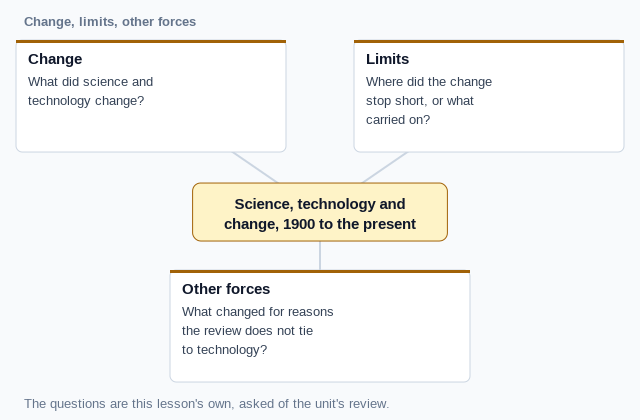
In short. This review topic asks how far science and technology changed the world after 1900, using the unit's key concepts as evidence for the change and for its limits.
- Rapid advances in science and technology altered the understanding of the universe and the natural world and led to advances in communication, transportation, industry, agriculture, and medicine.
- The review also lists changes it does not tie to science or technology, in economies, rights and culture.
- An argument about extent names the change, then qualifies it with evidence of where it stopped or what carried on.
Part 2 Learn it Weighing change in a globalized world
9.9a. What science and technology changed
This last topic adds no new statements. It focuses on the skill of argumentation, and it repeats key concepts from the unit for you to argue with.
The frame is broad: Rapid advances in science and technology altered the understanding of the universe and the natural world and led to advances in communication, transportation, industry, agriculture, and medicine. That is two kinds of change, in what people understood and in what they could do.
Five statements from 9.1 Advances in Technology and Exchange After 1900 fill in the second kind. New modes of communication and transportation reduced the problem of geographic distance. Energy technologies, including petroleum and nuclear power, raised productivity and the production of material goods. The Green Revolution and commercial agriculture increased productivity and sustained the earth's growing population. Medical innovations, including vaccines and antibiotics, increased the ability of humans to survive and live longer lives. More effective birth control contributed to declining rates of fertility in much of the world.
Watch the last one's wording: contributed to and in much of the world. Those words already limit the change.
Quick check · Select all
A student argues: "Science and technology after 1900 changed both how people understood the world and what they could do in it." Based on the review, which two pieces of evidence could best corroborate the argument? Pick two.
Select 2 answers, then check.
9.9b. Changes with other drivers
The review then lists changes it does not tie to science or technology.
One is about economies: states responded in a variety of ways to the economic challenges of the 20th century. Two are from 9.5 Calls for Reform and Responses After 1900: rights-based discourses challenged old assumptions about race, class, gender, and religion, and in much of the world access to education and to new political and professional roles became more inclusive. Three are from 9.6 Globalized Culture After 1900, on the arts, entertainment and popular culture, and on consumer culture crossing national borders.
For an argument about extent, these matter. The review does not tie them to science or technology. Arguing that they had other drivers is your argument, and the statements' own words, such as rights-based discourses challenging old assumptions, are the evidence for it.
The review is not the whole unit, either. It leaves out the statements on disease, the environment, the global economy, resistance to globalization and international organizations. Those are still evidence from this unit, and you can use them.
Quick check · Select all
A student argues: "Science and technology were not the only forces for change after 1900; ideas about people's rights changed societies too." Based on the review, which two pieces of evidence could best corroborate the argument? Pick two.
Select 2 answers, then check.
9.9c. Arguing for change, with limits
The skill is to corroborate, qualify, or modify an argument using diverse and alternative evidence in order to develop a complex argument. One way such an argument might do that, the skill says, is to explain nuance of an issue by analyzing multiple variables.
This lesson uses working meanings of its own, not College Board's. To corroborate is to add evidence that agrees. To qualify is to keep the claim and limit how far it holds. To modify is to change part of the claim itself.
College Board's sample activity for this topic asks for a paragraph that argues for a change but qualifies the argument by acknowledging continuity, and it offers this frame: Science and technology led to profound changes like ___; however, this change did have limits, for example ___ remained constant.
On the exam, College Board says no multiple-choice questions explicitly assess the argumentation skill; the document-based question and long essay question assess argumentation. The checks here practice the same reasoning in a quicker form.
Quick check · Multiple choice
A claim written for this page: "More effective birth control made fertility fall everywhere in the world." Based on the review, which evidence could best be used to qualify the claim?
Part 3 Watch it done A change, qualified by a continuity
Watch the first steps, then take the last one yourself.
Write the paragraph the sample activity asks for: a claim that science and technology brought change, qualified by acknowledging a continuity, with evidence from this unit.
Step 1 · Choose the change
Medical innovations, including vaccines and antibiotics, increased the ability of humans to survive and live longer lives. That fills the first blank: profound changes like vaccines and antibiotics helping people survive and live longer.
Step 2 · Look for a continuity on the same matter
9.2 Technological Advances and Limitations After 1900: Disease says diseases associated with poverty, such as malaria, tuberculosis, and cholera, persisted. That statement is not in the review's list, but it is evidence from this unit.
Why this step?
Why look for a continuity on the same matter, not any continuity at all?
A limit only qualifies the claim it touches. A continuity about something else would sit beside the change without saying anything about how far it reached.
Your step · Decide and justify
Finish it. A student fills the second blank: "for example diseases associated with poverty, such as malaria, tuberculosis, and cholera, persisted." Does that fill the frame well?
What makes that the right call?
Part 4 Try it An imagined historian's sweeping claim
A claim written for this page by an imagined historian (the historian is not real): "After 1900, science and technology changed life for the better in every part of the world."
The evidence below comes from this unit. Each piece either backs the claim or keeps it and limits how far it holds.
Try it · Sort it
Sort each piece of evidence by what it does to the historian's claim.
Corroborates the claim
Qualifies the claim
Part 5 Explain it How far science and technology changed the world
This is a self-check. Nothing you type leaves this page. Compare your answer with the model and each scoring point.
Free-response practice · Question 2 style
This is a partial long essay. Write a thesis, one sentence of context and one paragraph of evidence, not a full essay.
In the period from 1900 to the present, rapid advances in science and technology altered the understanding of the universe and the natural world.
Explain the extent to which science and technology brought change in the period from 1900 to the present.
Model answer
Thesis: Science and technology brought deep change after 1900 in communication, farming and health, but the change had limits, since some of it reached much of the world rather than all of it, some old problems persisted, and, I would argue, other changes came from ideas as much as machines.
Context: The development of industrial capitalism had already brought continued improvement in manufacturing methods that increased the availability, affordability, and variety of consumer goods, which I would argue means the advances after 1900 built on an earlier age of rapid change rather than starting one.
The change was large. New modes of communication, including radio and the internet, reduced the problem of geographic distance, and medical innovations, including vaccines and antibiotics, increased the ability of humans to survive and live longer lives. Its limits show in the evidence too. Birth control contributed to declining rates of fertility in much of the world, which is not all of it, and diseases associated with poverty, such as malaria and cholera, persisted, which I would argue shows where the medical change stopped short. Other changes, I would argue, had other drivers: rights-based discourses challenged old assumptions about race, class, gender, and religion.
Score your own answer. This is a self-check, not a grade. Tick each point your answer makes.
Part 6 Check yourself One country, 1950 and 2000
The table drives the first two questions. The last two come from the rest of the lesson.
Five rows from a record of an imagined country. The record was written for this lesson and is not real.
| Row | What is recorded | 1950 | 2000 |
|---|---|---|---|
| 1 | Homes with a mobile phone | None | 6 in 10 |
| 2 | Material goods made in the country's factories, in tons | 2 million | 9 million |
| 3 | Children born per woman, on average | 6 | 3 |
| 4 | Women among members of the national parliament | 1 in 50 | 1 in 5 |
| 5 | Shops selling brands made abroad | 10 | 900 |
Case question 1 · Fill the statement
Complete the note on the record.
Row fits a change the review ties to energy technologies, and row fits a change in political roles that the review does not tie to science or technology.
Case question 2 · Spot the error
A student wrote this summary of the record. Which line goes wrong?
The rest stand on their own and do not use the case.
Check yourself · Multiple choice
A claim written for this page: "In the 20th century, every state met its economic challenges in the same way." Based on the review and this unit, which evidence could best be used to modify the claim?
Check yourself · Select all
A student argues: "Cultural change after 1900 came from more than one source." Based on the review, which two pieces of evidence could best corroborate the argument? Pick two.
Select 2 answers, then check.
Part 7 Keep it Bring back earlier ideas
One question from international organizations, the lesson just before this one, and one from globalized culture three lessons back.
From 9.8 Institutions Developing in a Globalized World · Select all
Which two does this topic say about the new international organizations? Pick two.
Select 2 answers, then check.
From 9.6 Globalized Culture After 1900 · Multiple choice
Which choice best describes what this topic says about arts, entertainment, and popular culture?
In three lines
- Rapid advances in science and technology changed what people understood and what they could do, in communication, transportation, industry, agriculture, and medicine.
- The review also lists changes in economies, rights and culture that it does not tie to science or technology.
- An argument about extent names the change and qualifies it with evidence of its limits, such as a disease that persisted.
Exam strategy for this topic
- Section I Part A, Multiple Choice: 55 questions in 55 minutes.
- Section I Part B, Short Answer: 3 questions in 40 minutes.
- Section II, Document-Based Question and Long Essay: 2 questions in 100 minutes.
- This lesson's Explain it is shaped like free-response question 2, Long essay.
When a long essay asks the extent of a change, name the change, then a limit drawn from the evidence, such as in much of the world or a disease that persisted, and say which side weighs more.
Questions students ask
Does the review cover everything in Unit 9?
No. It lists the statements of Topics 9.1, 9.5 and 9.6 and two broader ones. It leaves out the statements on disease, the environment, the global economy, resistance to globalization and international organizations, which are still evidence from this unit.
Where can a continuity for the sample activity come from?
From evidence that says something carried on. In this unit, Topic 9.2 says diseases associated with poverty persisted. That statement is outside the review's list, but it is unit evidence. Linking it to the medical change is your argument.
Were science and technology the only causes of change after 1900?
The review does not say so. It also lists rights-based discourses challenging old assumptions and states responding in a variety of ways to economic challenges, and it ties neither to science or technology.
Does College Board define corroborate, qualify and modify?
The skill names the three moves without defining them. This lesson gives them working meanings of its own and says so.
Will a multiple-choice question test this skill?
College Board says no multiple-choice questions explicitly assess the argumentation skill; the document-based question and long essay question assess argumentation. Practicing it here prepares you for those.
Course alignment, for teachers
AP World History: Modern topic 9.9, Unit 9: Globalization.
- Skill 6.D: Corroborate, qualify, or modify an argument using diverse and alternative evidence in order to develop a complex argument.
This lesson maps all 12 essential knowledge statements of the topic, and the one learning objective with none of its own, to the part that teaches each one: 13 are checked by a scored question. The map is in the lesson file.