Unit 6 · Topic 6.2 · about 30 minutes · 7 parts · 9 scored checks, 2 of them multiple choice, plus 2 from earlier lessons
AP World History: Modern 6.2: State Expansion from 1750 to 1900
Unit 6: 12 to 15% of the multiple-choice section
What you'll be able to do
- Compare processes by which state power shifted in various parts of the world from 1750 to 1900.
Key vocabulary
| Term | What it means | The exam trap |
|---|---|---|
| Non-state entity | A holder of land or power that is not a government, such as a company. | A company could hold a colony without being a state. Check who held a colony before the state took it over. |
| Direct control | Rule by a state's own government, not through another body. | Strengthening control and assuming direct control are not the same step. The statement says the second happened in some cases. |
| Settler colony | A colony where people from the ruling side came to live and farm. | Settler colonies were set up in some parts of empires. Do not read the term as covering every colony. |
| Diplomacy | Dealing between states or rulers through talks and agreements, such as treaties. | Diplomacy covers agreements as well as talks. A treaty that hands over land is still diplomacy. |
| Influence | Power to shape what happens in a place, short of full rule. | Influence can fall while a state still holds some land. Read whether a choice speaks of influence or of territory. |
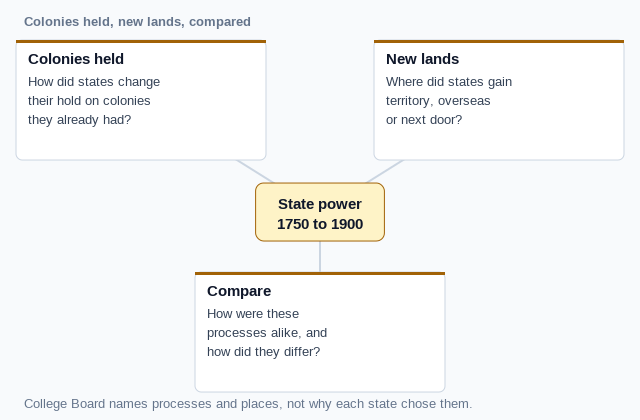 Tap to open the picture full size
Part 1 Think first Overseas or next door?
Guess first. Committing to an answer before the lesson helps the lesson stick, even when the guess is off.
Predict first
Picture a world map in 1750 and another in 1900. Between them, where do you expect growing states mostly gained land?
In short. From 1750 to 1900, state power shifted by several processes: states tightened control of colonies they held, took new territory overseas, set up settler colonies and conquered and settled neighboring land.
- Some states with existing colonies strengthened their control, and in some cases assumed direct control over colonies non-state entities had held.
- European states, the United States and Japan acquired territories throughout Asia and the Pacific, while Spanish and Portuguese influence declined; many European states used warfare and diplomacy in Africa.
- The United States, Russia and Japan expanded their land holdings by conquering and settling neighboring territories.
Part 2 Learn it Processes of state expansion
6.2a. Colonies already held
Part of the change happened inside empires that already existed. Some states with existing colonies strengthened their control over those colonies and in some cases assumed direct control over colonies previously held by non-state entities.
A non-state entity is a holder that is not a government. College Board's two examples: the shift from the private ownership of the Congo by King Leopold II to the Belgian government, and the shift from the Dutch East India Company to Dutch government control in Indonesia and Southeast Asia. Keep some and in some cases: not every state did this, and strengthening control did not always mean direct rule.
A second process also worked inside existing empires. Europeans established settler colonies in some parts of their empires. The example given is New Zealand. Again the word is some: a settler colony was one kind of colony, not the pattern everywhere.
Quick check · Select all
Which two statements describe processes by which European state power shifted or expanded, according to this topic? Pick two.
Select 2 answers, then check.
6.2b. New territory overseas
Other states gained new land across the sea. European states as well as the United States and Japan acquired territories throughout Asia and the Pacific, while Spanish and Portuguese influence declined. The sentence holds a rise and a fall together: some states gained territory in the region while two lost influence there.
In Africa the statement names a method. Many European states used both warfare and diplomacy to expand their empires in Africa. Both matters: force and agreement were two tools of one expansion, not rival paths. The examples are Britain in West Africa, Belgium in the Congo and the French in West Africa.
Notice what the Africa statement leaves out. It names European states only, and many of them, not all.
Quick check · Select all
A diary entry written for this page is by a Spanish official late in this period: "Our country's influence in Asia and the Pacific is not what it was. Other states now take the lands there." Which two developments described in this topic best situate the diary entry within its broader context? Pick two.
Select 2 answers, then check.
6.2c. Land next door, and how to compare
The last process kept to the map's own edges. The United States, Russia, and Japan expanded their land holdings by conquering and settling neighboring territories.
Two states sit in more than one statement. The United States and Japan are named for land next door and for territories throughout Asia and the Pacific. Russia is named only for neighboring land, and Spain only for declining influence.
The learning objective asks you to compare these processes. A comparison names a feature two cases share and a feature where they part. Conquering and settling neighboring land and setting up a settler colony both involve settling, for instance, but one lies beside the expanding state and the other in part of an overseas empire. "Both empires grew" is true of every process here, so it compares nothing.
Quick check · Select all
Which two states does this topic name both among those that acquired territories throughout Asia and the Pacific and among those that expanded their land holdings by conquering and settling neighboring territories? Pick two.
Select 2 answers, then check.
Part 3 Watch it done Comparing the Congo and Indonesia
Watch the first steps, then take the last one yourself.
Compare the shift in control of the Congo with the shift in control of Indonesia and Southeast Asia, as College Board's examples give them.
Step 1 · State each case as the examples give it
The Congo shifted from the private ownership of King Leopold II to the Belgian government. Indonesia and Southeast Asia shifted from the Dutch East India Company to Dutch government control.
Step 2 · Ask who held each colony before and after
Before: a king holding land as his private property, and a company. Neither is a government. After: in both cases, a state. That is the process the statement names, a state assuming direct control over a colony previously held by a non-state entity.
Why this step?
Leopold II was a king. Why does his Congo count as held by a non-state entity?
The example says private ownership. He held the Congo as his own property, not as the Belgian state, and the shift was to the Belgian government.
Your step · Decide and justify
Finish it. Which sentence better compares the two cases?
Why is it the better comparison?
Part 4 Try it Compare, place or neither?
Two accounts written for this page. They are not real.
> Account 1, a governor's report from a European colony in Southeast Asia: "The forts and warehouses in these islands, which the company's agents ran, now answer to the ministry at home. I govern them in the government's name."
> Account 2, a farmer's letter from a European colony in the Pacific: "Forty families came out on our ship, and each has land to clear. The governor says more ships of families are coming."
A student wrote six sentences about the two accounts. Decide what each sentence does.
Try it · Sort it
Sort each sentence by what it does with the accounts.
Compares the two accounts on a specific feature
Places one account in a broader development
Does neither
Part 5 Explain it Comparing two paths, from documents
This is a self-check. Nothing you type leaves this page. Read the model and the scoring points against what you wrote.
Free-response practice · Question 1 style
A short practice in the shape of the document-based question: a thesis, one sentence of context and one paragraph that uses both documents and explains the point of view or purpose of one, instead of a full essay. Both documents are written for this page and are not real.
Document 1: a report from a Russian officer to his commander: "Each spring our columns move further across the steppe, and villages of our own farmers follow behind them."
Document 2: a letter from a farmer in New Zealand to relatives in Europe: "Come out to us. There is good land here for any family willing to work it."
Using both documents, compare the processes by which state power shifted in various parts of the world from 1750 to 1900.
Model answer
Thesis: Russia and the Europeans who set up settler colonies both extended state power by settling land, but Russia conquered and settled territory beside its own, while settler colonies lay in parts of Europeans' overseas empires.
Context: While revolution and rebellion against existing governments were establishing new nation-states around the world, older states were also pushing their power outward, as Russia did across the steppe and as Europeans did in settler colonies such as New Zealand.
Document 1 shows the land process: the columns move across the steppe and Russian farmers follow, conquering and then settling neighboring territory, as the United States and Japan also did. Its point of view is an officer reporting to a commander, so it describes the advance as steady progress and says nothing of the people already on the steppe. Document 2 shows a settler colony. New Zealand was a settler colony, one of those Europeans established in some parts of their empires, and the farmer's invitation to family in Europe shows settlement coming from far across the sea. The two differ in where the land lay, next door or overseas. Both also differ from a third process, a state assuming direct control over a colony a non-state entity had held, as the Belgian government did with King Leopold II's Congo.
Score your own answer. This is a self-check, not a grade. Tick each point your answer makes.
Part 6 Check yourself Four colonies, compared
The table drives the first two questions. The last two come from the rest of the lesson.
Four colonies, described for this lesson from College Board's statements. The colonies are invented, and the table gives no names.
| Colony | Before | After |
|---|---|---|
| A, in Southeast Asia | A chartered trading company ran it | The home government's ministry runs it |
| B, in South Asia | The home government ruled it | The same government rules it, with more officials and troops |
| C, in the Pacific | No European rule | Farm families from Europe have settled it, inside a European empire |
| D, in West Africa | Several local kingdoms | Part of a European empire, after treaties with some rulers and wars with others |
Case question 1 · Fill the statement
Complete the comparison of colonies A and B.
Colony B shows only the first half of the statement on colonies already held: its government over it, but no control passed to the state from a , as it did in colony A.
Case question 2 · Spot the error
A student compared the four colonies. Which line goes wrong?
The rest stand on their own and do not use the case.
Check yourself · Multiple choice
A letter written for this page is from a European official in Africa: "Where the local ruler signs our treaty, we will not need our soldiers. Where he refuses, they will march." Which development described in this topic best situates the letter within a broader historical context?
Check yourself · Multiple choice
Which choice best describes a difference between how Russia and the European states expanded, as this topic presents them?
Part 7 Keep it Bring back earlier ideas
One question from the rationales lesson just before this one, and one from the lesson on society and industrialization in Unit 5.
From 6.1 Rationales for Imperialism from 1750 to 1900 · Select all
A newspaper editorial written for this page reads: "Our nation must stand first among nations. Where our rule goes, we bring civilization to peoples who lack it." Which two ideologies named in this topic's statement does the editorial best reflect? Pick two.
Select 2 answers, then check.
From 5.9 Society and the Industrial Age · Select all
Which two statements describe how this topic says industrialization changed social hierarchies or roles? Pick two.
Select 2 answers, then check.
In three lines
- Some states strengthened control of colonies they held, in some cases taking direct control from non-state entities such as Leopold II and the Dutch East India Company.
- European states, the United States and Japan acquired territories in Asia and the Pacific as Spanish and Portuguese influence declined; in Africa, many European states used warfare and diplomacy.
- Europeans set up settler colonies in some parts of their empires, and the United States, Russia and Japan conquered and settled neighboring land.
Exam strategy for this topic
- Section I Part A, Multiple Choice: 55 questions in 55 minutes.
- Section I Part B, Short Answer: 3 questions in 40 minutes.
- Section II, Document-Based Question and Long Essay: 2 questions in 100 minutes.
- This lesson's Explain it is shaped like free-response question 1, Document-based.
When a question asks you to compare how state power shifted, name the specific feature two cases share and the one where they part, such as who held a colony before, or whether the land lay next door or overseas. A feature every case shares compares nothing.
Questions students ask
Which states expanded both overseas and over land?
The United States and Japan are named both for acquiring territories throughout Asia and the Pacific and for conquering and settling neighboring territories. Russia is named only for the land process.
Why does Leopold II's Congo count as non-state control?
College Board's example calls it private ownership, and the shift was to the Belgian government. The king held it as his own, not as the state.
Did every European state expand in Africa?
The statement says many European states used both warfare and diplomacy to expand there, and it gives Britain, Belgium and France as examples. It does not say all did.
What happened to Spain and Portugal?
Their influence declined while European states, the United States and Japan acquired territories throughout Asia and the Pacific. College Board gives no cause for the decline.
Does the topic say why states chose one process over another?
No. It names the processes and some places and examples, not the reasons behind each state's path. Explain a choice only from what a source or another topic gives.
Course alignment, for teachers
AP World History: Modern topic 6.2, Unit 6: Consequences of Industrialization.
- Skill 4.B: Explain how a specific historical development or process is situated within a broader historical context.
This lesson maps all 5 essential knowledge statements of the topic, and the one learning objective with none of its own, to the part that teaches each one: 6 are checked by a scored question. The map is in the lesson file.