Unit 2 · Topic 2.6 · about 30 minutes · 7 parts · 9 scored checks, 2 of them multiple choice, plus 2 from earlier lessons
AP World History: Modern 2.6: Environmental Consequences of Connectivity
Unit 2: 8 to 10% of the multiple-choice section
What you'll be able to do
- Explain the environmental effects of the networks of exchange in Afro-Eurasia from c. 1200 to c. 1450.
Key vocabulary
| Term | What it means | The exam trap |
|---|---|---|
| Crop | A plant grown for food or other use. | A plant and a good made from it can appear in one list. Read which a choice names. |
| Pathogen | A germ that causes disease. | A question may name a germ or the disease it causes. Read which one a choice describes. |
| Epidemic disease | A disease that spreads widely through a population. | An epidemic is a disease spreading widely, not one person falling ill. Read how far a choice says it spread. |
| Trade route | A path that merchants and goods travel between places. | A route can carry more than one kind of thing. Read what a choice says moved along it. |
 Tap to open the picture full size
Part 1 Think first A sickness in port
Commit to a guess before you read. A wrong guess now still helps the right idea stick.
Predict first
A sickness appears in a busy port city far from any place it was seen before. What do you expect most likely carried it there?
In short. From c. 1200 to c. 1450, the networks of exchange carried living things as well as goods: crops and pathogens continued to diffuse, and epidemic diseases, including the bubonic plague, spread along trade routes.
- There was continued diffusion of crops: the framework's possible examples are bananas in Africa, new rice varieties in East Asia and the spread of citrus in the Mediterranean.
- There was continued diffusion of pathogens, with epidemic diseases, including the bubonic plague, along trade routes.
- Continued means the spread was not new in this period, and the statement names no effects of the diseases beyond their spread.
Part 2 Learn it What the routes carried besides goods
2a. Crops that kept moving
Exchange had effects on the natural world. The framework's statement on them is one sentence, and its first half is about plants: there was continued diffusion of crops. A crop is a plant grown for food or other use.
Its possible examples come from three regions: bananas in Africa, new rice varieties in East Asia and the spread of citrus in the Mediterranean.
The key word is continued. Crops were already spreading between regions before 1200, and in this period that spread went on. An answer that says crops began to spread in these years has changed the statement.
The framework says where each example appears, not how it got there or what it changed once it arrived. So use the examples as cases of crops diffusing, and leave out details the statement does not give.
Quick check · Select all
Which three of these are crops that diffused along trade routes in this period? Pick three.
Select 3 answers, then check.
2b. Pathogens along the routes
The second half of the sentence is about disease. The diffusion of pathogens, the germs that cause disease, continued too, with epidemic diseases, including the bubonic plague, along trade routes. An epidemic disease is one that spreads widely through a population.
Two details matter. Including makes the bubonic plague one of the epidemic diseases, not the only one. Along trade routes says where the diseases spread: on the same routes that carried goods. Crops and pathogens moved along the same routes as the goods.
That is all the statement says. It names no effects of the plague on the places it reached, so this lesson does not add any.
The unit's review statement in 2.7 Comparison of Economic Exchange files crops and pathogens under biological diffusion, beside cultural and technological diffusion. Crops and pathogens are both living things, which is why they sit there and not with paper or a faith.
Quick check · Select all
Which two statements about disease in Afro-Eurasia from c. 1200 to c. 1450 are accurate? Pick two.
Select 2 answers, then check.
Part 3 Watch it done Find the pattern in three crops
Watch the first steps, then take the last one yourself.
Identify the pattern that bananas in Africa, new rice varieties in East Asia and the spread of citrus in the Mediterranean have in common in this period.
Step 1 · Put the cases side by side
Three regions and three plants: Africa and bananas, East Asia and new rice varieties, the Mediterranean and citrus. What differs is the place and the crop.
Step 2 · Name what they share
All three are the framework's possible examples of one development: the continued diffusion of crops. The pattern is crops spreading between regions, the same in each case.
Why this step?
Why does the word continued belong in the pattern?
The framework says the diffusion of crops continued in this period. Leaving the word out lets a reader think the spread was new, which the statement does not say.
Your step · Decide and justify
Finish it. Which sentence states the pattern the three examples share?
Which evidence supports your choice?
Part 4 Try it What spread?
Six scenes along imagined trade routes. They were written for this page, not taken from a source. Some show what this lesson covers, and some show what 2.5 Cultural Consequences of Connectivity covered. Decide which is which.
Try it · Sort it
Each scene shows something spreading along a trade route. Sort it by what spread.
Crops or pathogens
Ideas, beliefs or techniques
Part 5 Explain it An effect on the natural world
This is a self-check. Nothing you type leaves this page. Compare your answer with the model and each scoring point.
Free-response practice · Question 2 style
A cut-down long essay: a thesis, one sentence of context and one paragraph of evidence.
In the period c. 1200 to c. 1450, trade routes connected many regions of Afro-Eurasia.
Explain one environmental effect of the networks of exchange in Afro-Eurasia in the period c. 1200 to c. 1450.
Model answer
Thesis: The networks of exchange carried living things as well as goods, so crops and pathogens continued to diffuse along trade routes, including epidemic diseases such as the bubonic plague.
Context: Goods were not the only things moving between societies. Increased cross-cultural interactions were also spreading traditions and innovations, such as paper from China, so crops and pathogens were part of a wider movement between societies.
There was continued diffusion of crops, such as bananas in Africa and the spread of citrus in the Mediterranean. There was continued diffusion of pathogens as well, with epidemic diseases, including the bubonic plague, along trade routes. The link is the route itself: the same trade routes that carried goods between regions carried crops and pathogens with them.
Score your own answer. This is a self-check, not a grade. Tick each point your answer makes.
Part 6 Check yourself What moved along the routes
The table drives the first two questions. The last three come from the rest of the lesson.
A student listed things that spread in Afro-Eurasia from c. 1200 to c. 1450, from this lesson and the last one. The list was written for this lesson from the framework's examples.
| What spread | Where |
|---|---|
| Bananas | In Africa |
| The bubonic plague | Along trade routes |
| Paper | From China |
| Buddhism's influence | In East Asia |
| Citrus | In the Mediterranean |
Case question 1 · Spot the error
The student wrote a summary of the table. Which line is the first to go wrong?
Case question 2 · Match
Each scene was written for this question. Match it to the row of the table that shows the same kind of spread.
The rest stand on their own and do not use the case.
Check yourself · Multiple choice
Which statement best describes an environmental effect of Afro-Eurasia's networks of exchange from c. 1200 to c. 1450?
Check yourself · Multiple choice
A student notices that in this period the bubonic plague spread along the same routes that carried luxury goods. Which pattern from the course does the observation fit?
Check yourself · Select all
The course's review statement for this unit says a deepening and widening of networks of human interaction contributed to cultural, technological and biological diffusion. Which two developments from this unit are examples of biological diffusion? Pick two.
Select 2 answers, then check.
Part 7 Keep it Bring back earlier ideas
One question from the cultural effects lesson just before this one, and one from the Indian Ocean lesson three back.
From 2.5 Cultural Consequences of Connectivity · Multiple choice
Which statement best describes a cultural effect of increased cross-cultural interactions in Afro-Eurasia from c. 1200 to c. 1450?
From 2.3 Exchange in the Indian Ocean · Select all
Which three of these were technologies or knowledge that the growth of Indian Ocean trade drew on? Pick three.
Select 3 answers, then check.
In three lines
- There was continued diffusion of crops, such as bananas in Africa, new rice varieties in East Asia and citrus in the Mediterranean.
- There was continued diffusion of pathogens, with epidemic diseases, including the bubonic plague, along trade routes.
- The statement names the spread and where it ran, and no effects of the diseases beyond that.
Exam strategy for this topic
- Section I Part A, Multiple Choice: 55 questions in 55 minutes.
- Section I Part B, Short Answer: 3 questions in 40 minutes.
- Section II, Document-Based Question and Long Essay: 2 questions in 100 minutes.
- This lesson's Explain it is shaped like free-response question 2, Long essay.
When a stem asks about environmental effects of trade, look for what moved with the goods. Then check the time words in each choice against the statement before you settle on one.
Questions students ask
Was the spread of crops new in this period?
No. College Board's framework says there was continued diffusion of crops and pathogens, so the spread went on from earlier times.
What did the bubonic plague do to the places it reached?
This statement does not say. It names the bubonic plague among the epidemic diseases that spread along trade routes, and gives nothing about its effects, so this lesson does not add any.
Why does the spread of crops and disease count as an environmental effect?
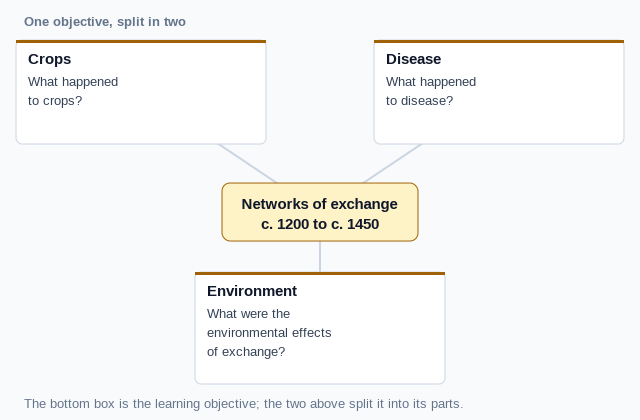
The framework places this statement under the learning objective about the environmental effects of the networks of exchange in Afro-Eurasia from c. 1200 to c. 1450.
Are bananas, rice and citrus the only crops to know?
They are possible examples. The framework says its illustrative examples are not additional, preferred or required information, so another crop you have studied that diffused in this period can serve too.
Course alignment, for teachers
AP World History: Modern topic 2.6, Unit 2: Networks of Exchange.
- Skill 5.A: Identify patterns among or connections between historical developments and processes.
This lesson maps the one essential knowledge statement of the topic, and the one learning objective with none of its own, to the part that teaches each one: 2 are checked by a scored question. The map is in the lesson file.