Unit 2 · Topic 2.2 · about 30 minutes · 7 parts · 9 scored checks, 2 of them multiple choice, plus 2 from earlier lessons
AP World History: Modern 2.2: The Mongol Empire and the Making of the Modern World
Unit 2: 8 to 10% of the multiple-choice section
What you'll be able to do
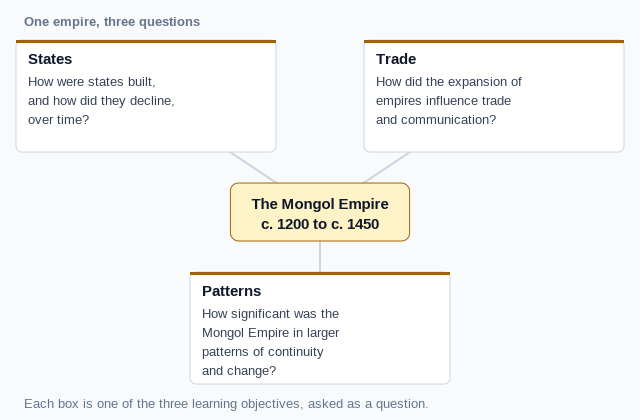
- Explain how states and empires were built and declined in Eurasia over time.
- Explain how the expansion of empires, including the Mongols, influenced trade and communication over time.
- Explain the significance of the Mongol Empire within larger patterns of continuity and change.
Key vocabulary
| Term | What it means | The exam trap |
|---|---|---|
| Empire | A state that rules over many lands and peoples. | A question about empires may be about their rise, their fall or their trade. Read which one it asks about. |
| Khanate | A state ruled by a khan, the title of a Mongol ruler. | Khanate names a Mongol state, not the Mongol people as a whole. Read whether a choice means the state or the people. |
| Imperial state | A state organized as an empire. | Imperial describes how a state was organized, not whether it was old or new. Read the adjective in front of it. |
| Trade network | The routes, markets and people through which trade moves. | A network includes people as well as roads. Read what part of it a choice describes. |
| Interregional | Between regions, rather than inside one. | Check which regions a choice connects, and in which direction, before you accept it. |
| Transfer | Something, such as knowledge or a technique, passing from one people or region to another. | Every transfer has a starting point and an end point. Read both in a choice. |
 Tap to open the picture full size
Part 1 Think first One empire or many?
Commit to a guess before you read. A wrong guess now still helps the right idea stick.
Predict first
A history book's chapter is called "The Mongol Empire and the Making of the Modern World." When you read the College Board statements the chapter is built on, what do you expect they say about the Mongols?
In short. From c. 1200 to c. 1450, empires collapsed in different regions and in some areas new imperial states replaced them, including the Mongol khanates, and the Mongols appear in each of the period's patterns of empire as one case among others.
- Empires collapsed in different regions of the world, and in some areas they were replaced by new imperial states, including the Mongol khanates.
- The expansion of empires, including the Mongols, facilitated Afro-Eurasian trade and communication as new people were drawn into their conquerors' economies and trade networks.
- Interregional contacts and conflicts between states and empires, including the Mongols, encouraged significant technological and cultural transfers, such as the transfer of numbering systems to Europe.
Part 2 Learn it The Mongols in three patterns
2a. Empires fall, and some are replaced
Start with states. In this period, empires collapsed in different regions of the world, and in some areas they were replaced by new imperial states, including the Mongol khanates. A khanate is a state ruled by a khan.
Two limits sit inside that sentence, and both matter.
In some areas means replacement did not happen everywhere an empire fell. Including means the Mongol khanates were one kind of new imperial state, not the only one.
The statement also leaves something out: it gives no cause for the collapses. It does not say the Mongols brought down the empires that fell, and neither should you. The learning objective asks how state building and decline happened over time, and here the framework names the decline and the replacement without saying how either came about.
Quick check · Multiple choice
Which statement best describes the political change in this period that the course connects to the Mongols?
2b. Conquest that drew people into trade
Next, trade. The expansion of empires, including the Mongols, facilitated Afro-Eurasian trade and communication.
The statement also says how: new people were drawn into their conquerors' economies and trade networks. When an empire expanded, the people it conquered became part of the economy and the trade networks the conquerors ran. Facilitated means made easier.
That is a link from a political development (an empire growing) to an economic one (more trade and communication). The link the framework gives runs through people: conquered people were brought into networks they had not been part of.
Notice including again. The framework says the expansion of empires did this, and it names the Mongols as one of those empires.
Quick check · Select all
Which two statements describe how the expansion of empires, including the Mongols, affected Afro-Eurasia? Pick two.
Select 2 answers, then check.
2c. Contact, conflict and what they carried
Last, culture and technology. Interregional contacts and conflicts between states and empires, including the Mongols, encouraged significant technological and cultural transfers.
A transfer is something passing from one people or region to another. The framework's possible examples are the transfer of Greco-Islamic medical knowledge to western Europe, the transfer of numbering systems to Europe and the adoption of Uyghur script.
The cause has two parts. Contacts and conflicts both encouraged transfers, so conflict belongs in the cause as well as contact. Read the direction of each example, too: the medical knowledge went to western Europe, and the numbering systems went to Europe.
Across the three chunks one word keeps returning. In each statement the Mongols come after including, inside a pattern of the period's states and empires.
Quick check · Select all
Which two statements about technological and cultural transfers in this period are accurate? Pick two.
Select 2 answers, then check.
Part 3 Watch it done Connect expansion to trade
Watch the first steps, then take the last one yourself.
Identify a connection between the expansion of the Mongol Empire and a change in Afro-Eurasian trade, and describe how the two are linked.
Predict first
Before the steps: what do you expect links an empire's conquests to trade?
Step 1 · Find the statement that joins the two
The connection asked for runs from a political development to an economic one. The statement that joins them is the one on expansion: the expansion of empires, including the Mongols, facilitated Afro-Eurasian trade and communication.
Step 2 · Name the link
The same statement says how: new people were drawn into their conquerors' economies and trade networks. That is the link a connection needs. Conquest put new people inside networks they had not been part of.
Why this step?
Why is "the Mongols expanded, and trade grew" not yet a connection?
It sets two facts side by side without saying how one bears on the other. A connection names the link between them, here the people drawn into the conquerors' trade networks.
Your step · Decide and justify
Finish it. Which sentence connects the Mongols' expansion to a change in trade the way the framework does?
Which evidence supports your choice?
Part 4 Try it A flowchart of change
College Board's sample activity for this lesson has students build a flowchart of the political, economic and cultural changes that occurred in Eurasia "as a result of the Mongol Empire". The six scenes below were written for this page, not taken from a source. Each matches something the framework describes. Place each one in the flowchart.
Try it · Sort it
Each scene shows a change in Eurasia linked to the Mongol Empire. Sort it by the kind of change it shows.
Political: states and empires
Economic: trade and communication
Cultural: transfers
Part 5 Explain it How expansion changed trade
This is a self-check. Nothing you type leaves this page. Compare your answer with the model and each scoring point.
Free-response practice · Question 2 style
Practice for the long essay question, cut down to three parts: a thesis, a sentence of context and a paragraph of evidence.
In the period c. 1200 to c. 1450, the Mongols were among the empires that expanded.
Explain how the expansion of the Mongol Empire changed trade and communication in Afro-Eurasia in the period c. 1200 to c. 1450.
Model answer
Thesis: The Mongols' expansion changed trade and communication by drawing conquered people into the Mongols' economies and trade networks, and the contacts and conflicts it brought encouraged transfers between peoples.
Context: In the same period, improved commercial practices were increasing the volume of trade and expanding the range of existing routes, including the Silk Roads, so the Mongols' expansion came in years when trade on existing routes was already growing.
The expansion of empires, including the Mongols, facilitated Afro-Eurasian trade and communication as new people were drawn into their conquerors' economies and trade networks. Contacts and conflicts between states and empires, including the Mongols, also encouraged technological and cultural transfers, such as the transfer of numbering systems to Europe and the adoption of Uyghur script. The change came through people: conquest brought new people inside the conquerors' networks, and contact and conflict carried knowledge between them.
Score your own answer. This is a self-check, not a grade. Tick each point your answer makes.
Part 6 Check yourself Where the Mongols appear
The table drives the first two questions. The last two come from the rest of the lesson.
This table sets the framework's three statements side by side, splitting each into the pattern it describes and the words that name the Mongols. It was built for this lesson from the statements themselves.
| Kind of change | The pattern | Where the Mongols appear |
|---|---|---|
| Political | Empires collapsed in different regions of the world and in some areas were replaced by new imperial states | including the Mongol khanates |
| Economic | The expansion of empires facilitated Afro-Eurasian trade and communication as new people were drawn into their conquerors' economies and trade networks | including the Mongols |
| Cultural | Interregional contacts and conflicts between states and empires encouraged significant technological and cultural transfers | including the Mongols |
Case question 1 · Spot the error
A student summarized the table in five lines. Which line is the first to claim something the table does not support?
Case question 2 · Fill the statement
A new case, written for this question: herders in a land the Mongols have just conquered begin selling their animals to traders from across the empire. Complete the sentence about where the case fits in the table.
The case fits the table's row, and that row's words "including the Mongols" make the Mongols empire whose expansion facilitated trade and communication.
The rest stand on their own and do not use the case.
Check yourself · Multiple choice
The course's statements say empires collapsed and were replaced by new imperial states, "including the Mongol khanates", and that the expansion of empires, "including the Mongols", facilitated trade. What does that wording show about the Mongols' place in this period?
Check yourself · Select all
Which two of these connect a development to a result in the way the course does? Pick two.
Select 2 answers, then check.
Part 7 Keep it Bring back earlier ideas
One question from the Silk Roads lesson just before this one, and one from the Europe lesson a few back.
From 2.1 The Silk Roads · Select all
Which two of these were innovations in transportation and commercial technologies that encouraged interregional trade in luxury goods? Pick two.
Select 2 answers, then check.
From 1.6 Developments in Europe from c. 1200 to c. 1450 · Multiple choice
Which statement best describes the political organization of Europe from c. 1200 to c. 1450?
In three lines
- Empires collapsed in different regions of the world, and in some areas new imperial states, including the Mongol khanates, replaced them.
- The expansion of empires, including the Mongols, facilitated Afro-Eurasian trade and communication as new people were drawn into their conquerors' networks.
- Contacts and conflicts between states and empires, including the Mongols, encouraged technological and cultural transfers.
Exam strategy for this topic
- Section I Part A, Multiple Choice: 55 questions in 55 minutes.
- Section I Part B, Short Answer: 3 questions in 40 minutes.
- Section II, Document-Based Question and Long Essay: 2 questions in 100 minutes.
- This lesson's Explain it is shaped like free-response question 2, Long essay.
For a question about connections or patterns, read the statement's pattern first, then see where a named case fits in it. A choice that turns one case into the whole pattern claims more than the statement does.
Questions students ask
Did the Mongols cause other empires to collapse?
The framework does not say so. It says empires collapsed in different regions of the world and in some areas were replaced by new imperial states, including the Mongol khanates. It gives no cause for the collapses.
How did conquest help trade?
The framework says the expansion of empires, including the Mongols, facilitated Afro-Eurasian trade and communication as new people were drawn into their conquerors' economies and trade networks.
Were the transfers only peaceful?
No. The framework names interregional contacts and conflicts between states and empires as what encouraged significant technological and cultural transfers.
What was Uyghur script?
The framework lists the adoption of Uyghur script as one possible example of a technological and cultural transfer. It says nothing more about the script, so this lesson does not either.
Does the framework explain why the topic says the making of the modern world?
The phrase is in the topic's title. The statements themselves describe empires collapsing and being replaced, the expansion of empires facilitating trade and communication, and contacts and conflicts encouraging transfers.
Course alignment, for teachers
AP World History: Modern topic 2.2, Unit 2: Networks of Exchange.
- Skill 5.A: Identify patterns among or connections between historical developments and processes.
This lesson maps all 3 essential knowledge statements of the topic, and the 3 learning objectives with none of their own, to the part that teaches each one: 6 are checked by a scored question. The map is in the lesson file.