Unit 8 · Topic 8.2 · about 30 minutes · 7 parts · 9 scored checks, 2 of them multiple choice, plus 2 from earlier lessons
AP World History: Modern 8.2: The Cold War
Unit 8: 8 to 10% of the multiple-choice section
What you'll be able to do
- Explain the causes and effects of the ideological struggle of the Cold War.
Key vocabulary
| Term | What it means | The exam trap |
|---|---|---|
| Superpower | A state with far more power than the rest; here, the United States and the Soviet Union after World War II. | The statement names two superpowers and describes each by its own system. Read which system a choice gives which state. |
| Ideological conflict | A conflict over ideas about how a society, its government and its economy should be run. | Ideological names what the conflict was about, ideas, not how it was fought. A choice can be about weapons or alliances and still be about this conflict. |
| Capitalism | An economic system in which private owners hold most property and businesses and trade in markets. This is a general meaning, not College Board's. | Capitalism is an economic system, and democracy a political one. Keep the two words apart when a choice pairs them. |
| Communism | A system in which the state or the community holds property in common; in the Soviet Union, run by an authoritarian communist state. This is a general meaning, not College Board's. | Communism here is a whole system, not one policy. A source can name a single policy without naming the system it belongs to. |
| Non-Aligned Movement | A movement the statement names among groups that opposed and promoted alternatives to the existing orders; College Board's examples are Sukarno and Kwame Nkrumah. | The statement gives the movement's two actions and no program. A choice that spells out its alternatives is going past what the topic says. |
 Tap to open the picture full size
Part 1 Think first Two winners, one quarrel
Make a guess before you read. A wrong guess still helps the right idea stick.
Predict first
After 1945, two states stood above the rest. One was a democracy with a capitalist economy, the other a communist state run by one party. What do you expect their rivalry was mostly about?
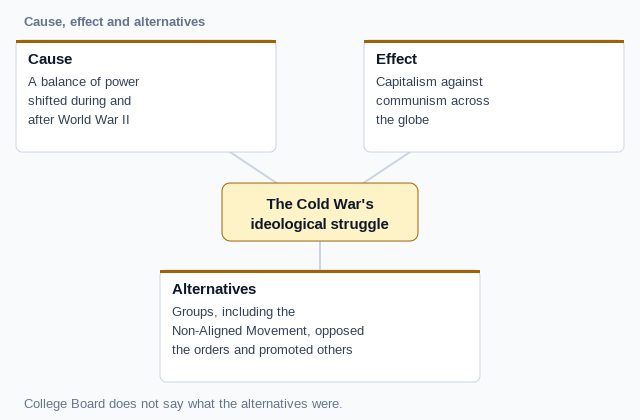
In short. The Cold War grew out of a global balance of power that shifted during and after World War II, as the United States and the Soviet Union emerged as superpowers.
- The democracy of the United States and the authoritarian communist Soviet Union emerged as superpowers.
- Their emergence led to ideological conflict and a power struggle between capitalism and communism across the globe.
- Groups and individuals, including the Non-Aligned Movement, opposed and promoted alternatives to the existing economic, political, and social orders.
Part 2 Learn it The Cold War and its alternatives
8.2a. From a shifted balance to a struggle
This topic's first statement is a chain of causes, and causation is its reasoning process:
The global balance of economic and political power shifted during and after World War II and rapidly evolved into the Cold War. The democracy of the United States and the authoritarian communist Soviet Union emerged as superpowers, which led to ideological conflict and a power struggle between capitalism and communism across the globe.
Read it in two steps. First, the balance of power shifted, and that shift rapidly evolved into the Cold War. Second, two superpowers emerged, and their emergence led to the conflict.
The statement describes each superpower by its system. The United States is a democracy; the Soviet Union is authoritarian and communist. So the conflict was ideological, a quarrel over how a society should be run, and it was also a power struggle. Across the globe sets its reach: it was not confined to the two states.
Quick check · Select all
Which two does this topic give as causes of the Cold War or of its ideological struggle? Pick two.
Select 2 answers, then check.
8.2b. Reading a source from the struggle
This topic's skill is explaining the point of view, purpose, historical situation, and/or audience of a source. In a Cold War source the four questions often lean on one another.
- Historical situation: a struggle between capitalism and communism with two superpowers at its head.
- Point of view: which side, if any, the author speaks from.
- Audience: who the words were meant for. Party members at home and listeners in a rival country hear different things.
- Purpose: what the source sets out to do, such as rally supporters or win over doubters.
A sentence that only names the author or the date has not explained anything. Explaining means saying how one of these shapes what the source says. A government speech that praises its own system is not a neutral survey; in a struggle between two systems, its point of view comes from the side it serves.
Quick check · Multiple choice
A speech written for this page (it is not a real source) is given in 1948 by a Soviet official to a meeting of communist party members: "The capitalist powers want to rule the markets of the world. We stand with the workers of every land." Given its audience and historical situation, which choice best explains the speech's purpose?
8.2c. Opposing the existing orders
The second statement turns from the superpowers to others: Groups and individuals, including the Non-Aligned Movement, opposed and promoted alternatives to the existing economic, political, and social orders.
It gives two actions. They opposed the existing orders, and they promoted alternatives to them. College Board's examples for the Non-Aligned Movement are two leaders, Sukarno in Indonesia and Kwame Nkrumah in Ghana.
The statement is short on detail. It does not say what the existing orders were, what the alternatives were, or whether the movement acted because of the Cold War. It sets the movement in this topic and leaves the link there. A source can show one leader's view, but the statement gives no more than the two actions.
This topic's sample activity pairs speeches from the two superpowers' officials with President Sukarno's speech at the opening of the Bandung Conference (1955).
Quick check · Select all
According to this topic, what did groups and individuals, including the Non-Aligned Movement, do? Pick two.
Select 2 answers, then check.
Part 3 Watch it done Sourcing a pamphlet
Watch the first steps, then take the last one yourself.
A pamphlet written for this page (it is not a real source), printed in 1949 by a government information office in the United States for readers in other countries: "In a free country, you choose who governs you, and what you build is yours. Where communism rules, one party chooses for you, and the state owns what you build."
Explain the pamphlet's point of view and how its historical situation shapes it.
Predict first
Before the steps: what will matter most for the pamphlet's point of view?
Step 1 · Read who wrote it and for whom
A government office in the United States wrote it, and it was printed for readers in other countries. It speaks for a state, not for one private writer.
Step 2 · Place it in its situation
In 1949 the democracy of the United States and the authoritarian communist Soviet Union faced each other as superpowers, in a struggle between capitalism and communism across the globe. The pamphlet sets two ways of life against each other, choosing who governs and owning what you build against rule by one party.
Why this step?
Why does the struggle matter to the point of view, and not just to the date?
In a struggle between two systems, an office of one of the superpowers is a party to it. Its praise of one system and attack on the other come from the side it serves, so the situation explains the slant.
Your step · Decide and justify
Finish it. Which sentence explains the pamphlet's point of view through its historical situation?
What makes that sentence explain the point of view?
Part 4 Try it Sourcing a teacher's letter
A letter written for this page (it is not a real source), sent in 1958 by a teacher in a newly independent state to a friend living abroad:
> Our president tells the crowds that we will not be anyone's colony again, not in trade and not in thought. Both of the great powers send us offers. He says we will take what helps us and follow neither of them.
A student wrote a paragraph sourcing the letter.
Try it · Spot the error
Which line of the student's paragraph misreads the letter?
Part 5 Explain it Two systems, from two documents
This is a self-check. Nothing you type leaves this page. Set your answer beside the model and each scoring point.
Free-response practice · Question 1 style
A short practice in the shape of the document-based question: a thesis, one sentence of context and one paragraph that uses both documents and explains the point of view or audience of one, instead of a full essay. Both documents are written for this page and are not real.
Document 1: a speech by a United States official to the country's lawmakers, 1947: "Two ways of life now face each other across the world. One rests on free elections and free markets. The other rests on the rule of one party. We must help those who choose freedom."
Document 2: the teacher's letter from Try it, 1958.
Using both documents, explain the causes and effects of the ideological struggle of the Cold War.
Model answer
Thesis: The ideological struggle of the Cold War came from the rise of two superpowers with opposed systems after World War II, and its effects reached across the globe, where states were courted by both sides and some leaders looked for a course of their own.
Context: In the years after World War II, increasing anti-imperialist sentiment contributed to the dissolution of empires and the restructuring of states, and states that had only just come into being, like the one in Document 2, met a superpower struggle that reached across the globe.
Document 1 shows a cause. The official sets "free elections and free markets" against "the rule of one party," the conflict between capitalism and communism that followed the emergence of the United States and the Soviet Union as superpowers. His audience matters: he is speaking to the country's lawmakers, so "we must help those who choose freedom" asks them to back the American side abroad. Document 2 shows an effect in a newly independent state. "Both of the great powers send us offers," so the struggle had reached a newly independent state, and its president answers by refusing to follow either one, opposing the existing order and promoting another, as the Non-Aligned Movement did.
Score your own answer. This is a self-check, not a grade. Tick each point your answer makes.
Part 6 Check yourself Three voices from the struggle
The table drives the first two questions. The last two come from the rest of the lesson.
Three short sources from the Cold War. All three were written for this lesson and are not real.
| Row | Year, speaker and audience | Its words |
|---|---|---|
| 1 | 1947, a Soviet official, to party members in Moscow | "The capitalist states are gathering against us. Every worker must do their part." |
| 2 | 1952, a radio station run by the United States government, to listeners in a rival country | "Your government hides the truth from you. Ask why your shops are empty." |
| 3 | 1961, the leader of a newly independent state, to a meeting of such leaders | "Let others divide the world between them. We will plan our own economies and choose our own friends." |
Case question 1 · Match
Match each row to the purpose its speaker and audience best fit.
Case question 2 · Fill the statement
Complete the note on row 2.
Row 2's broadcaster speaks for , to listeners living under .
The rest stand on their own and do not use the case.
Check yourself · Multiple choice
According to this topic, what did the emergence of the United States and the Soviet Union as superpowers lead to?
Check yourself · Select all
A speech written for this page (it is not a real source) opens a 1955 meeting of leaders from states that had recently become independent: "We are told the world must choose between two camps. We say there is another road, and we will build it ourselves." Which two choices best explain the speech's point of view and purpose? Pick two.
Select 2 answers, then check.
Part 7 Keep it Bring back earlier ideas
One question from the lesson just before this one, and one from the mass atrocities of World War II three lessons back.
From 8.1 Setting the Stage for the Cold War and Decolonization · Multiple choice
According to this topic, what shifted the global balance of power?
From 7.8 Mass Atrocities After 1900 · Multiple choice
According to this topic's statement, what led to the attempted destruction of specific populations?
In three lines
- A balance of power shifted during and after World War II rapidly evolved into the Cold War.
- The United States and the Soviet Union emerged as superpowers, which led to a struggle between capitalism and communism across the globe.
- Groups and individuals, including the Non-Aligned Movement, opposed the existing orders and promoted alternatives.
Exam strategy for this topic
- Section I Part A, Multiple Choice: 55 questions in 55 minutes.
- Section I Part B, Short Answer: 3 questions in 40 minutes.
- Section II, Document-Based Question and Long Essay: 2 questions in 100 minutes.
- This lesson's Explain it is shaped like free-response question 1, Document-based.
When you source a Cold War document, say which side of the struggle its author speaks from, or who it was meant for, and then show how that shapes one thing the document says.
Questions students ask
Why is the Cold War called an ideological conflict?
The statement says the emergence of the two superpowers led to ideological conflict between capitalism and communism, so the quarrel was over how societies should be run. It was also a power struggle across the globe.
What were the alternatives the Non-Aligned Movement promoted?
The statement does not say. It gives two actions, opposing the existing orders and promoting alternatives, and names Sukarno in Indonesia and Kwame Nkrumah in Ghana as examples.
Did the Non-Aligned Movement form because of the Cold War?
The statement sets it in this topic but does not give it a cause. Say what it did, and let a source show one leader's reasons.
What sources does this topic's sample activity use?
Excerpts from John Foster Dulles's "Dynamic Peace" speech (1957), V. M. Molotov's "The Task of Our Time: Unite Against the Enslavement of the People" (1947) and President Sukarno's speech at the opening of the Bandung Conference (1955). Students write a claim on the objective and explain how each source's point of view, purpose, situation or audience bears on it.
How is this topic different from 8.1?
8.1 Setting the Stage for the Cold War and Decolonization gives the shift in power as the setting. This topic says what the shift evolved into, the Cold War, and what the superpowers' emergence led to.
Course alignment, for teachers
AP World History: Modern topic 8.2, Unit 8: Cold War and Decolonization.
- Skill 2.B: Explain the point of view, purpose, historical situation, and/or audience of a source.
This lesson maps all 2 essential knowledge statements of the topic, and the one learning objective with none of its own, to the part that teaches each one: 3 are checked by a scored question. The map is in the lesson file.